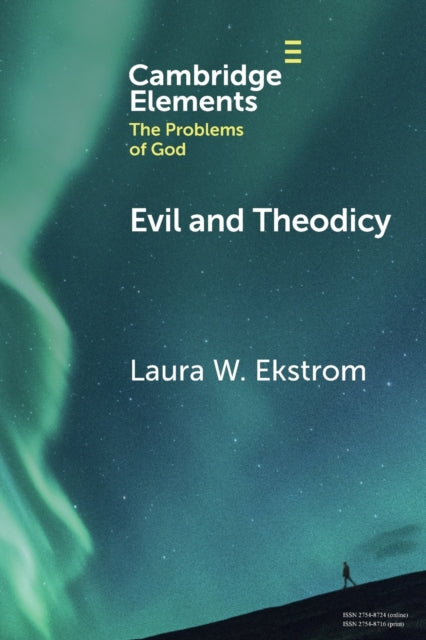
Laura W.Ekstrom
Evil and Theodicy
Evil and Theodicy
💎 Earn 84 Points (£0.84) on this item.
YOU SAVE £1.01
- Condition: Brand new
- UK Delivery times: Usually arrives within 2 - 3 working days
- UK Shipping: Fee starts at £2.39. Subject to product weight & dimension
Bulk ordering. Want 15 or more copies? Get a personalised quote and bigger discounts. Learn more about bulk orders.
Couldn't load pickup availability
- More about Evil and Theodicy
The study of suffering and its relation to the existence of God is known as theodicy, and it motivates the project by examining arguments against God's existence and critically assessing the response of skeptical theism. Even if the prospects for theodicy are dim, work in theodicies is practical.
Format: Paperback / softback
Length: 75 pages
Publication date: 02 February 2023
Publisher: Cambridge University Press
Suffering is an inescapable part of the human experience, and it has profound implications for our understanding of the existence of God and our own meaning in life. The quest to make sense of suffering in the context of a divine being is a central aspect of human spirituality and philosophy. Evil and Theodicy is a project that seeks to address these questions by examining arguments rooted in evil against God's existence and critically assessing the response of skeptical theism.
The project is motivated by the desire to understand how evil can exist in a world created by a loving and omnipotent God. It explores various lines of theodicy, which are attempts to explain the coexistence of evil and God's goodness. These lines of theodicy include the free will defense, the problem of evil, the argument from reason, the argument from design, the argument from suffering, and the argument from the existence of good.
Ekstrom, the author of Evil and Theodicy, argues that even if the prospects for theodicy are dim with respect to defending the rationality of theistic belief in light of suffering, work in theodicies is still practically useful. She suggests that theodicies can help us to better understand the nature of evil, to develop more compassionate and effective responses to suffering, and to deepen our spiritual and philosophical understanding of the world.
One of the key arguments in Evil and Theodicy is that the problem of evil is not a fatal challenge to theistic belief. Ekstrom argues that the problem of evil can be addressed through various lines of theodicy, including the free will defense, the problem of evil, the argument from reason, the argument from design, the argument from suffering, and the argument from the existence of good.
The free will defense, for example, argues that evil is the result of human free will, which allows us to make choices that go against God's desires. While this defense may seem intuitively appealing, Ekstrom argues that it is not sufficient to explain the full range of evil in the world. The problem of evil, she suggests, requires a more comprehensive explanation that takes into account the nature of God and the nature of human free will.
The problem of evil, on the other hand, argues that the existence of evil is incompatible with the existence of a good and omnipotent God. Skeptical theism, which is the view that God does not exist, is often used to challenge the problem of evil. However, Ekstrom argues that skeptical theism is not a viable alternative to theistic belief. She suggests that skeptical theism is not only inconsistent with the evidence for God's existence, but it also fails to provide a satisfying explanation for the existence of evil.
The argument from reason, on the other hand, argues that the existence of God is reasonable based on the evidence for his existence. Ekstrom argues that the argument from reason is a powerful tool for defending theistic belief in the face of the problem of evil. She suggests that the argument from reason can be supported by various philosophical arguments, including the argument from design, the argument from the existence of consciousness, and the argument from the existence of morality.
The argument from design, for example, argues that the complexity and beauty of the natural world are evidence of the existence of a designer. Ekstrom argues that the argument from design is a powerful tool for defending theistic belief in the face of the problem of evil. She suggests that the argument from design can be supported by various scientific observations, including the fine-tuning of the universe, the existence of complex biological systems, and the existence of intelligent life.
The argument from suffering, on the other hand, argues that the existence of evil is evidence of the existence of a loving and omnipotent God. Ekstrom argues that the argument from suffering is a powerful tool for defending theistic belief in the face of the problem of evil. She suggests that the argument from suffering can be supported by various philosophical arguments, including the argument from the existence of free will, the argument from the value of human life, and the argument from the existence of moral evil.
The argument from the existence of good, on the other hand, argues that the existence of evil is not evidence of the absence of good. Ekstrom argues that the existence of good is a necessary condition for the existence of evil. She suggests that the argument from the existence of good can be supported by various philosophical arguments, including the argument from the existence of consciousness, the argument from the value of human life, and the argument from the existence of moral good.
In conclusion, Suffering is an inescapable part of the human experience, and it has profound implications for our understanding of the existence of God and our own meaning in life. Evil and Theodicy is a project that seeks to address these questions by examining arguments rooted in evil against God's existence and critically assessing the response of skeptical theism. While the prospects for theodicy may be dim with respect to defending the rationality of theistic belief in light of suffering, work in theodicies is still practically useful. Theodicies can help us to better understand the nature of evil, to develop more compassionate and effective responses to suffering, and to deepen our spiritual and philosophical understanding of the world.
Weight: 122g
Dimension: 227 x 153 x 6 (mm)
ISBN-13: 9781009293044
UK and International shipping information
UK and International shipping information
UK Delivery and returns information:
- Delivery within 2 - 3 days when ordering in the UK.
- Shipping fee for UK customers from £2.39. Fully tracked shipping service available.
- Returns policy: Return within 30 days of receipt for full refund.
International deliveries:
Shulph Ink now ships to Australia, Belgium, Canada, France, Germany, Ireland, Italy, India, Luxembourg Saudi Arabia, Singapore, Spain, Netherlands, New Zealand, United Arab Emirates, United States of America.
- Delivery times: within 5 - 10 days for international orders.
- Shipping fee: charges vary for overseas orders. Only tracked services are available for most international orders. Some countries have untracked shipping options.
- Customs charges: If ordering to addresses outside the United Kingdom, you may or may not incur additional customs and duties fees during local delivery.