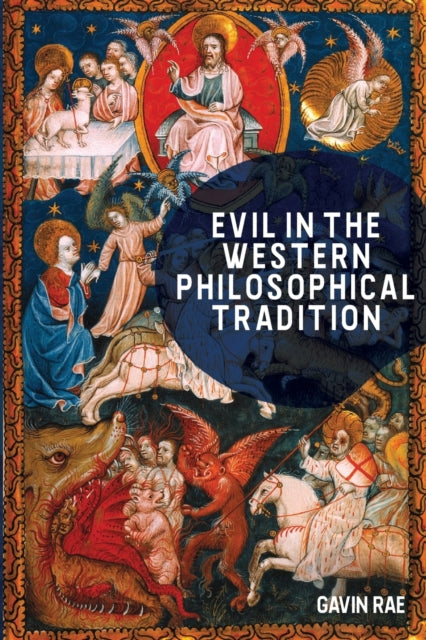
Gavin Rae
Evil in the Western Philosophical Tradition
Evil in the Western Philosophical Tradition
💎 Earn 115 Points (£1.15) on this item.
YOU SAVE £6.99
- Condition: Brand new
- UK Delivery times: Usually arrives within 2 - 3 working days
- UK Shipping: Fee starts at £3.89. Subject to product weight & dimension
Bulk ordering. Want 15 or more copies? Get a personalised quote and bigger discounts. Learn more about bulk orders.
Couldn't load pickup availability
- More about Evil in the Western Philosophical Tradition
The problem of evil has been a complex and contested issue throughout history, with various philosophical perspectives offering different interpretations and solutions. Gavin Rae's book explores the history of Western conceptions of evil, tracing it from early Christian philosophy to modern philosophy and secularisation.
Format: Paperback / softback
Length: 360 pages
Publication date: 28 February 2021
Publisher: Edinburgh University Press
Gavin Rae delves into the intricate and multifaceted history of Western conceptions of evil, unveiling a rich tapestry of complexity, diversity, and ongoing debate. His comprehensive analysis spans from the early and Medieval Christian philosophical frameworks to modern philosophy, German Idealism, post-structuralism, and contemporary analytic philosophy, as well as the secularization movement. Rae's exploration takes readers on a journey through the evolution of ideas about evil, exploring the various perspectives and arguments that have shaped our understanding of this profound concept.
In the early and Medieval Christian philosophical frameworks, the problem of evil was a central concern. Theologians sought to reconcile the existence of evil with the belief in an all-powerful and benevolent God. They developed various theories to explain the presence of evil, including the free will defense, the problem of natural evil, and the argument from divine hiddenness.
However, as time passed, the problem of evil continued to be a source of debate and speculation. Modern philosophy, particularly German Idealism, introduced new perspectives on the nature of evil. Idealists such as Friedrich Nietzsche and Arthur Schopenhauer argued that evil was not a fundamental aspect of the world but rather a result of human imperfections and the limitations of human understanding.
Post-structuralism, which emerged in the mid-20th century, challenged traditional philosophical assumptions about the nature of truth and reality. Post-structuralists such as Jacques Derrida and Michel Foucault argued that the concept of evil was not a fixed or universal entity but rather a product of social and cultural constructions. They suggested that evil was not something that existed independently of human perception and interpretation but rather was a result of the power dynamics and hierarchies that shape our societies.
Contemporary analytic philosophy has continued to explore the problem of evil, focusing on the ethical and philosophical implications of evil. Analytic philosophers such as Peter Singer and Amartya Sen have argued that the existence of evil raises important questions about the nature of morality and the value of human life. They have explored various ethical frameworks, such as utilitarianism and deontology, to address the problem of evil and have proposed solutions to mitigate its impact.
The secularization movement, which began in the 18th century, has also had an impact on the study of evil. Secularists argue that the concept of evil is not necessary for a rational and ethical understanding of the world. They argue that the existence of evil can be explained through naturalistic explanations, such as the theory of evolution or the existence of natural disasters.
In conclusion, Gavin Rae's analysis of the history of Western conceptions of evil highlights the complex and multifaceted nature of this concept. From the early and Medieval Christian philosophical frameworks to modern philosophy, German Idealism, post-structuralism, and contemporary analytic philosophy, the study of evil has evolved and expanded in its scope and depth. Rae's work provides a valuable contribution to our understanding of the problem of evil and its implications for our ethical and philosophical lives.
Weight: 534g
Dimension: 154 x 229 x 24 (mm)
ISBN-13: 9781474445337
UK and International shipping information
UK and International shipping information
We deliver throughout the United Kingdom and to 128 countries and territories worldwide, including the United States, Australia, Canada, Germany, Spain and France.