Simone Beetz
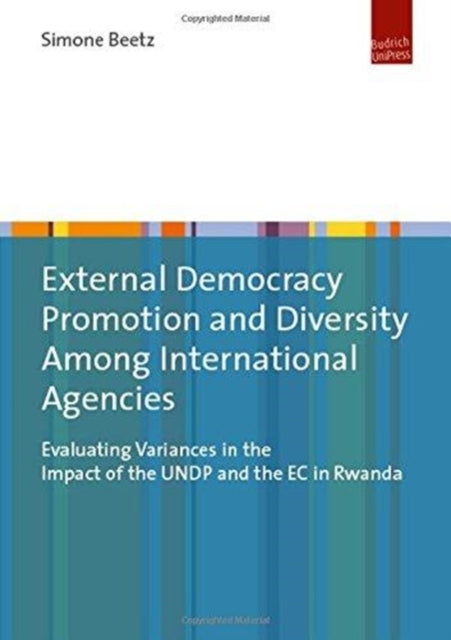
External Democracy Promotion and Diversity Among International Agencies - Evaluating Variances in the Impact of the Undp and the EC in Rwanda
External Democracy Promotion and Diversity Among International Agencies - Evaluating Variances in the Impact of the Undp and the EC in Rwanda
💎 Earn 168 Points (£1.68) on this item.
YOU SAVE £10.25
- Condition: Brand new
- UK Delivery times: Usually arrives within 2 - 3 working days
- UK Shipping: Fee starts at £2.39. Subject to product weight & dimension
Bulk ordering. Want 15 or more copies? Get a personalised quote and bigger discounts. Learn more about bulk orders.
Couldn't load pickup availability
- More about External Democracy Promotion and Diversity Among International Agencies - Evaluating Variances in the Impact of the Undp and the EC in Rwanda
Despite international agencies' efforts to promote democracy, their results have been mixed. This research examines how the UNDP and the EC promoted democracy in Rwanda from 2003 to 2013, highlighting differences in democracy strategies and developing a new concept of variances.
Format: Paperback / softback
Length: 348 pages
Publication date: 01 December 2021
Publisher: Verlag Barbara Budrich
This comprehensive research delves into the intricate and multifaceted outcomes of international agencies in their endeavors to promote democracy, despite their collective commitment to shaping a common policy as emphasized in various international agreements. In the backdrop of critiques and the pursuit of innovative solutions, the study analyzes the strategies employed by the United Nations Development Programme (UNDP) and the European Commission (EC) in promoting democracy in Rwanda from 2003 to 2013. Through this in-depth analysis, the author unveils the diverse approaches taken by these organizations, identifies key factors contributing to variations in impact, and introduces a novel concept of "variances" to shed light on these distinctions.
The United Nations Development Programme (UNDP) and the European Commission (EC) have both played significant roles in promoting democracy in Rwanda since 2003. The UNDP has focused on building institutions, promoting human rights, and promoting economic development, while the EC has focused on supporting political parties and civil society organizations. Both organizations have faced challenges in promoting democracy in Rwanda, including resistance from the government and opposition groups, and have had to adapt their strategies to respond to these challenges.
One of the key challenges faced by the UNDP and the EC in promoting democracy in Rwanda is the lack of political will and commitment from the government to promote democratic reforms. The government has often been resistant to international pressure to reform its political system, and has instead focused on maintaining its power and control over the country. This has led to tensions between the government and the international community, and has made it difficult for the UNDP and the EC to achieve their goals.
Another challenge faced by the UNDP and the EC in promoting democracy in Rwanda is the lack of infrastructure and resources in the country. Rwanda is one of the poorest countries in the world, and has faced significant challenges in building its infrastructure, including roads, schools, and hospitals. This has made it difficult for the UNDP and the EC to implement their programs and projects effectively, and has also contributed to the country's economic and social development challenges.
Despite these challenges, the UNDP and the EC have made significant progress in promoting democracy in Rwanda. The UNDP has helped to build institutions such as the National Assembly, the Senate, and the Judiciary, and has promoted human rights and economic development. The EC has supported political parties and civil society organizations, and has helped to promote political dialogue and reconciliation in the country.
However, there are still significant challenges that need to be addressed in order to promote democracy in Rwanda fully. One of the key challenges is the need to address the issue of political polarization and division in the country. The country has been divided along ethnic lines for many years, and this has contributed to political instability and violence. The UNDP and the EC need to work together to promote political dialogue and reconciliation, and to address the underlying causes of political polarization and division in the country.
Another challenge is the need to address the issue of corruption in the country. Corruption is a significant problem in Rwanda, and has contributed to the country's economic and social development challenges. The UNDP and the EC need to work together to promote transparency and accountability in the government, and to address the underlying causes of corruption in the country.
Finally, the need to address the issue of gender inequality in the country is also a significant challenge. Gender inequality is a significant problem in Rwanda, and has contributed to the country's economic and social development challenges. The UNDP and the EC need to work together to promote gender equality and to address the underlying causes of gender inequality in the country.
In conclusion, the UNDP and the EC have made significant progress in promoting democracy in Rwanda since 2003. However, there are still significant challenges that need to be addressed in order to promote democracy in Rwanda fully. The UNDP and the EC need to work together to promote political dialogue and reconciliation, to address the issue of political polarization and division, to promote transparency and accountability in the government, and to promote gender equality. Only by addressing these challenges can Rwanda achieve its goal of becoming a democratic and prosperous country.
Weight: 504g
Dimension: 151 x 215 x 19 (mm)
ISBN-13: 9783863887575
This item can be found in:
UK and International shipping information
UK and International shipping information
UK Delivery and returns information:
- Delivery within 2 - 3 days when ordering in the UK.
- Shipping fee for UK customers from £2.39. Fully tracked shipping service available.
- Returns policy: Return within 30 days of receipt for full refund.
International deliveries:
Shulph Ink now ships to Australia, Belgium, Canada, France, Germany, Ireland, Italy, India, Luxembourg Saudi Arabia, Singapore, Spain, Netherlands, New Zealand, United Arab Emirates, United States of America.
- Delivery times: within 5 - 10 days for international orders.
- Shipping fee: charges vary for overseas orders. Only tracked services are available for most international orders. Some countries have untracked shipping options.
- Customs charges: If ordering to addresses outside the United Kingdom, you may or may not incur additional customs and duties fees during local delivery.