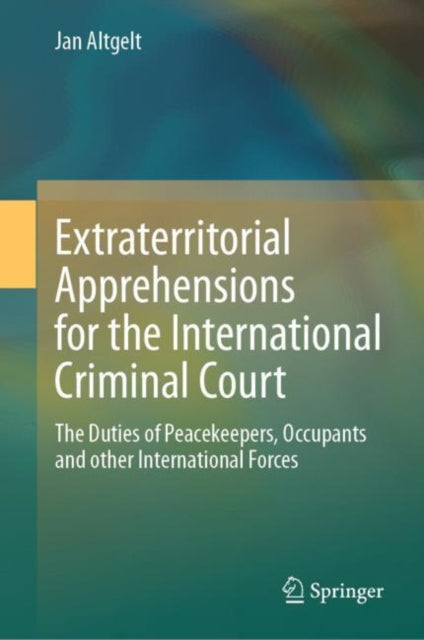
Jan Altgelt
Extraterritorial Apprehensions for the International Criminal Court: The Duties of Peacekeepers, Occupants and other International Forces
Extraterritorial Apprehensions for the International Criminal Court: The Duties of Peacekeepers, Occupants and other International Forces
💎 Earn 578 Points (£5.78) on this item.
We can order this item for you. Delivery usually takes about 4 to 6 weeks.
This item is not held in our immediate stock. We will order it for you after checkout.
Estimated delivery: About 4 to 6 weeks
YOU SAVE £24.36
- Condition: Brand new
- UK Delivery times: Usually arrives within 2 - 3 working days
- UK Shipping: Fee starts at £2.39. Subject to product weight & dimension
Bulk ordering. Want 15 or more copies? Get a personalised quote and bigger discounts. Learn more about bulk orders.
Couldn't load pickup availability
- More about Extraterritorial Apprehensions for the International Criminal Court: The Duties of Peacekeepers, Occupants and other International Forces
The book explores whether the International Criminal Court (ICC) can deter violence in limited statehood areas by seeking assistance from international forces such as UN peace support operations, UN-mandated missions, and belligerent occupants. It examines the law and practice of the UN Security Council regarding mandating international forces to arrest and transfer alleged offenders to the ICC or other international courts, as well as the limitations to such extraterritorial action, such as the prohibition of the use of force and the principle of territorial sovereignty. It also discusses how international forces can uphold the right to liberty and security and the principle of non-refoulement when they extraterritorially apprehend ICC suspects.
Format: Hardback
Length: 250 pages
Publication date: 09 February 2024
Publisher: Springer International Publishing AG
The starting point of this book is the generally shared observation that in violence-torn areas of limited statehood, the civilian population is often subject to deliberate attacks. This violence often escalates to core crimes such as war crimes, crimes against humanity, and even genocide. The International Criminal Court (ICC) could potentially deter such crimes. In order to do so, it largely depends on the cooperation of the states on the territory of which alleged core criminals operate. Since such states are often unwilling or unable to cooperate, the book explores whether the ICC could instead seek assistance from international forces such as UN peace support operations, UN-mandated missions, and belligerent occupants. The book covers, on the one hand, the law and practice of the UN Security Council with regard to mandating international forces to arrest and transfer alleged offenders to the ICC or to other international courts. On the other, it addresses to what extent international forces may or must hand alleged offenders over to the ICC, regardless of such mandates. More precisely, the book examines whether the duties to prosecute genocide, torture, enforced disappearance, grave breaches, and other war crimes apply extraterritorially and – if so – whether international forces can discharge these duties by transferring suspects to the ICC. At the same time, the book addresses the limitations to such extraterritorial action: firstly, to what extent the prohibition of the use of force and the principle of territorial sovereignty restrict extraterritorial deprivations of liberty and transfer to the ICC. Secondly, it explores the restrictions and permissions that the law of occupation and other norms of international humanitarian law impose on such apprehensions and transfers.
The book's starting point
The book's starting point is the generally shared observation that in violence-torn areas of limited statehood, the civilian population is often subject to deliberate attacks. This violence often escalates to core crimes such as war crimes, crimes against humanity, and even genocide. The International Criminal Court (ICC) could potentially deter such crimes. In order to do so, it largely depends on the cooperation of the states on the territory of which alleged core criminals operate. Since such states are often unwilling or unable to cooperate, the book explores whether the ICC could instead seek assistance from international forces such as UN peace support operations, UN-mandated missions, and belligerent occupants. The book covers, on the one hand, the law and practice of the UN Security Council with regard to mandating international forces to arrest and transfer alleged offenders to the ICC or to other international courts. On the other, it addresses to what extent international forces may or must hand alleged offenders over to the ICC, regardless of such mandates. More precisely, the book examines whether the duties to prosecute genocide, torture, enforced disappearance, grave breaches, and other war crimes apply extraterritorially and – if so – whether international forces can discharge these duties by transferring suspects to the ICC. At the same time, the book addresses the limitations to such extraterritorial action: firstly, to what extent the prohibition of the use of force and the principle of territorial sovereignty restrict extraterritorial deprivations of liberty and transfer to the ICC. Secondly, it explores the restrictions and permissions that the law of occupation and other norms of international humanitarian law impose on such apprehensions and transfers.
Weight: 571g
Dimension: 235 x 155 (mm)
ISBN-13: 9783031458958
Edition number: 1st ed. 2024
This item can be found in:
UK and International shipping information
UK and International shipping information
UK Delivery and returns information:
- Delivery within 2 - 3 days when ordering in the UK.
- Shipping fee for UK customers from £2.39. Fully tracked shipping service available.
- Returns policy: Return within 30 days of receipt for full refund.
International deliveries:
Shulph Ink now ships to Australia, Belgium, Canada, France, Germany, Ireland, Italy, India, Luxembourg Saudi Arabia, Singapore, Spain, Netherlands, New Zealand, United Arab Emirates, United States of America.
- Delivery times: within 5 - 10 days for international orders.
- Shipping fee: charges vary for overseas orders. Only tracked services are available for most international orders. Some countries have untracked shipping options.
- Customs charges: If ordering to addresses outside the United Kingdom, you may or may not incur additional customs and duties fees during local delivery.