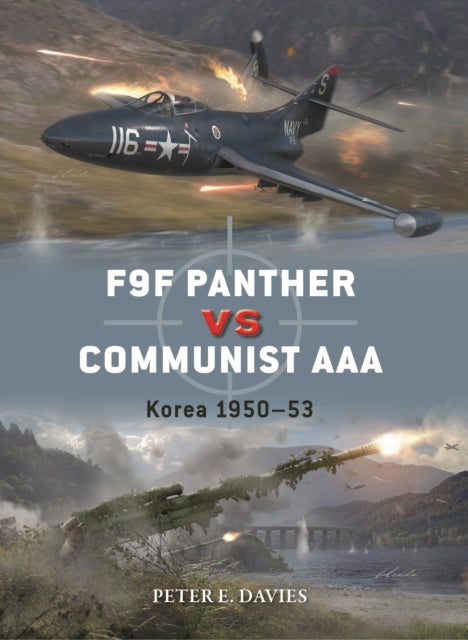
Peter E. Davies
F9F Panther vs Communist AAA: Korea 1950-53
F9F Panther vs Communist AAA: Korea 1950-53
YOU SAVE £4.74
- Condition: Brand new
- UK Delivery times: Usually arrives within 2 - 3 working days
- UK Shipping: Fee starts at £3.89. Subject to product weight & dimension
Bulk ordering. Want 15 or more copies? Get a personalised quote and bigger discounts. Learn more about bulk orders.
Couldn't load pickup availability
- More about F9F Panther vs Communist AAA: Korea 1950-53
During the Korean War, US Navy F9F Panther jet fighter-bombers faced deadly opposition from communist anti-aircraft artillery (AAA) defenses. The Panthers were effective in ground-attack roles, but flak damage increased as the Chinese improved their AAA weapons. This study explores the tactics and gunnery of both opponents, with full-color illustrations and analysis of loss rates.
Format: Paperback / softback
Length: 80 pages
Publication date: 23 June 2022
Publisher: Bloomsbury Publishing PLC
The Korean War was a pivotal conflict in the history of modern warfare, marked by intense aerial combat between the United States Navy and communist forces. One of the most iconic aircraft used in this battle was the US Navy's F9F Panther jet fighter-bomber. Originally designed as a high-speed jet fighter, the Panther was modified for ground-attack duties, a tradition that had been established in the US military.
In April 1951, the Panther made history by becoming the first jet to launch from a carrier with bombs loaded. These bombs were used to destroy a crucial railway bridge at Songjin, demonstrating the Panther's versatility and effectiveness in ground-attack missions. The Panther's four 20 mm guns were highly regarded for their ability to suppress flak, making it an ideal escort for propeller-driven AD Skyraider and F4U Corsair attack aircraft.
However, as the war progressed, the Chinese military began to improve their anti-aircraft artillery (AAA) capabilities. They introduced heavy guns of 37 mm caliber and above, which posed a significant threat to the Panther. The communist AAA crews were well-trained and equipped with advanced technology, including optical height finders, predictors, and in many cases, radar control. They learned to conceal their weapons in civilian buildings, use wires to bring aircraft down, and set up false targets as flak traps.
This study delves into the deadly battle between the US Navy's F9F Panthers and the communist AAA defenses that proliferated throughout the Korean War. It provides a detailed look at both opponents' tactics and gunnery, including full-color illustrations that showcase cockpit scenes and armament views. The volume also includes a comprehensive analysis of the US Navy Panthers' loss rates and their causes, shedding light on the challenges faced by these aircraft in the harsh Korean environment.
The Panther's performance in the Korean War was mixed. While it was highly effective in ground-attack missions, it struggled against the superior AAA defenses of the communist forces. The Panther's low-altitude performance and limited range made it vulnerable to ground fire, and its slow speed and maneuverability made it difficult to evade enemy fire. Additionally, the Panther's vulnerability to flak damage was a significant concern, as the Chinese military had developed effective tactics to suppress it.
Despite these challenges, the Panther played a crucial role in the Korean War. Its ability to launch from a carrier and carry out ground-attack missions was instrumental in supporting United Nations forces and slowing down the communist advance. The Panther's versatility and effectiveness in ground-attack missions also made it a valuable asset in other conflicts, such as the Vietnam War.
In conclusion, the Korean War was a defining moment in the history of modern warfare, and the battle between the US Navy's F9F Panthers and the communist AAA defenses was a critical component of this conflict. The Panther's performance in the Korean War was mixed, but its versatility and effectiveness in ground-attack missions made it a valuable asset to the United Nations forces. Despite the challenges faced by these aircraft, their legacy continues to be felt in the modern military, and they remain an important part of the history of aerial combat.
Weight: 266g
Dimension: 184 x 248 x 8 (mm)
ISBN-13: 9781472850645
UK and International shipping information
UK and International shipping information
We deliver throughout the United Kingdom and to 128 countries and territories worldwide, including the United States, Australia, Canada, Germany, Spain and France.