Shulph Ink
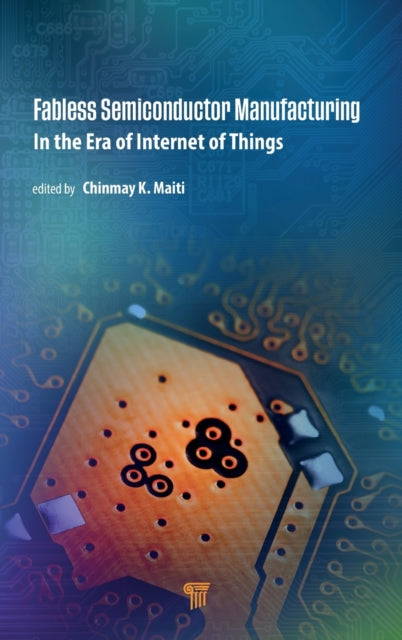
Fabless Semiconductor Manufacturing: In the Era of Internet of Things
Fabless Semiconductor Manufacturing: In the Era of Internet of Things
💎 Earn 547 Points (£5.47) on this item.
We can order this item for you. Delivery usually takes about 4 to 6 weeks.
This item is not held in our immediate stock. We will order it for you after checkout.
Estimated delivery: About 4 to 6 weeks
YOU SAVE £6.50
- Condition: Brand new
- UK Delivery times: Usually arrives within 2 - 3 working days
- UK Shipping: Fee starts at £3.89. Subject to product weight & dimension
Bulk ordering. Want 15 or more copies? Get a personalised quote and bigger discounts. Learn more about bulk orders.
Couldn't load pickup availability
- More about Fabless Semiconductor Manufacturing: In the Era of Internet of Things
This book is the first to introduce strain engineering in the design of flexible and stretchable electronic devices. It provides computer-aided microelectronics education to enhance students' learning and offers detailed examples of two- and three-dimensional process and device simulation. It also covers broad coverage spanning conventional to the state-of-the-art stress- and strain-engineered devices at 7 nm and smaller technology nodes.
Format: Hardback
Length: 324 pages
Publication date: 17 November 2022
Publisher: Jenny Stanford Publishing
The groundbreaking work "Strain Engineering in the Design of Flexible and Stretchable Electronic Devices" is a seminal text that revolutionized the field of microelectronics by introducing the concept of strain engineering into the design of flexible and stretchable electronic devices. This innovative approach has opened up a new realm of possibilities for developing wearable electronics, biomedical devices, and other advanced technologies that can seamlessly integrate with the human body.
To enhance students' learning experiences in computer-aided microelectronics, this book offers a comprehensive and practical approach. It provides detailed examples of two- and three-dimensional process and device simulation, using state-of-the-art software tools to simulate the behavior of electronic components and devices under various stress and strain conditions. The broad coverage spans conventional to the state-of-the-art stress- and strain-engineered devices at 7 nm and smaller technology nodes, ensuring that students are equipped with the latest knowledge and skills in this rapidly evolving field.
One of the key strengths of this book is its comprehensive coverage of strain engineering principles. It begins by introducing the basic concepts of strain and stress, and then delves into the mathematical models and computational techniques used to analyze and design strain-engineered devices. The authors provide detailed explanations of the underlying physics and mechanics that govern the behavior of these devices, making the material accessible to students with a range of backgrounds.
Throughout the book, numerous real-world examples are presented to illustrate the practical applications of strain engineering. These examples cover a wide range of industries, including telecommunications, consumer electronics, healthcare, and automotive. Each example is carefully designed to demonstrate the benefits and limitations of strain engineering, and to highlight the challenges and opportunities that arise in the design and manufacturing of these devices.
In addition to its technical content, "Strain Engineering in the Design of Flexible and Stretchable Electronic Devices" emphasizes the importance of interdisciplinary collaboration in the field of microelectronics. The authors discuss the interactions between strain engineering, materials science, and electrical engineering, and highlight the need for collaboration between researchers, engineers, and manufacturers to achieve successful commercialization of strain-engineered devices.
The book is well-organized and easy to read, with clear headings, subheadings, and illustrations to assist students in navigating the material. It also includes a comprehensive bibliography and an index, making it an invaluable resource for students, researchers, and professionals in the field of microelectronics.
In conclusion, "Strain Engineering in the Design of Flexible and Stretchable Electronic Devices" is a groundbreaking work that has transformed the field of microelectronics by introducing the concept of strain engineering into the design of flexible and stretchable electronic devices. This book offers a comprehensive and practical approach to computer-aided microelectronics education, providing detailed examples of process and device simulation, and broad coverage of conventional to state-of-the-art stress- and strain-engineered devices. By emphasizing interdisciplinary collaboration and providing real-world examples, this book ensures that students are equipped with the latest knowledge and skills in this rapidly evolving field. Whether you are a student, researcher, or professional in microelectronics, this book is a must-read for anyone interested in developing innovative and cutting-edge technologies that can seamlessly integrate with the human body.
Weight: 790g
Dimension: 229 x 152 (mm)
ISBN-13: 9789814968270
UK and International shipping information
UK and International shipping information
We deliver throughout the United Kingdom and to 128 countries and territories worldwide, including the United States, Australia, Canada, Germany, Spain and France.