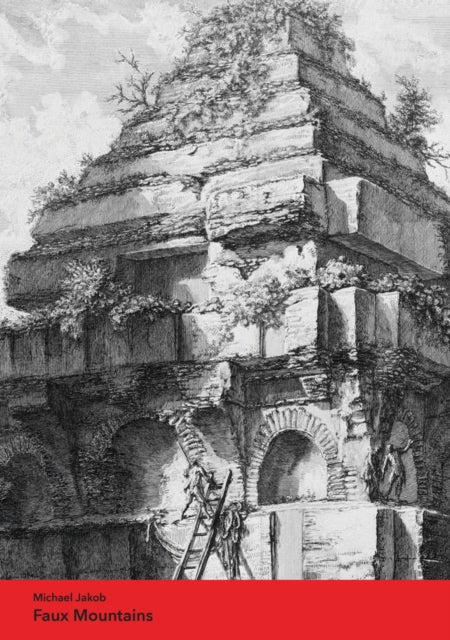
Michael Jakob
Faux Mountains
Faux Mountains
💎 Earn 125 Points (£1.25) on this item.
YOU SAVE $3.00
- Condition: Brand new
- UK Delivery times: Usually arrives within 2 - 3 working days
- UK Shipping: Fee starts at £3.89. Subject to product weight & dimension
Bulk ordering. Want 15 or more copies? Get a personalised quote and bigger discounts. Learn more about bulk orders.
Couldn't load pickup availability
- More about Faux Mountains
Artificial mountains have influenced urbanism, architecture, and landscape architecture throughout history. From ancient burial sites to Renaissance gardens, they have been used to express codified messages and celebrate the Supreme Being. The industrial revolution has also contributed to the rise of anthropic topography. In twentieth-century art, mountains have been explored in reverse, displaced, and rebuilt forms, culminating in Robert Smithson's masterful exploration.
Format: Paperback / softback
Length: 168 pages
Publication date: 18 July 2022
Publisher: Oro Editions
Artificial mountains are a ubiquitous reality that have significantly influenced the history of urbanism, architecture, and landscape architecture. These man-made structures have been used for various purposes throughout history, including burial sites, religious ceremonies, and symbolic representations. In ancient China, incense burners were designed to evoke the Five Sacred Mountains, while in Greece, Mount Parnassus became an important element in European garden history and a symbol of the Renaissance. During the Baroque period in Rome, prominent artists worked on constructing massive ephemeral mounds to express codified messages. The artificial mountain model was also employed during the French Revolution, with the famous celebration of the Supreme Being taking place on a gigantic faux mountain.
The history of landscape architecture is characterized by the construction of architectural mounds, often built using local excavation material. The industrial revolution acted as another source for the rise of an anthropic topography, creating forms that we now recognize as entirely artificial. Architects have found in the form of mountains a model and a gestalt with which to play in an ironic way. In twentieth-century art, mountains have become ubiquitous, culminating in Robert Smithson's masterful exploration of reversed, displaced, and rebuilt mountains. Michael Jakobs' study is the first to address this fascinating worldwide phenomenon, spanning from antiquity to our days.
Weight: 446g
Dimension: 162 x 246 x 14 (mm)
ISBN-13: 9781943532551
UK and International shipping information
UK and International shipping information
We deliver throughout the United Kingdom and to 128 countries and territories worldwide, including the United States, Australia, Canada, Germany, Spain and France.