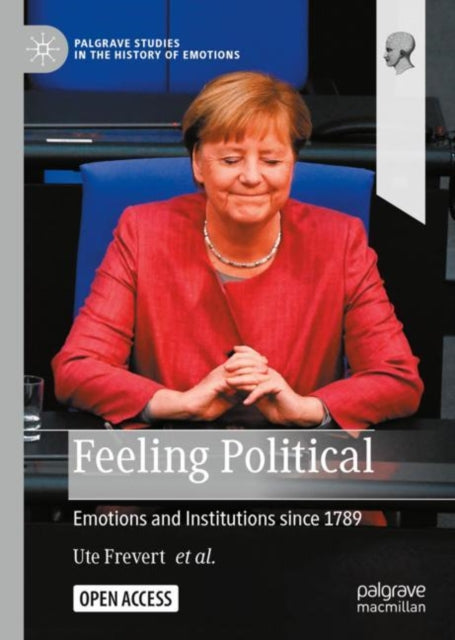
Ute Frevert,Kerstin Maria Pahl,Francesco Buscemi,Philipp Nielsen,Agnes Arndt,Michael Amico,Karsten Lichau,Hannah Malone,Julia Wambach,Juliane Brauer
Feeling Political: Emotions and Institutions since 1789
Feeling Political: Emotions and Institutions since 1789
💎 Earn 185 Points (£1.85) on this item.
We can order this item for you. Delivery usually takes about 4 to 6 weeks.
This item is not held in our immediate stock. We will order it for you after checkout.
Estimated delivery: About 4 to 6 weeks
YOU SAVE £7.83
- Condition: Brand new
- UK Delivery times: Usually arrives within 2 - 3 working days
- UK Shipping: Fee starts at £2.39. Subject to product weight & dimension
Bulk ordering. Want 15 or more copies? Get a personalised quote and bigger discounts. Learn more about bulk orders.
Couldn't load pickup availability
- More about Feeling Political: Emotions and Institutions since 1789
This book explores the role of emotions in shaping political engagement and outcomes in European and US history, using twelve case studies from 1800 to the present. It emphasizes the institutionalization of emotions and their impact on political participation.
Format: Hardback
Length: 390 pages
Publication date: 07 April 2022
Publisher: Springer Nature Switzerland AG
This open-access book historicizes both emotions and politics, arguing that the historical work of emotion is best understood in terms of the dynamics of institutionalization. This is demonstrated through twelve case studies that focus on pivotal moments in European and US history from 1800 to the present. Each case study clarifies how emotions were central to people's political engagement and its effects. The sources range from parliamentary buildings and social movements to images and speeches of presidents, from fascist cemeteries to the International Criminal Court. Both the timeframe and geographical focus have been chosen to highlight the increasingly participatory character of nineteenth- and twentieth-century politics, which is inconceivable without the work of emotions.
Emotions have played a significant role in shaping political outcomes throughout history, from the American Revolution to the Arab Spring. This book explores the historical work of emotion, examining how emotions have been institutionalized and how they have influenced political engagement and decision-making.
The book begins by examining the role of emotions in the formation of political institutions. It argues that emotions have been used to justify political actions, such as wars and revolutions, and that they have been used to create and maintain social hierarchies. For example, during the French Revolution, the emotions of anger and resentment towards the monarchy were used to justify the overthrow of the aristocracy and the establishment of a republic.
The book then moves on to explore how emotions have been used to influence political engagement and decision-making. It argues that emotions can be used to mobilize people and to create a sense of shared purpose and identity. For example, during the Civil Rights Movement in the United States, the emotions of fear and frustration towards segregation were used to mobilize people and to create a sense of urgency and collective action.
The book also explores how emotions have been used to justify political decisions. It argues that emotions can be used to override rational decision-making and to create a sense of urgency and collective action. For example, during the Cold War, the emotions of fear and suspicion towards the Soviet Union were used to justify the United States' involvement in the Vietnam War.
The book also examines how emotions have been used to undermine political institutions. It argues that emotions can be used to delegitimize political leaders and to create a sense of disillusionment and disengagement. For example, during the Arab Spring, the emotions of frustration and anger towards authoritarian regimes were used to undermine these regimes and to create a sense of hope and possibility for political change.
The book concludes by examining the implications of the historical work of emotion for contemporary politics. It argues that emotions can be used to create political change and to promote social justice, but that they can also be used to justify political actions that are harmful to society. It calls for a more nuanced understanding of the role of emotions in politics and for a more ethical and responsible use of emotions in political decision-making.
In conclusion, this book provides a comprehensive and insightful exploration of the historical work of emotion, examining how emotions have been institutionalized and how they have influenced political engagement and decision-making. It is a valuable resource for scholars and students of politics, history, and social psychology, and it will be of interest to anyone who is interested in understanding the role of emotions in shaping political outcomes.
Weight: 646g
Dimension: 153 x 218 x 30 (mm)
ISBN-13: 9783030898571
Edition number: 1st ed. 2022
UK and International shipping information
UK and International shipping information
UK Delivery and returns information:
- Delivery within 2 - 3 days when ordering in the UK.
- Shipping fee for UK customers from £2.39. Fully tracked shipping service available.
- Returns policy: Return within 30 days of receipt for full refund.
International deliveries:
Shulph Ink now ships to Australia, Belgium, Canada, France, Germany, Ireland, Italy, India, Luxembourg Saudi Arabia, Singapore, Spain, Netherlands, New Zealand, United Arab Emirates, United States of America.
- Delivery times: within 5 - 10 days for international orders.
- Shipping fee: charges vary for overseas orders. Only tracked services are available for most international orders. Some countries have untracked shipping options.
- Customs charges: If ordering to addresses outside the United Kingdom, you may or may not incur additional customs and duties fees during local delivery.