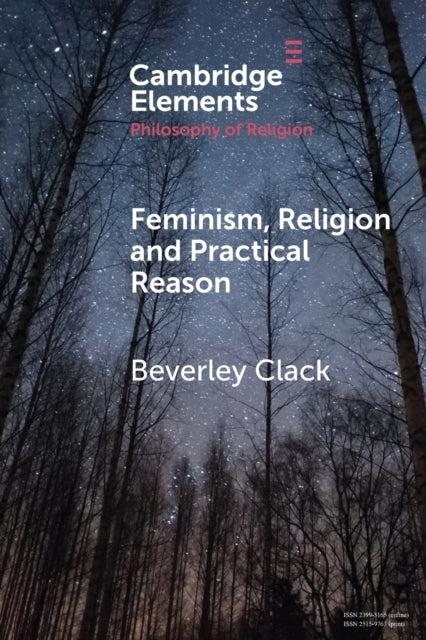
BeverleyClack
Feminism, Religion and Practical Reason
Feminism, Religion and Practical Reason
💎 Earn 84 Points (£0.84) on this item.
We can order this item for you. Delivery usually takes about 4 to 6 weeks.
This item is not held in our immediate stock. We will order it for you after checkout.
Estimated delivery: About 4 to 6 weeks
YOU SAVE £1.01
- Condition: Brand new
- UK Delivery times: Usually arrives within 2 - 3 working days
- UK Shipping: Fee starts at £2.39. Subject to product weight & dimension
Bulk ordering. Want 15 or more copies? Get a personalised quote and bigger discounts. Learn more about bulk orders.
Couldn't load pickup availability
- More about Feminism, Religion and Practical Reason
This Element builds upon the legacy of feminist philosophies of religion, revisiting and extending aspects of their work for a contemporary context struggling with post-truth forms of politics. It reclaims the power of collective action and the importance of the struggle for truth to realize the feminist desire for more flourishing forms of life and relationship.
Format: Paperback / softback
Length: 75 pages
Publication date: 06 January 2022
Publisher: Cambridge University Press
Pamela Sue Anderson's groundbreaking work, A Feminist Philosophy of Religion (1998), and Grace Jantzen's equally influential Becoming Divine: Towards a Feminist Philosophy of Religion (1998) laid the foundation for subsequent feminist philosophies of religion. This Element takes a step forward, building upon the rich legacy of these scholars' investigations. It revisits and expands upon their ideas, adapting them to the contemporary context grappling with the profound impact of post-truth forms of politics. By reclaiming the power of collective action within religious communities and emphasizing the pursuit of truth, this Element offers a transformative perspective on the world. It is essential to realize the feminist aspiration for more flourishing forms of life and relationships, which are central to the feminist philosophy of religion.
In A Feminist Philosophy of Religion, Anderson delves into the complexities of gender roles and religious traditions, challenging traditional notions of femininity and masculinity. She argues that religion has often been used to justify patriarchal structures and oppression, perpetuating harmful stereotypes and inequalities. Anderson advocates for a feminist perspective that recognizes the diversity of women's experiences and promotes gender equality within religious institutions.
Similarly, in Becoming Divine, Jantzen explores the concept of divinity and its implications for feminist philosophy. She argues that traditional understandings of divinity are often male-dominated and hierarchical, perpetuating gender imbalances and power disparities. Jantzen proposes a feminist perspective that recognizes the diversity of female experiences and promotes a more inclusive and egalitarian understanding of divinity.
Both Anderson and Jantzen's works highlight the importance of intersectionality in feminist philosophy of religion. They recognize that women's experiences are shaped not only by their gender but also by their race, class, sexuality, and other social identities. By incorporating intersectionality into their analysis, they argue that feminist philosophy of religion must address the complex and interrelated systems of oppression that affect women's lives.
Furthermore, these feminist philosophers of religion emphasize the role of social change in realizing feminist ideals. They argue that religious institutions and practices must be transformed to promote gender equality and social justice. This requires a critical engagement with religious texts and traditions, as well as a willingness to challenge and reform oppressive beliefs and practices.
In conclusion, Pamela Sue Anderson's A Feminist Philosophy of Religion and Grace Jantzen's Becoming Divine: Towards a Feminist Philosophy of Religion have played a pivotal role in shaping feminist philosophies of religion. By reclaiming the power of collective action and emphasizing the pursuit of truth, this Element builds upon the legacy of these scholars' investigations. It offers a transformative perspective on the world, recognizing the diversity of women's experiences and promoting gender equality within religious institutions. Through intersectionality and social change, feminist philosophy of religion can contribute to a more just and equitable society.
Weight: 128g
Dimension: 153 x 228 x 8 (mm)
ISBN-13: 9781108796866
Edition number: New ed
UK and International shipping information
UK and International shipping information
UK Delivery and returns information:
- Delivery within 2 - 3 days when ordering in the UK.
- Shipping fee for UK customers from £2.39. Fully tracked shipping service available.
- Returns policy: Return within 30 days of receipt for full refund.
International deliveries:
Shulph Ink now ships to Australia, Belgium, Canada, France, Germany, Ireland, Italy, India, Luxembourg Saudi Arabia, Singapore, Spain, Netherlands, New Zealand, United Arab Emirates, United States of America.
- Delivery times: within 5 - 10 days for international orders.
- Shipping fee: charges vary for overseas orders. Only tracked services are available for most international orders. Some countries have untracked shipping options.
- Customs charges: If ordering to addresses outside the United Kingdom, you may or may not incur additional customs and duties fees during local delivery.