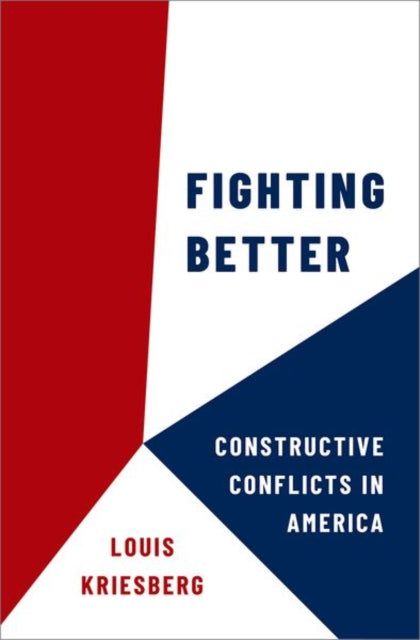
LouisKriesberg
Fighting Better: Constructive Conflicts in America
Fighting Better: Constructive Conflicts in America
💎 Earn 127 Points (£1.27) on this item.
We can order this item for you. Delivery usually takes about 4 to 6 weeks.
This item is not held in our immediate stock. We will order it for you after checkout.
Estimated delivery: About 4 to 6 weeks
YOU SAVE £1.51
- Condition: Brand new
- UK Delivery times: Usually arrives within 2 - 3 working days
- UK Shipping: Fee starts at £2.39. Subject to product weight & dimension
Bulk ordering. Want 15 or more copies? Get a personalised quote and bigger discounts. Learn more about bulk orders.
Couldn't load pickup availability
- More about Fighting Better: Constructive Conflicts in America
The people in the United States are experiencing an extreme degree of division, political partisanship, and civic disorder. Louis Kriesberg argues that the crises confronting the US are the result of changes in dynamics along three societal dimensions: class, status, and power. He offers ideas for how some of those fights might have been waged more effectively and with longer-term benefits, connecting current US crises to past mistakes.
Format: Paperback / softback
Length: 344 pages
Publication date: 09 February 2023
Publisher: Oxford University Press Inc
The people of the United States are currently facing a severe level of division, political partisanship, and civic unrest. Disagreements are raging over various issues, including misinformation, voting rights, school curriculum, government spending, and personal privacy. How can these distressing circumstances be overcome? More specifically, what distinguishes conflicts that lead to progress from those that exacerbate polarization, inequality, and societal distress?
In his book Fighting Better, Louis Kriesberg argues that the crises confronting the US today are the result of changes in dynamics along three societal dimensions: class, status, and power. These changes were largely driven by individuals engaging in conflicts, whether constructively, destructively, or avoiding overt conflicts altogether. Kriesberg assesses the effectiveness of major domestic conflicts in the United States since 1945 in terms of advancing justice, liberty, and equal opportunity for all Americans. Furthermore, he offers ideas for how some of those fights could have been waged more effectively, with longer-term benefits, connecting current US crises to past mistakes. By doing so, Kriesberg deepens our understanding of how the way conflicts are waged can help to reduce inequities in class, power, and status, particularly with regard to gender and race.
The United States is experiencing a period of profound division, political polarization, and civic unrest. This crisis is characterized by destructive fights over various issues, including misinformation, voting rights, school curriculum, government spending, and personal privacy. The root causes of these conflicts lie in changes in dynamics along three societal dimensions: class, status, and power. These changes were largely driven by individuals engaging in conflicts, whether constructively, destructively, or avoiding overt conflicts altogether.
To address this crisis, it is essential to understand the factors that contribute to conflicts and their impact on society. One key factor is the increasing inequality in the United States, which has led to a growing divide between the rich and the poor. This inequality has created a sense of resentment and frustration among many people, who feel that their voices are not being heard by the government and that their economic opportunities are limited.
Another factor contributing to conflicts is the rise of political partisanship, which has led to a polarization of the political landscape. People are increasingly identifying themselves with a particular political party and are less willing to compromise or engage in constructive dialogue with those who hold different views. This polarization has made it difficult for the government to address complex issues and has led to gridlock and inaction.
Finally, the power of social media and other forms of communication has played a significant role in exacerbating conflicts. Social media platforms have provided a platform for individuals to express their opinions and grievances, but they have also been used to spread misinformation and propaganda, which can lead to misunderstandings and tensions.
To overcome these challenges, it is important to address the root causes of conflicts and promote constructive engagement and dialogue. This can be achieved through policies that promote economic equality, such as increased investment in education and job training programs, and initiatives that promote political unity and compromise.
In addition, it is important to address the power of social media and other forms of communication. Social media platforms should be held accountable for the spread of misinformation and propaganda and should take steps to promote constructive dialogue and engagement. This can be achieved through policies that promote transparency and accountability, such as fact-checking and user verification, and by promoting diversity and inclusion on social media platforms.
Finally, it is important to promote civic engagement and participation among individuals and communities. This can be achieved through initiatives that promote education and awareness about the political process, such as voter registration drives and community forums, and through programs that encourage individuals to get involved in local politics and community organizations.
In conclusion, the people of the United States are currently facing a severe level of division, political polarization, and civic unrest. This crisis is characterized by destructive fights over various issues, including misinformation, voting rights, school curriculum, government spending, and personal privacy. The root causes of these conflicts lie in changes in dynamics along three societal dimensions: class, status, and power. To overcome this crisis, it is essential to address the root causes of conflicts and promote constructive engagement and dialogue. This can be achieved through policies that promote economic equality, political unity and compromise, and civic engagement and participation. By doing so, we can create a more inclusive and equitable society that is better equipped to address the challenges of the 21st century.
Dimension: 235 x 156 (mm)
ISBN-13: 9780197674802
This item can be found in:
UK and International shipping information
UK and International shipping information
UK Delivery and returns information:
- Delivery within 2 - 3 days when ordering in the UK.
- Shipping fee for UK customers from £2.39. Fully tracked shipping service available.
- Returns policy: Return within 30 days of receipt for full refund.
International deliveries:
Shulph Ink now ships to Australia, Belgium, Canada, France, Germany, Ireland, Italy, India, Luxembourg Saudi Arabia, Singapore, Spain, Netherlands, New Zealand, United Arab Emirates, United States of America.
- Delivery times: within 5 - 10 days for international orders.
- Shipping fee: charges vary for overseas orders. Only tracked services are available for most international orders. Some countries have untracked shipping options.
- Customs charges: If ordering to addresses outside the United Kingdom, you may or may not incur additional customs and duties fees during local delivery.