Andy Clark
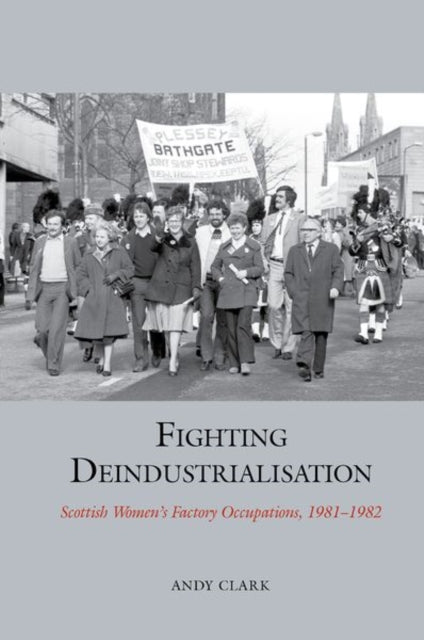
Fighting Deindustrialisation: Scottish Women's Factory Occupations, 1981-1982
Fighting Deindustrialisation: Scottish Women's Factory Occupations, 1981-1982
💎 Earn 165 Points (£1.65) on this item.
- Condition: Brand new
- UK Delivery times: Usually arrives within 2 - 3 working days
- UK Shipping: Fee starts at £2.39. Subject to product weight & dimension
Bulk ordering. Want 15 or more copies? Get a personalised quote and bigger discounts. Learn more about bulk orders.
Couldn't load pickup availability
- More about Fighting Deindustrialisation: Scottish Women's Factory Occupations, 1981-1982
Andy Clark's book "Fighting Deindustrialisation" explores and analyzes one of the most significant and under-researched periods in modern Scottish labor history. During 1981 and 1982, three workforces refused to accept job losses due to the accelerated deindustrialization of Scotland's economy. The predominantly women assembly workers at Lee Jeans, Lovable Bra, and Plessey Capacitors occupied their factories and fought against capital movement, corporate greed, and unfair job losses. Clark argues that these occupations should be considered one of the most significant periods in Scotland's history of deindustrialization and seeks to incorporate women's militant resistance within academic and popular understandings of working-class activism in later 20th-century Scotland.
Format: Paperback / softback
Length: 264 pages
Publication date: 01 January 2023
Publisher: Liverpool University Press
Andy Clark delves into and analyzes one of the most significant yet understudied chapters in modern Scottish labor history in his book Fighting Deindustrialisation. During a fourteen-month period in 1981 and 1982, Scotland experienced the harsh consequences of the rapid deindustrialization of its economy. Three workforces, consisting predominantly of women, refused to surrender their jobs despite the closures of their plants. The predominantly female assembly workers at Lee Jeans (Greenock), Lovable Bra (Cumbernauld), and Plessey Capacitors (Bathgate) were informed that their multinational employers had made the difficult decision to shut down their operations. At each site, a fierce battle was waged against capital movement, corporate greed, and unfair job losses. The workers took over their factories and refused to leave until their demands were met and the closures were averted. Remarkably, this objective was achieved at all three sites, with none of the factories completely closing as a result of the women's occupations.
In this book, these occupations are analyzed for the first time using a diverse range of analytical frameworks, including oral history, memory studies, industrial relations scholarship, and deindustrialization studies. Clark's comprehensive examination argues that the actions of 1981–82 should be regarded as one of the most pivotal periods in Scotland's history of deindustrialization. However, the public memory of this period is fragile, and Fighting Deindustrialisation begins the process of integrating women's militant resistance into academic and popular interpretations of working-class activism in later 20th-century Scotland.
The book explores the experiences of these women workers, their struggles, and their resilience in the face of adversity. It sheds light on the social and economic context of the deindustrialization era, highlighting the impact of globalization, Thatcherism, and the decline of traditional industries on working-class communities. Clark also examines the political dimensions of the occupations, exploring the role of trade unions and labor unions, as well as the broader social movements of the time, in shaping the workers' resistance.
Through a combination of primary sources, such as interviews with the workers themselves, and secondary research, Clark provides a detailed account of the occupations and their aftermath. He highlights the significance of these events in shaping the labor movement and working-class politics in Scotland, and their relevance to contemporary debates about deindustrialization, inequality, and social justice.
Fighting Deindustrialisation is a valuable addition to the literature on labor history and social movements, offering a fresh perspective on a period that has been largely overlooked. It demonstrates the power of collective action and the resilience of working-class communities in the face of economic adversity. By integrating women's militant resistance into academic and popular understandings of working-class activism, the book contributes to a more comprehensive and inclusive understanding of Scotland's past and present.
Dimension: 234 x 156 (mm)
ISBN-13: 9781802077124
UK and International shipping information
UK and International shipping information
UK Delivery and returns information:
- Delivery within 2 - 3 days when ordering in the UK.
- Shipping fee for UK customers from £2.39. Fully tracked shipping service available.
- Returns policy: Return within 30 days of receipt for full refund.
International deliveries:
Shulph Ink now ships to Australia, Belgium, Canada, France, Germany, Ireland, Italy, India, Luxembourg Saudi Arabia, Singapore, Spain, Netherlands, New Zealand, United Arab Emirates, United States of America.
- Delivery times: within 5 - 10 days for international orders.
- Shipping fee: charges vary for overseas orders. Only tracked services are available for most international orders. Some countries have untracked shipping options.
- Customs charges: If ordering to addresses outside the United Kingdom, you may or may not incur additional customs and duties fees during local delivery.