Craig Robertson
Filing Cabinet: A Vertical History of Information
Filing Cabinet: A Vertical History of Information
💎 Earn 106 Points (£1.06) on this item.
YOU SAVE £2.76
- Condition: Brand new
- UK Delivery times: Usually arrives within 2 - 3 working days
- UK Shipping: Fee starts at £2.39. Subject to product weight & dimension
Bulk ordering. Want 15 or more copies? Get a personalised quote and bigger discounts. Learn more about bulk orders.
Couldn't load pickup availability
- More about Filing Cabinet: A Vertical History of Information
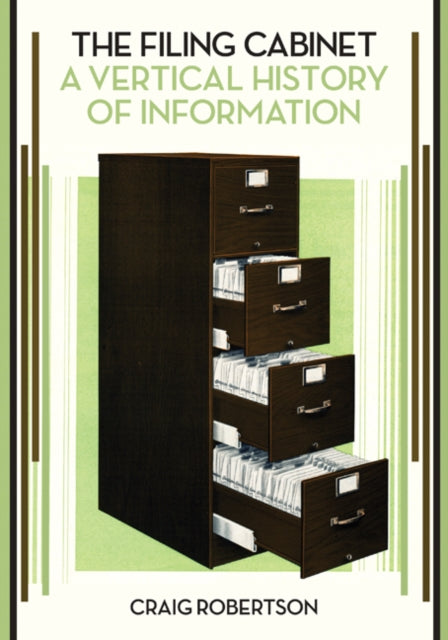
The filing cabinet, invented in the 1890s, revolutionized how information and data were sorted, stored, retrieved, and used by organizing loose papers in tabbed folders. It was an "automatic memory" machine that contributed to a new type of information labor privileging manual dexterity over mental deliberation and helped to naturalize the changes that brought women into the workforce as low-level clerical workers.
\n Format: Paperback / softback
\n Length: 280 pages
\n Publication date: 07 May 2021
\n Publisher: University of Minnesota Press
\n
The filing cabinet, a deceptively ordinary piece of office furniture, has played a significant role in shaping our relationship with information. While its plain appearance may have obscured its transformative impact, Craig Robertson's comprehensive history reveals its profound influence on the histories of information technology and work.
Invented in the 1890s, the filing cabinet emerged as a response to the nineteenth-century belief in efficiency. Prior to its invention, paper records were haphazardly organized, with no standardized system in place. The filing cabinet revolutionized the way information was stored, sorted, retrieved, and used. It introduced the concept of tabbed folders, allowing loose papers to be organized alphanumerically. This systematic approach made it easier for people to access, circulate, and structure information, leading to a significant shift in the way we interact with data.
Robertson's unconventional history of the origins of the information age presents the filing cabinet as an information storage container, an "automatic memory" machine that contributed to the emergence of a new type of information labor. This labor was characterized by manual dexterity and required women, who were often seen as more nimble and skilled in handling paperwork, to fill low-level clerical positions. The filing cabinet's design, with its folders, files, and tabs, continued to shape how we interact with information and data in the digital world, perpetuating gendered assumptions about womens roles in the workplace.
In conclusion, the filing cabinet's history is a testament to the power of design and technology to shape our interactions with information. Its mundane appearance may have concealed its profound impact, but Craig Robertson's book sheds light on the ways in which this overlooked artifact has shaped our understanding of information management and labor. By examining the filing cabinet's origins and its role in the information age, we can gain a deeper appreciation for the complexities of our digital world and the ongoing challenges of gender equality in the workplace.
\n Weight: 508g\n
Dimension: 152 x 229 x 25 (mm)\n
ISBN-13: 9781517909468\n \n
This item can be found in:
UK and International shipping information
UK and International shipping information
UK Delivery and returns information:
- Delivery within 2 - 3 days when ordering in the UK.
- Shipping fee for UK customers from £2.39. Fully tracked shipping service available.
- Returns policy: Return within 30 days of receipt for full refund.
International deliveries:
Shulph Ink now ships to Australia, Belgium, Canada, France, Germany, Ireland, Italy, India, Luxembourg Saudi Arabia, Singapore, Spain, Netherlands, New Zealand, United Arab Emirates, United States of America.
- Delivery times: within 5 - 10 days for international orders.
- Shipping fee: charges vary for overseas orders. Only tracked services are available for most international orders. Some countries have untracked shipping options.
- Customs charges: If ordering to addresses outside the United Kingdom, you may or may not incur additional customs and duties fees during local delivery.