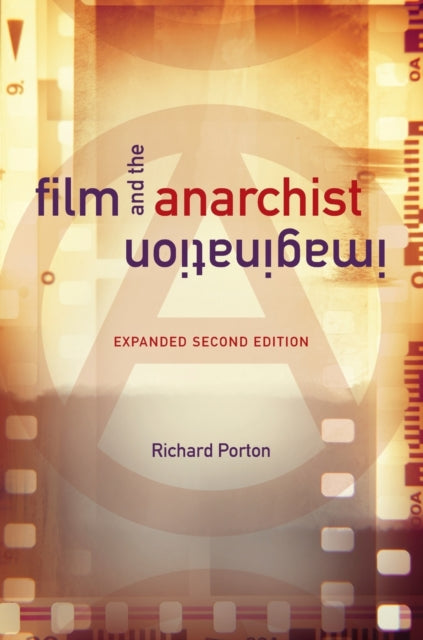
Richard Porton
Film and the Anarchist Imagination: Expanded Second Edition
Film and the Anarchist Imagination: Expanded Second Edition
YOU SAVE £3.51
- Condition: Brand new
- UK Delivery times: Usually arrives within 2 - 3 working days
- UK Shipping: Fee starts at £2.39. Subject to product weight & dimension
Bulk ordering. Want 15 or more copies? Get a personalised quote and bigger discounts. Learn more about bulk orders.
Couldn't load pickup availability
- More about Film and the Anarchist Imagination: Expanded Second Edition
Film and the Anarchist Imagination offers an authoritative account of films featuring anarchist characters and motifs, exploring their portrayal of labor agitation, revolutionary struggle, workplace resistance, anarchist pedagogy, self-emancipation, and anti-statist insurrection. It covers a range of films from the silent era to contemporary works, engaging with the works of Jean Vigo, Jean-Luc Godard, Lina Wertmüller, Yvonne Rainer, Ken Loach, and others. The second edition reflects on negative portrayals of anarchism and the embrace of post-anarchism.
Format: Paperback / softback
Length: 352 pages
Publication date: 13 October 2020
Publisher: University of Illinois Press
Film and the Anarchist Imagination, a groundbreaking work by Richard Porton, has gained widespread acclaim since its initial release. Porton's comprehensive exploration of films featuring anarchist characters and motifs offers a unique and authoritative perspective on the long traditions of labor agitation and revolutionary struggle portrayed in cinema. While acknowledging the tendency of cinema to perpetuate ludicrous anarchist stereotypes, Porton focuses on films that reflect or promote workplace resistance, anarchist pedagogy, self-emancipation, and anti-statist insurrection. Spanning from the silent era to classics like Zéro de Conduite and Love and Anarchy to contemporary films like The Nothing Factory, Porton engages the works of Jean Vigo, Jean-Luc Godard, Lina Wertmüller, Yvonne Rainer, Ken Loach, and many others. In this updated second edition, Porton reflects on several new topics, including the negative portrayals of anarchism over the past twenty years and the contemporary embrace of post-anarchism.
Porton's approach to analyzing films is meticulous and nuanced. He examines the ways in which filmmakers have depicted anarchist characters and their struggles, highlighting both the positive and negative aspects of their portrayals. He acknowledges the historical context in which these films were made, the social and political conditions that influenced their production, and the ways in which they have been received by audiences.
One of the key themes that Porton explores is the relationship between anarchism and labor agitation. He argues that anarchism has been a powerful force for social change throughout history, and that films have played a significant role in promoting this agenda. He highlights the ways in which anarchist characters have been used to challenge the status quo, to expose the injustices of capitalism, and to advocate for workers' rights.
However, Porton also acknowledges the negative portrayals of anarchism in cinema. He points out that many films have portrayed anarchists as violent, irrational, and dangerous, and that this has contributed to the negative perception of anarchism in society. He argues that this portrayal is often based on a misunderstanding of anarchism's principles and values, and that it has been used to justify state repression and violence.
To counter these negative portrayals, Porton suggests that filmmakers should approach anarchism with a more nuanced and realistic perspective. He argues that anarchism is a complex and diverse movement that encompasses a wide range of beliefs and practices, and that it is important to portray it in a way that is accurate and respectful. He suggests that filmmakers should focus on the positive aspects of anarchism, such as its commitment to social justice, its emphasis on individual freedom, and its rejection of authoritarianism.
In addition to his analysis of films, Porton also provides a wealth of historical information about anarchism. He discusses the origins of anarchism, its development over time, and its various branches and ideologies. He also explores the ways in which anarchism has been used in political movements and social struggles throughout history.
One of the most interesting aspects of Porton's book is his discussion of anarchist pedagogy. He argues that anarchism has a unique approach to education that emphasizes the importance of self-learning and self-empowerment. He highlights the ways in which anarchist schools and communities have been created to provide education to marginalized and oppressed groups, and he argues that these schools and communities have been successful in promoting social change.
Porton also explores the ways in which anarchist pedagogy has been used in contemporary films. He points out that many contemporary films have featured anarchist characters and themes, and that these films have been used to promote social justice and political activism. He highlights the films of Jean Vigo, Jean-Luc Godard, Lina Wertmüller, and Yvonne Rainer as examples of this.
However, Porton also acknowledges the challenges that anarchist pedagogy faces in contemporary society. He points out that many schools and communities are underfunded and understaffed, and that this can make it difficult for them to provide quality education to their students. He also argues that the rise of neoliberalism has led to a decline in the importance of education, and that this has had a negative impact on anarchist pedagogy.
In conclusion, Film and the Anarchist Imagination is a groundbreaking work that offers a unique and authoritative perspective on the long traditions of labor agitation and revolutionary struggle portrayed in cinema. Richard Porton's meticulous and nuanced analysis of films featuring anarchist characters and motifs provides a valuable insight into the ways in which filmmakers have portrayed anarchism, and the ways in which it has been received by audiences. While acknowledging the negative portrayals of anarchism in cinema, Porton suggests that filmmakers should approach anarchism with a more nuanced and realistic perspective, and that anarchist pedagogy has a unique approach to education that can be used to promote social change. Whether you are a fan of cinema or a student of anarchism, this book is essential reading.
Weight: 568g
Dimension: 157 x 233 x 36 (mm)
ISBN-13: 9780252085246
This item can be found in:
UK and International shipping information
UK and International shipping information
UK Delivery and returns information:
- Delivery within 2 - 3 days when ordering in the UK.
- Shipping fee for UK customers from £2.39. Fully tracked shipping service available.
- Returns policy: Return within 30 days of receipt for full refund.
International deliveries:
Shulph Ink now ships to Australia, Belgium, Canada, France, Germany, Ireland, Italy, India, Luxembourg Saudi Arabia, Singapore, Spain, Netherlands, New Zealand, United Arab Emirates, United States of America.
- Delivery times: within 5 - 10 days for international orders.
- Shipping fee: charges vary for overseas orders. Only tracked services are available for most international orders. Some countries have untracked shipping options.
- Customs charges: If ordering to addresses outside the United Kingdom, you may or may not incur additional customs and duties fees during local delivery.