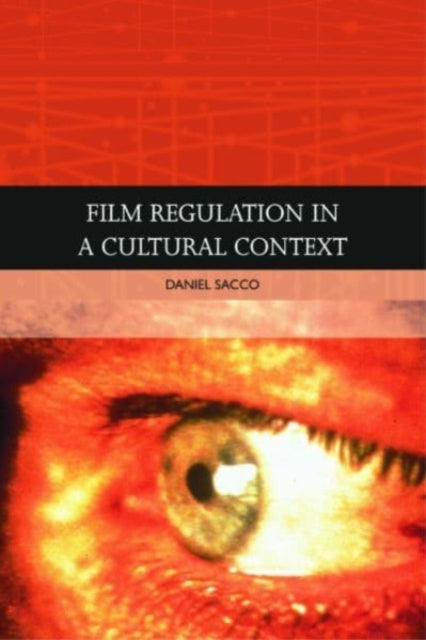
Daniel Sacco
Film Regulation in a Cultural Context
Film Regulation in a Cultural Context
💎 Earn 364 Points (£3.64) on this item.
We can order this item for you. Delivery usually takes about 4 to 6 weeks.
This item is not held in our immediate stock. We will order it for you after checkout.
Estimated delivery: About 4 to 6 weeks
YOU SAVE £22.13
- Condition: Brand new
- UK Delivery times: Usually arrives within 2 - 3 working days
- UK Shipping: Fee starts at £2.39. Subject to product weight & dimension
Bulk ordering. Want 15 or more copies? Get a personalised quote and bigger discounts. Learn more about bulk orders.
Couldn't load pickup availability
- More about Film Regulation in a Cultural Context
Film Regulation in a Cultural Context compares censorship's distinct and varying profiles across five different national contexts - U.S.A.,Britain,Canada,Australia and France. It analyzes the causes and consequences of the transition away from formal censor boards and toward current practices of classification and ratings. The book draws parallels between the rhetorical practices of censors, critics, distributors, and advertisers that have assumed the social control of film culture. It examines cinematic works that provoked censorious impulses throughout the shift away from formal film censorship in the late modern West, such as Fat Girl, Irreversible, Ken Park, The Brown Bunny, Wolf Creek, and Welcome to New York. Sacco examines the means by which the social control of film content persists in a national post-censorship media landscape, and how concepts of film classification manifest in commercial market contexts, journalistic criticism, and practices of distribution and advertising.
Format: Hardback
Length: 192 pages
Publication date: 31 July 2023
Publisher: Edinburgh University Press
Introduction:
Censorship, a pervasive societal phenomenon, takes on distinct and varying profiles across five distinct national contexts: the United States of America, Britain, Canada, Australia, and France. This comparative analysis aims to explore the historical roots and consequences of the transition away from formal censor boards and toward current practices of classification and ratings. By conducting a detailed textual analysis of the relevant films, we will contextualize and evaluate the rhetorical arguments put forth against them in controversial public receptions. Furthermore, we will draw parallels between the rhetorical practices of censors, critics, distributors, and advertisers, who have assumed the social control of film culture.
Historical Analysis:
In order to understand the historical context of film regulation, it is essential to examine the causes and consequences of the transition away from formal censor boards and toward current practices of classification and ratings. This shift occurred in the late modern West, driven by a variety of factors, including the rise of mass media, the expansion of international trade, and the growing influence of political and social movements. Formal censor boards, which had been in place for centuries, were gradually replaced by classification systems that aimed to provide a more nuanced and objective approach to regulating film content.
One of the primary causes of the transition was the recognition of the limitations of formal censorship. Censor boards were often subject to political pressure, and their decisions were often based on personal biases rather than objective criteria. Additionally, the rise of new technologies, such as film and video recording, made it increasingly difficult for censor boards to control the distribution and consumption of films.
The consequences of the transition were significant. On the one hand, the classification and rating systems provided a more efficient and effective means of regulating film content. They allowed for a greater degree of autonomy for filmmakers, while also providing consumers with more information about the content of films. On the other hand, the transition also led to increased controversy and debate about the role of government in regulating film content.
Detailed Textual Analysis:
In order to contextualize and evaluate the rhetorical arguments put forth against the films under study, we will conduct a detailed textual analysis of the relevant films. This analysis will include a close reading of the scripts, dialogue, and visual imagery, as well as an examination of the historical and cultural contexts in which the films were produced. By analyzing the rhetorical arguments put forth against the films, we will be able to identify the key themes and issues that were at the forefront of the public controversies surrounding them.
One of the key themes that emerged from the public controversies surrounding the films was the issue of sexual content and violence. Films such as Fat Girl, Irreversable, Ken Park, The Brown Bunny, Wolf Creek, and Welcome to New York all provoked censorious impulses due to their explicit and graphic depictions of sexual activity and violence. These films were often criticized for their lack of morality, their promotion of harmful stereotypes, and their potential to influence young viewers.
Another key theme that emerged from the public controversies surrounding the films was the issue of cultural representation. Films such as Fat Girl, Irreversable, Ken Park, The Brown Bunny, Wolf Creek, and Welcome to New York all challenged traditional notions of gender, sexuality, and race. They depicted marginalized and underrepresented groups in a positive and empowering light, and they were often praised for their bravery and authenticity.
However, the public controversies surrounding these films also highlighted the limitations of the classification and rating systems. While the systems provided a more nuanced and objective approach to regulating film content, they were also subject to political and commercial pressures. Filmmakers were often forced to compromise their artistic vision in order to appeal to the broader audience, and distributors and advertisers were often concerned with maximizing profits.
Parallels between Censors and Critics:
In addition to drawing parallels between the rhetorical practices of censors and critics, distributors, and advertisers, we will also examine the means by, and ends to which the social control of film content persists in a national post-censorship media landscape. One of the key mechanisms by which the social control of film content persists is through the concept of film classification. Film classification is a system of categorizing films based on their content, such as violence, sex, and language.
Film classification is often used by distributors and advertisers to market films to specific audiences. For example, a film that is classified as PG-13 may be marketed to teenagers, while a film that is classified as R may be marketed to adults. The classification system is also used by film festivals and advocacy groups to promote films that align with their values and beliefs.
However, the classification system is also subject to criticism and controversy. Some argue that the classification system is too restrictive and that it limits the artistic freedom of filmmakers. Others argue that the classification system is too lenient and that it allows for the promotion of harmful content to young viewers.
Conclusion:
In conclusion, Film Regulation in a Cultural Context examines cinematic works that provoked censorious impulses throughout the shift away from formal film censorship in the late modern West. The public controversies surrounding Fat Girl, Irreversable, Ken Park, The Brown Bunny, Wolf Creek, and Welcome to New York, each highlight significant stages in this cultural shift, which necessitated policy revision within Britain, Canada, and Australia's institutions of film censorship. Sacco draws parallels. Parallels and distinctions between governmental film regulation policies and the social control mechanisms at work within a wider network of institutions, including news media, film festivals, and advocacy groups. He examines the means by, and ends to which the social control of film content persists in a national post-censorship media landscape, and how concepts of film classification manifest in commercial market contexts, journalistic criticism, and practices of distribution and advertising. By conducting a comparative analysis of censorship's distinct and varying profiles across five different national contexts, we can gain a deeper understanding of the historical roots and consequences of the transition away from formal censor boards and toward current practices of classification and ratings. This analysis will also help us to identify the key themes and issues that are at the forefront of the public controversies surrounding cinematic works, and to evaluate the rhetorical arguments put forth by censors, critics, distributors, and advertisers. Ultimately, this analysis will contribute to our understanding of the complex and multifaceted relationship between film regulation, film culture, and society.
Dimension: 234 x 156 (mm)
ISBN-13: 9781474482387
This item can be found in:
UK and International shipping information
UK and International shipping information
UK Delivery and returns information:
- Delivery within 2 - 3 days when ordering in the UK.
- Shipping fee for UK customers from £2.39. Fully tracked shipping service available.
- Returns policy: Return within 30 days of receipt for full refund.
International deliveries:
Shulph Ink now ships to Australia, Belgium, Canada, France, Germany, Ireland, Italy, India, Luxembourg Saudi Arabia, Singapore, Spain, Netherlands, New Zealand, United Arab Emirates, United States of America.
- Delivery times: within 5 - 10 days for international orders.
- Shipping fee: charges vary for overseas orders. Only tracked services are available for most international orders. Some countries have untracked shipping options.
- Customs charges: If ordering to addresses outside the United Kingdom, you may or may not incur additional customs and duties fees during local delivery.