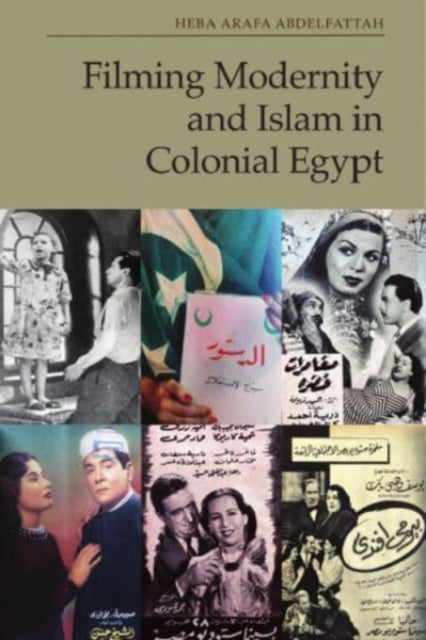
Heba Arafa Abdelfattah
Filming Modernity and Islam in Colonial Egypt
Filming Modernity and Islam in Colonial Egypt
💎 Earn 402 Points (£4.02) on this item.
YOU SAVE £24.46
- Condition: Brand new
- UK Delivery times: Usually arrives within 2 - 3 working days
- UK Shipping: Fee starts at £2.39. Subject to product weight & dimension
Bulk ordering. Want 15 or more copies? Get a personalised quote and bigger discounts. Learn more about bulk orders.
Couldn't load pickup availability
- More about Filming Modernity and Islam in Colonial Egypt
This book explores the formative years of Egyptian cinema (1919-52) to contest the contradiction between Islam and innovation. It discusses over 30 feature films, drawing on English and Arabic archival material, and sets out a dialogic and innovative approach to studying modernity and Islam as interdependent lived experiences. It challenges the Orientalist formalist approach, which subjects subaltern cinema to the Hollywood standards of film language, and writes a compelling account of Egyptian cinema as creative imagination and an Islamic popular culture shaped by Muslims and Non-Muslims.
Format: Hardback
Length: 448 pages
Publication date: 31 October 2023
Publisher: Edinburgh University Press
Introduction:
The history of Egyptian cinema is a fascinating journey that spans from its inception in 1919 to its peak in the 1950s. During this period, the country experienced a remarkable transformation, marked by the clash between traditional Islamic values and the emerging forces of modernity. This contradiction played a central role in shaping the development of Egyptian cinema, as filmmakers sought to navigate the complex terrain between these two opposing forces.
The Formative Years:
The formative years of Egyptian cinema (1919-1952) were marked by a period of experimentation and innovation. The country's first feature film, "The Story of a Woman," was released in 1923, and it marked the beginning of a new era in Egyptian cinema. However, the early films were heavily influenced by the conservative values of the Muslim clergy, who viewed cinema as a threat to the moral fabric of society.
Contradiction between Islam and Innovation:
The contradiction between Islam and innovation was a central theme in Egyptian cinema during the formative years. Filmmakers struggled to find a balance between the traditional values of Islam and the demands of modernity, which often led to censorship and controversy. For example, films that depicted women in revealing clothing or that challenged the authority of the Muslim clergy were often censored or banned.
Over 30 Feature Films:
This book explores over 30 feature films that were produced during the formative years of Egyptian cinema. These films cover a wide range of genres, including drama, comedy, and horror, and they provide a rich insight into the social and cultural landscape of colonial Egypt. The book draws on a wide range of archival material, including records of the British Foreign Office, the Egyptian National Archive, diaries of filmmakers and film censors, magazines and newspapers, and Islamic legal opinions on theatre and cinema.
A Dialogic and Innovative Approach:
This book takes a dialogic and innovative approach to studying modernity and Islam as interdependent lived experiences. It steps outside the Orientalist formalist approach, which subjects subaltern cinema to the Hollywood standards of film language. Instead, it seeks to understand the unique cultural and social context in which Egyptian cinema developed, and it explores the ways in which filmmakers negotiated the complex relationship between these two forces.
Egyptian Cinema as Creative Imagination and Islamic Popular Culture:
The result of this study is a compelling account of Egyptian cinema as creative imagination and an Islamic popular culture shaped by Muslims and Non-Muslims. The book argues that Egyptian cinema was not anti-religion but rather a supplemental secular public sphere that provided a means for the expression of cultural identity and the negotiation of social and political tensions.
Conclusion:
In conclusion, this book offers a valuable contribution to the study of cinema and modernity in the Middle East. It provides a nuanced and complex understanding of the relationship between Islam and innovation in Egyptian cinema, and it challenges the conventional narratives that have been used to describe this relationship. By exploring the formative years of Egyptian cinema, this book sheds light on the ways in which cinema can be used as a tool for cultural expression and social change, even in the face of adversity and censorship.
Weight: 856g
Dimension: 162 x 241 x 33 (mm)
ISBN-13: 9781399520751
UK and International shipping information
UK and International shipping information
UK Delivery and returns information:
- Delivery within 2 - 3 days when ordering in the UK.
- Shipping fee for UK customers from £2.39. Fully tracked shipping service available.
- Returns policy: Return within 30 days of receipt for full refund.
International deliveries:
Shulph Ink now ships to Australia, Belgium, Canada, France, Germany, Ireland, Italy, India, Luxembourg Saudi Arabia, Singapore, Spain, Netherlands, New Zealand, United Arab Emirates, United States of America.
- Delivery times: within 5 - 10 days for international orders.
- Shipping fee: charges vary for overseas orders. Only tracked services are available for most international orders. Some countries have untracked shipping options.
- Customs charges: If ordering to addresses outside the United Kingdom, you may or may not incur additional customs and duties fees during local delivery.