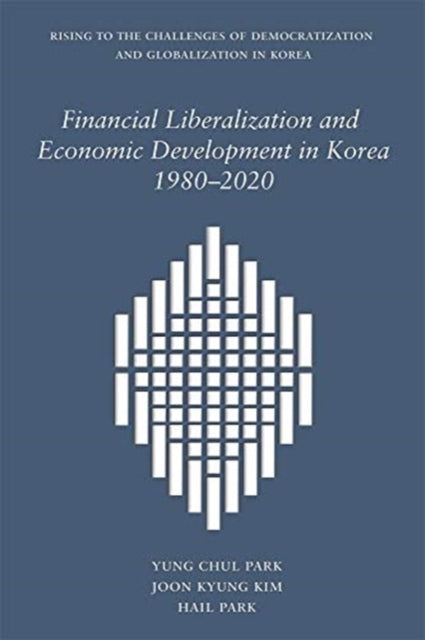
Yung Chul Park,Joon Kyung Kim,Hail Park
Financial Liberalization and Economic Development in Korea, 1980-2020
Financial Liberalization and Economic Development in Korea, 1980-2020
💎 Earn 194 Points (£1.94) on this item.
YOU SAVE £5.06
- Condition: Brand new
- UK Delivery times: Usually arrives within 2 - 3 working days
- UK Shipping: Fee starts at £2.39. Subject to product weight & dimension
Bulk ordering. Want 15 or more copies? Get a personalised quote and bigger discounts. Learn more about bulk orders.
Couldn't load pickup availability
- More about Financial Liberalization and Economic Development in Korea, 1980-2020
Koreas financial development has been a tale of liberalization and opening since the early 1980s, but it has failed to steer the country away from a credit card boom and bust, liquidity crisis, and run on its savings banks. This study analyzes the deepening of and structural changes in Koreas financial system since the early 1980s and presents the empirical results of the effects of financial development on economic growth, stability, and the distribution of income. It finds that financial liberalization has contributed little to fostering the growth and stability of the Korean economy and has exacerbated income distribution problems.
Format: Hardback
Length: 375 pages
Publication date: 30 April 2021
Publisher: Harvard University, Asia Center
Since the early 1980s, Korea's financial development has been a remarkable tale of liberalization and opening. Following the 1997 financial crisis, significant strides were made in constructing a market-oriented financial system through comprehensive reforms aimed at deregulation and the opening of financial markets. However, the new system failed to prevent the country from experiencing a credit card boom and bust in 2003, a liquidity crisis in 2008, and a run on its savings banks in 2011, all of which posed severe challenges. The ongoing COVID-19 pandemic crisis has further tested the resilience of the Korean financial system.
It is evident that financial liberalization, despite its popularity, has not proven to be a panacea. This study delves into the deepening of and structural changes in Korea's financial system since the early 1980s, with a particular focus on examining the effects of financial development on economic growth, stability, and income distribution. The findings of this research indicate that, contrary to conventional wisdom, financial liberalization has made limited contributions to fostering the growth and stability of the Korean economy and has actually exacerbated income distribution problems.
To address these concerns, the authors of this study employ empirical examinations of various finance and growth theories. They argue that there is a clear need to further enhance the efficiency, soundness, and stability of Korean financial institutions and markets. This includes measures such as improving regulatory frameworks, strengthening risk management practices, and promoting financial inclusion.
In conclusion, Korea's financial development has undergone significant transformations over the past several decades. While financial liberalization has played a role in shaping the country's financial landscape, its impact on economic growth, stability, and income distribution remains a subject of debate. It is essential to continue refining financial policies and regulations to ensure that the Korean financial system remains robust and resilient in the face of future challenges.
Weight: 596g
Dimension: 160 x 235 x 29 (mm)
ISBN-13: 9780674251281
This item can be found in:
UK and International shipping information
UK and International shipping information
UK Delivery and returns information:
- Delivery within 2 - 3 days when ordering in the UK.
- Shipping fee for UK customers from £2.39. Fully tracked shipping service available.
- Returns policy: Return within 30 days of receipt for full refund.
International deliveries:
Shulph Ink now ships to Australia, Belgium, Canada, France, Germany, Ireland, Italy, India, Luxembourg Saudi Arabia, Singapore, Spain, Netherlands, New Zealand, United Arab Emirates, United States of America.
- Delivery times: within 5 - 10 days for international orders.
- Shipping fee: charges vary for overseas orders. Only tracked services are available for most international orders. Some countries have untracked shipping options.
- Customs charges: If ordering to addresses outside the United Kingdom, you may or may not incur additional customs and duties fees during local delivery.