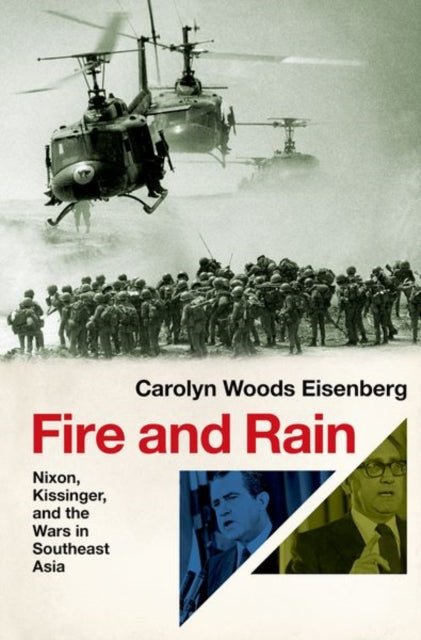
Carolyn WoodsEisenberg
Fire and Rain: Nixon, Kissinger, and the Wars in Southeast Asia
Fire and Rain: Nixon, Kissinger, and the Wars in Southeast Asia
💎 Earn 141 Points (£1.41) on this item.
YOU SAVE £1.68
- Condition: Brand new
- UK Delivery times: Usually arrives within 2 - 3 working days
- UK Shipping: Fee starts at £2.39. Subject to product weight & dimension
Bulk ordering. Want 15 or more copies? Get a personalised quote and bigger discounts. Learn more about bulk orders.
Couldn't load pickup availability
- More about Fire and Rain: Nixon, Kissinger, and the Wars in Southeast Asia
Fire and Rain is a book that tells the story of how national security decisions made by President Richard Nixon and Secretary of State Henry Kissinger affected the lives of people in Vietnam, Laos, and Cambodia. It uses declassified documents to re-interpret the Nixon Administration's relations with the Soviet Union and China and argues that the war was not a national security necessity.
Format: Hardback
Length: 624 pages
Publication date: 13 February 2023
Publisher: Oxford University Press Inc
This gripping account intertwines Nixon and Kissinger's pursuit of the war in Southeast Asia, their diplomacy with the Soviet Union and China, and the on-the-ground military events and US domestic reactions to the war conducted in Vietnam, Laos, and Cambodia. Fire and Rain is a compelling, meticulous narrative of how national security decisions made at the highest levels of government affect the lives of individuals at home and abroad. By drawing these connections, Carolyn Woods Eisenberg brings to life policy decisions about Vietnam, Laos, and Cambodia, conveying their significance to a new generation of readers. She breaks fresh ground in contextualizing Richard Nixon and Henry Kissinger's decisions within a wider institutional and societal framework. While recognizing the distinctive personalities and ideas of these two men, this study more broadly conveys the competing roles and impact of the professional military, the Congress, and a mobilized peace movement. Drawing upon a vast collection of declassified documents, Eisenberg presents an important re-interpretation of the Nixon Administration's relations with the Soviet Union and China vis-à-vis the war in Southeast Asia. She argues that in their desperate effort to overcome, or at least overshadow, their failure in Vietnam, Nixon and Kissinger made major concessions to both nations in the field of arms control, their response to the India-Pakistan war, and the diplomacy surrounding Taiwan—much of this secret. Despite policymakers' claims that the Vietnam War was a national security necessity that would demonstrate American strength to the communist superpowers and credibility to friendly governments, the historical record suggests a different reality. A half-century after the Paris Peace Conference marking the end of the war, it is clear that the costs of this conflict were far greater than anticipated. The war resulted in the deaths of millions of Vietnamese, Laotian, and Cambodian people, as well as the displacement of millions more. It also had a profound impact on the US military, leading to a decline in public support for the war and a shift in military strategy. The war also had a lasting impact on US foreign policy, leading to a more cautious approach to intervention and a greater emphasis on diplomacy and multilateralism. In conclusion, Fire and Rain is a powerful and important book that provides a detailed and nuanced account of the Vietnam War and its aftermath. By examining the decisions made by Nixon and Kissinger, as well as the broader institutional and societal context in which they operated, Eisenberg offers a fresh perspective on this complex and controversial period of American history. This book is essential reading for anyone interested in understanding the origins history and the ongoing consequences of the Vietnam War.
This gripping account intertwines Nixon and Kissinger's pursuit of the war in Southeast Asia, their diplomacy with the Soviet Union and China, and the on-the-ground military events and US domestic reactions to the war conducted in Vietnam, Laos, and Cambodia. Fire and Rain is a compelling, meticulous narrative of how national security decisions made at the highest levels of government affect the lives of individuals at home and abroad. By drawing these connections, Carolyn Woods Eisenberg brings to life policy decisions about Vietnam, Laos, and Cambodia, conveying their significance to a new generation of readers. She breaks fresh ground in contextualizing Richard Nixon and Henry Kissinger's decisions within a wider institutional and societal framework. While recognizing the distinctive personalities and ideas of these two men, this study more broadly conveys the competing roles and impact of the professional military, the Congress, and a mobilized peace movement. Drawing upon a vast collection of declassified documents, Eisenberg presents an important re-interpretation of the Nixon Administration's relations with the Soviet Union and China vis-à-vis the war in Southeast Asia. She argues that in their desperate effort to overcome, or at least overshadow, their failure in Vietnam, Nixon and Kissinger made major concessions to both nations in the field of arms, control, their response to the India-Pakistan war, and the diplomacy surrounding Taiwan—much of this secret. Despite policymakers' claims that the Vietnam War was a national security necessity that would demonstrate American strength to the communist superpowers and credibility to friendly governments, the historical record suggests a different reality. A half-century after the Paris Peace Conference marking the end of the war, it is clear that the costs of this conflict were far greater than anticipated. The war resulted in the deaths of millions of Vietnamese, Laotian, and Cambodian people, as well as the displacement of millions more. It also had a profound impact on the US military, leading to a decline in public support for the war and a shift in military strategy. The war also had a lasting impact on US foreign policy, leading to a more cautious approach to intervention and a greater emphasis on diplomacy and multilateralism. In conclusion, Fire and Rain is a powerful and important book that provides a detailed and nuanced account of the Vietnam War and its aftermath. By examining the decisions made by Nixon and Kissinger, as well as the broader institutional and societal context in which they operated, Eisenberg offers a fresh perspective on this complex and controversial period of American history. This book is essential reading for anyone interested in understanding the history and the ongoing consequences of the Vietnam War.
Weight: 970g
Dimension: 243 x 170 x 50 (mm)
ISBN-13: 9780197639061
This item can be found in:
UK and International shipping information
UK and International shipping information
UK Delivery and returns information:
- Delivery within 2 - 3 days when ordering in the UK.
- Shipping fee for UK customers from £2.39. Fully tracked shipping service available.
- Returns policy: Return within 30 days of receipt for full refund.
International deliveries:
Shulph Ink now ships to Australia, Belgium, Canada, France, Germany, Ireland, Italy, India, Luxembourg Saudi Arabia, Singapore, Spain, Netherlands, New Zealand, United Arab Emirates, United States of America.
- Delivery times: within 5 - 10 days for international orders.
- Shipping fee: charges vary for overseas orders. Only tracked services are available for most international orders. Some countries have untracked shipping options.
- Customs charges: If ordering to addresses outside the United Kingdom, you may or may not incur additional customs and duties fees during local delivery.