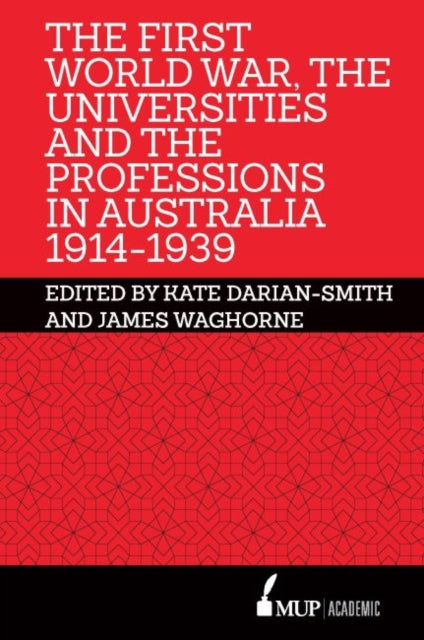
James Waghorne,Kate Darian-Smith
First World War, the Universities and the Professions in Australia 1914-1939
First World War, the Universities and the Professions in Australia 1914-1939
💎 Earn 238 Points (£2.38) on this item.
YOU SAVE £6.21
- Condition: Brand new
- UK Delivery times: Usually arrives within 2 - 3 working days
- UK Shipping: Fee starts at £2.39. Subject to product weight & dimension
Bulk ordering. Want 15 or more copies? Get a personalised quote and bigger discounts. Learn more about bulk orders.
Couldn't load pickup availability
- More about First World War, the Universities and the Professions in Australia 1914-1939
Australia's extraordinary contribution to World War I extended beyond its military forces to the expertise of its universities and professional men and women, transforming the professions and universities in the 1920s and 1930s. The First World War, the Universities and the Professions examines how the war transformed Australian society, with new jobs and training in economics, anthropology, and graphic art.
Format: Hardback
Length: 410 pages
Publication date: 19 February 2019
Publisher: Melbourne University Press
Australia's extraordinary contribution to World War I extended far beyond its military forces, encompassing the expertise of its universities and professional men and women. Scientists and engineers played a crucial role in the manufacture of munitions and the development of chemical weapons, while doctors provided vital care to soldiers in the trenches, treating their physical and psychological wounds. Public servants, lawyers, and translators were employed in the war bureaucracy, while artists and writers found innovative ways to convey the trauma of war. The graduates and staff of Australia's six universities in Sydney, Melbourne, Adelaide, Tasmania, Queensland, and Western Australia were deeply involved in this expansion of expertise.
But what happened to these individuals after the guns fell silent? How were the professions and universities transformed by the immediate and longer-term impacts of the war? The First World War, the Universities, and the Professions explores how the technical and conceptual advances that occurred during World War I transformed Australian society. It traces the evolving role of universities and their graduates in the 1920s and 1930s, the increasing government validation of research, the expansion of the public service, and the rise of modern professional associations and international networks. While the war contributed to greater specializations in traditional professions such as teaching or medicine, it also stimulated new jobs and training, whether in economics, anthropology, or graphic art.
This volume provides a fresh perspective on the interwar years, placing knowledge and expertise at the center of the Australian story. Its four sections—The Medical Sciences; Science and Technology; Humanities, Social Sciences, and Teaching; and The Arts: Design, Music, and Writing–offer a comprehensive overview of the period.
Australia's involvement in World War I was not limited to its military forces. The country's universities and professional men and women played a vital role in the war effort. Scientists and engineers oversaw the manufacture of munitions and the development of chemical weapons, ensuring that the Allied forces had the necessary resources to win the war. Doctors provided vital care to soldiers in the trenches, treating their physical and psychological wounds. Public servants, lawyers, and translators were employed in the war bureaucracy, ensuring that the war was conducted efficiently and effectively. Artists and writers found innovative ways to convey the trauma of war, capturing the horrors and sacrifices of the soldiers and civilians involved.
The graduates and staff of Australia's six universities in Sydney, Melbourne, Adelaide, Tasmania, Queensland, and Western Australia were deeply involved in this expansion of expertise. They worked tirelessly to develop new technologies, improve existing ones, and contribute to the war effort. Their contributions were recognized by the government, and many of them were awarded medals and honors for their service.
However, the war had a profound impact on the professions and universities. The medical sciences, for example, saw a significant increase in specialization, with new fields such as radiology and pathology emerging. Science and technology also advanced rapidly, with the development of new weapons and technologies such as the tank and the airplane. Humanities, social sciences, and teaching also saw significant changes, with the rise of new disciplines such as psychology and sociology.
The war also had a significant impact on the public service. Many public servants were recruited to work in the war bureaucracy, and they played a crucial role in managing the war effort. They were responsible for managing logistics, coordinating military operations, and providing support to the soldiers and civilians involved.
The rise of modern professional associations and international networks was also a result of the war. These organizations provided a platform for professionals to exchange ideas and collaborate on projects. They also helped to establish international standards and regulations, which were important for the development of the war effort.
However, the war also had its negative consequences. Many soldiers and civilians were killed or injured, and the war left a lasting impact on the country's economy and society. The war also led to the emergence of new social and political movements, such as the women's suffrage movement and the labor movement.
In conclusion, Australia's extraordinary contribution to World War I extended far beyond its military forces to the expertise of its universities and professional men and women. Scientists and engineers oversaw the manufacture of munitions and the development of chemical weapons, while doctors provided vital care to soldiers in the trenches. Public servants, lawyers, and translators were employed in the war bureaucracy, while artists and writers found innovative ways to convey the trauma of war. The graduates and staff of Australia's six universities in Sydney, Melbourne, Adelaide, Tasmania, Queensland, and Western Australia were deeply involved in this expansion of expertise. The war had a profound impact on the professions and universities, with new fields emerging, specialization increasing, and the public service playing a crucial role. However, the war also had its negative consequences, and it left a lasting impact on the country's economy and society.
Weight: 604g
Dimension: 158 x 217 x 24 (mm)
ISBN-13: 9780522872910
UK and International shipping information
UK and International shipping information
UK Delivery and returns information:
- Delivery within 2 - 3 days when ordering in the UK.
- Shipping fee for UK customers from £2.39. Fully tracked shipping service available.
- Returns policy: Return within 30 days of receipt for full refund.
International deliveries:
Shulph Ink now ships to Australia, Belgium, Canada, France, Germany, Ireland, Italy, India, Luxembourg Saudi Arabia, Singapore, Spain, Netherlands, New Zealand, United Arab Emirates, United States of America.
- Delivery times: within 5 - 10 days for international orders.
- Shipping fee: charges vary for overseas orders. Only tracked services are available for most international orders. Some countries have untracked shipping options.
- Customs charges: If ordering to addresses outside the United Kingdom, you may or may not incur additional customs and duties fees during local delivery.