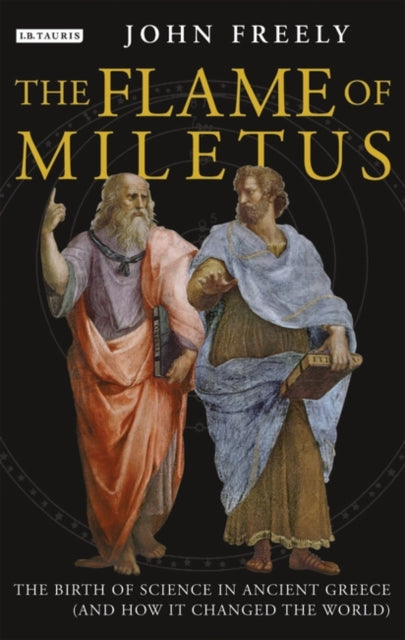
John Freely
Flame of Miletus: The Birth of Science in Ancient Greece (and How it Changed the World)
Flame of Miletus: The Birth of Science in Ancient Greece (and How it Changed the World)
💎 Earn 59 Points (£0.59) on this item.
We can order this item for you. Delivery usually takes about 4 to 6 weeks.
This item is not held in our immediate stock. We will order it for you after checkout.
Estimated delivery: About 4 to 6 weeks
YOU SAVE £1.19
- Condition: Brand new
- UK Delivery times: Usually arrives within 2 - 3 working days
- UK Shipping: Fee starts at £2.39. Subject to product weight & dimension
Bulk ordering. Want 15 or more copies? Get a personalised quote and bigger discounts. Learn more about bulk orders.
Couldn't load pickup availability
- More about Flame of Miletus: The Birth of Science in Ancient Greece (and How it Changed the World)
Miletus was a wealthy and significant town in ancient Greece, where Greek science and philosophy originated in the 6th century BC. This story spans from its early beginnings to its development in classical Athens and Hellenistic Alexandria, its diffusion to the wider world, and its preservation in Byzantium and its influence on the European Renaissance and our modern world.
Format: Paperback / softback
Length: 256 pages
Publication date: 12 June 2018
Publisher: Bloomsbury Publishing PLC
Miletus, a remarkable city in ancient Greece, holds a significant place in history. Situated on the Aegean coast of Asia Minor in the 6th century BC, it witnessed the birth of profound Greek scientific and philosophical traditions that would shape the world for generations to come. This captivating narrative spans the origins of Greek science, its flourishing in classical Athens and Hellenistic Alexandria, and its eventual dissemination to various regions. While most histories of Greek science conclude with the collapse of the Graeco-Roman world in late antiquity and the closure of classical pagan philosophy schools in A.D. 529, renowned historian John Freely takes us on a remarkable journey. He explores how the elements of Greek scientific and philosophical learning were embraced by the Islamic world, leading to the transmission of Graeco-Islamic science to western Europe. Furthermore, he delves into the preservation of Hellenic culture in Byzantium and its profound influence on the European renaissance and our modern world.
The city of Miletus, renowned for its wealth and importance, played a pivotal role in the development of Greek science and philosophy. Its strategic location on the Aegean coast facilitated trade and cultural exchange with neighboring civilizations, including the Egyptians, Babylonians, and Persians. This interaction led to the absorption of diverse ideas and knowledge, which contributed to the growth of Greek science and philosophy.
One of the most significant contributions of Miletus was its establishment of the Lyceum, a renowned center of learning that attracted scholars from all over the Mediterranean. The Lyceum was founded in the 5th century BC and was renowned for its extensive library and the teachings of its famous teachers, such as Aristotle and Plato. The Lyceum's emphasis on logical reasoning, empirical observation, and the pursuit of knowledge laid the foundation for the development of scientific methods and the study of the natural world.
Another notable achievement of Miletus was its contribution to mathematics. The city was home to the mathematician Pythagoras, who is credited with developing the Pythagorean theorem and the concept of the tetrad. Pythagoras' teachings influenced the development of mathematics in ancient Greece and beyond, and his ideas were later adopted by the Islamic world and transmitted to western Europe.
Miletus also played a significant role in the development of philosophy. The city was home to the philosopher Anaximander, who is considered one of the founders of Western philosophy. Anaximander's ideas about the origin of the universe and the nature of matter laid the foundation for the development of the scientific method and the study of the natural world.
In addition to its intellectual achievements, Miletus was also known for its cultural and artistic contributions. The city was home to the famous sculptor Polyclitus, who is renowned for his sculptures of the gods and heroes. Polyclitus' works were admired for their realism and detail, and his influence can be seen in the art of ancient Greece and beyond.
Miletus' contributions to science and philosophy continued to influence the world for centuries. The city's legacy was preserved and passed down through the centuries by the Byzantine Empire, which ruled over the region in the Middle Ages. The Byzantine Empire was known for its cultural and scientific achievements, and its influence can be seen in the development of medieval science and philosophy.
In conclusion, Miletus, a city on the Aegean coast of Asia Minor, played a crucial role in the development of Greek science and philosophy. Its establishment of the Lyceum, the teachings of Pythagoras and Anaximander, and its cultural and artistic contributions laid the foundation for the growth of scientific methods and the study of the natural world. Miletus' legacy continued to influence the world for centuries, and its contributions to science and philosophy are still celebrated today.
Weight: 334g
Dimension: 156 x 225 x 20 (mm)
ISBN-13: 9781788312455
UK and International shipping information
UK and International shipping information
UK Delivery and returns information:
- Delivery within 2 - 3 days when ordering in the UK.
- Shipping fee for UK customers from £2.39. Fully tracked shipping service available.
- Returns policy: Return within 30 days of receipt for full refund.
International deliveries:
Shulph Ink now ships to Australia, Belgium, Canada, France, Germany, Ireland, Italy, India, Luxembourg Saudi Arabia, Singapore, Spain, Netherlands, New Zealand, United Arab Emirates, United States of America.
- Delivery times: within 5 - 10 days for international orders.
- Shipping fee: charges vary for overseas orders. Only tracked services are available for most international orders. Some countries have untracked shipping options.
- Customs charges: If ordering to addresses outside the United Kingdom, you may or may not incur additional customs and duties fees during local delivery.