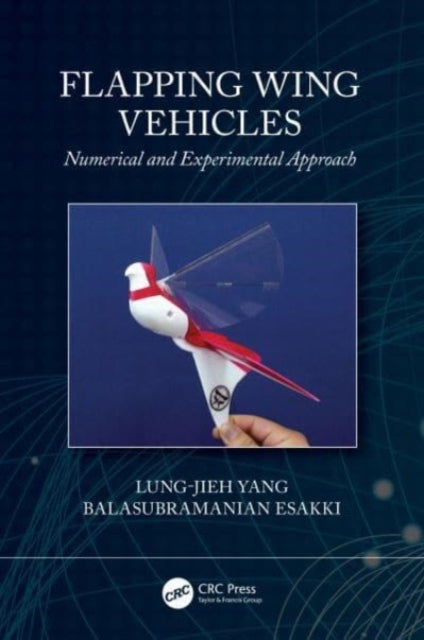
Lung-JiehYang,BalasubramanianEsakki
Flapping Wing Vehicles: Numerical and Experimental Approach
Flapping Wing Vehicles: Numerical and Experimental Approach
💎 Earn 349 Points (£3.49) on this item.
We can order this item for you. Delivery usually takes about 4 to 6 weeks.
This item is not held in our immediate stock. We will order it for you after checkout.
Estimated delivery: About 4 to 6 weeks
YOU SAVE £4.15
- Condition: Brand new
- UK Delivery times: Usually arrives within 2 - 3 working days
- UK Shipping: Fee starts at £3.89. Subject to product weight & dimension
Bulk ordering. Want 15 or more copies? Get a personalised quote and bigger discounts. Learn more about bulk orders.
Couldn't load pickup availability
- More about Flapping Wing Vehicles: Numerical and Experimental Approach
This book provides a comprehensive guide to designing and understanding flapping-wing vehicles, covering topics such as aerodynamics, materials, fabrication, manufacturing, CFD analysis, image-based control, and indigenous PCB design.
Format: Paperback / softback
Length: 405 pages
Publication date: 25 September 2023
Publisher: Taylor & Francis Ltd
This comprehensive guide covers every aspect of designing and understanding flapping-wing vehicles, from the fundamentals of aerodynamics to the practical considerations of fabrication, materials, and manufacturing. It delves into the realm of related engineering practices, such as CFD analysis of 3D wing profiles, image-based control of group of Ornithopters, and indigenous PCB design for achieving altitude and attitude control. Whether you're a student, researcher, or engineer, this guide provides you with the knowledge and tools you need to succeed in the field of flapping-wing vehicle design and operation.
A flapping-wing vehicle, also known as a bird or bat-like aircraft, is a type of aircraft that uses flapping wings to generate lift and propulsion. These vehicles are known for their ability to fly at low speeds and high angles of attack, making them ideal for a wide range of applications, including aerial surveillance, search and rescue operations, and recreational flying. In this comprehensive guide, we will explore the key aspects of flapping-wing vehicle design, including aerodynamics, wing design, propulsion systems, control systems, and materials. We will also discuss the practical considerations of fabrication, manufacturing, and testing, and provide examples of successful flapping-wing vehicle implementations.
Aerodynamics is a critical aspect of flapping-wing vehicle design, as it determines the lift and drag forces that act on the wings. The lift force is generated by the upward movement of the wings, which creates an airfoil that generates lift. The drag force is generated by the resistance to the air as the wings move through it. The aerodynamic principles that govern flapping-wing vehicle design include the Bernoulli's theorem, which states that an increase in the speed of a fluid occurs simultaneously with a decrease in pressure or the pressure gradient, and the Newton's second law of motion, which states that the force applied to an object is equal to the mass of the object multiplied by its acceleration.
Wing design is another critical aspect of flapping-wing vehicle design, as it determines the shape and size of the wings. The wings must be designed to generate enough lift to support the weight of the vehicle and to provide a stable platform for the propulsion system. The wing design must also be optimized to minimize drag and maximize lift. There are several types of wing designs used in flapping-wing vehicles, including symmetrical wings, asymmetrical wings, and hybrid wings. Symmetrical wings have a similar shape on both sides, while asymmetrical wings have a different shape on each side. Hybrid wings combine the benefits of symmetrical and asymmetrical wings to create a more efficient wing design.
Propulsion systems are also critical to flapping-wing vehicle design, as they provide the power to generate lift and propel the vehicle through the air. There are several types of propulsion systems used in flapping-wing vehicles, including pneumatic propulsion systems, electric propulsion systems, and hybrid propulsion systems. Pneumatic propulsion systems use compressed air to drive the wings, while electric propulsion systems use electric motors to drive the wings. Hybrid propulsion systems use a combination of pneumatic and electric propulsion systems to optimize the efficiency of the vehicle.
Control systems are essential to the operation of flapping-wing vehicles, as they allow the vehicle to maintain stability and control in the air. There are several types of control systems used in flapping-wing vehicles, including feedback control systems, active control systems, and passive control systems. Feedback control systems use sensors to measure the position and velocity of the vehicle and to adjust the wing angles and propulsion systems accordingly. Active control systems use actuators to adjust the wing angles and propulsion systems to control the vehicle's flight. Passive control systems use passive components, such as springs and dampers, to control the vehicle's flight.
Materials are also critical to flapping-wing vehicle design, as they determine the weight, strength, and durability of the vehicle. There are several types of materials used in flapping-wing vehicles, including carbon fiber, aluminum, and titanium. Carbon fiber is lightweight and strong, while aluminum is lightweight and durable. Titanium is strong and durable, but it is also expensive.
Fabrication is a critical process in flapping-wing vehicle design, as it involves the assembly of the vehicle's components. The fabrication process must be carefully planned and executed to ensure that the vehicle's components are assembled correctly and to minimize the risk of defects. There are several types of fabrication processes used in flapping-wing vehicles, including additive manufacturing, subtractive manufacturing, and hybrid manufacturing. Additive manufacturing involves the layering of materials to create the vehicle's components, while subtractive manufacturing involves the removal of material to create the vehicle's components. Hybrid manufacturing involves a combination of additive and subtractive manufacturing processes.
Manufacturing is a critical process in flapping-wing vehicle design, as it involves the production of the vehicle's components. The manufacturing process must be carefully planned and executed to ensure that the vehicle's components are produced correctly and to minimize the risk of defects. There are several types of manufacturing processes used in flapping-wing vehicles, including injection molding, extrusion, and 3D printing. Injection molding involves the injection of molten material into a mold to create the vehicle's components, while extrusion involves the extrusion of molten material through a die to create the vehicle's components. 3D printing involves the layering of materials to create the vehicle's components.
Testing is a critical process in flapping-wing vehicle design, as it allows the vehicle's designers and engineers to evaluate the performance of the vehicle and to identify any defects or issues. There are several types of testing used in flapping-wing vehicles, including wind tunnel testing, flight testing, and ground testing. Wind tunnel testing involves testing the vehicle in a wind tunnel to measure the lift and drag forces that act on the wings, while flight testing involves testing the vehicle in the air to measure the vehicle's performance and stability. Ground testing involves testing the vehicle on the ground to measure the vehicle's performance and stability.
In conclusion, flapping-wing vehicle design is a complex and challenging field that requires a deep understanding of aerodynamics, wing design, propulsion systems, control systems, and materials. This comprehensive guide provides you with the knowledge and tools you need to succeed in the field of flapping-wing vehicle design and operation. Whether you're a student, researcher, or engineer, this guide will help you to develop the skills and knowledge necessary to design and implement successful flapping-wing vehicle systems.
Weight: 453g
Dimension: 234 x 156 (mm)
ISBN-13: 9781032074139
UK and International shipping information
UK and International shipping information
We deliver throughout the United Kingdom and to 128 countries and territories worldwide, including the United States, Australia, Canada, Germany, Spain and France.