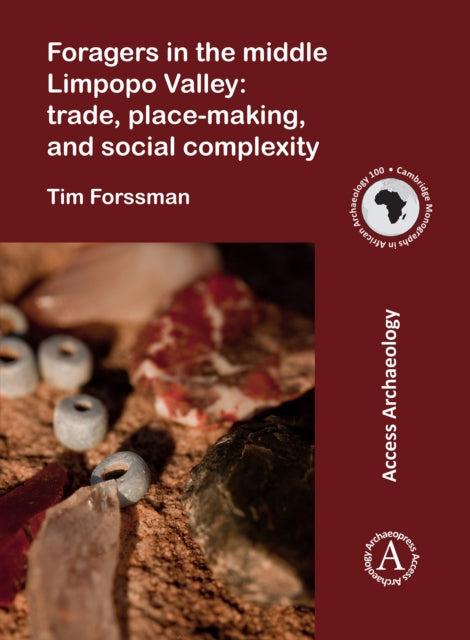
Tim Forssman
Foragers in the middle Limpopo Valley: Trade, Place-making, and Social Complexity
Foragers in the middle Limpopo Valley: Trade, Place-making, and Social Complexity
💎 Earn 165 Points (£1.65) on this item.
YOU SAVE £1.96
- Condition: Brand new
- UK Delivery times: Usually arrives within 2 - 3 working days
- UK Shipping: Fee starts at £3.89. Subject to product weight & dimension
Bulk ordering. Want 15 or more copies? Get a personalised quote and bigger discounts. Learn more about bulk orders.
Couldn't load pickup availability
- More about Foragers in the middle Limpopo Valley: Trade, Place-making, and Social Complexity
Between the last centuries BC and the early second millennium AD, central southern Africa experienced significant social change, with the establishment of state-level society at Mapungubwe, c. 1220 AD in the middle Limpopo Valley. Local forager communities also saw associated shifts, but their involvement in socio-political developments has been ignored. From the early first millennium AD, foragers themselves transformed their society, with changes in settlement patterns, craft production, trade relations, social interactions, wealth accumulation, and status. These changes occurred unevenly across the landscape, suggesting that valley foragers developed social complexity.
Format: Paperback / softback
Length: 140 pages
Publication date: 24 September 2020
Publisher: Archaeopress
Between the last centuries BC and the early second millennium AD, central southern Africa experienced a significant period of social transformation. Numerous landscapes within this region witnessed a multitude of socio-political developments that ultimately resulted in the establishment of state-level societies at Mapungubwe, c. 1220 AD, in the middle Limpopo Valley. These diverse landscapes were interconnected through various forms of circuitry, including social, political, economic, and topographic networks. While the focus of most discussions often revolves around farmer societies, it is important to acknowledge that local forager communities also experienced associated shifts. These forager communities were present prior to the arrival of farmers and played a significant role in local systems that led to the emergence of complex societies. Despite the extensive research conducted in the valley, the involvement of foragers in socio-political developments has been largely ignored, with a predominant emphasis on farmer sequences. However, from the early first millennium AD, foragers themselves underwent a transformative process. Notable changes were observed in settlement patterns, craft production, trade relations, social interactions, wealth accumulation, and status. Furthermore, these changes occurred unevenly across the landscape, with different forager sites exhibiting distinct responses to shifting social networks. When considered collectively, the spectrum of change suggests that valley foragers developed social complexity.
The establishment of state-level societies at Mapungubwe, c. 1220 AD, marked a pivotal moment in the history of central southern Africa. This period witnessed the emergence of complex social structures and the development of advanced technologies, such as metallurgy and pottery. The Limpopo Valley, in particular, became a hub of cultural and economic activity, with trade networks extending far beyond its borders. The forager communities that inhabited this region played a significant role in these developments, contributing their knowledge and skills to the growing civilization.
One of the most notable changes observed during this time was the development of complex social hierarchies. At Mapungubwe, for example, a hierarchical society emerged, with a king at the top and a series of nobles, priests, and artisans below. This social structure was based on the accumulation of wealth and power, and it facilitated the coordination of resources and the implementation of complex projects.
Another significant development was the emergence of specialized occupations. At Mapungubwe, foragers were involved in a wide range of activities, including agriculture, hunting, gathering, and craft production. They developed advanced techniques for farming, such as irrigation and crop rotation, which allowed them to produce more food than ever before. They also became skilled hunters and gatherers, able to procure a variety of resources that were essential for their survival.
In addition to their economic and social contributions, forager communities also played a role in the development of cultural practices and traditions. They were known for their artistic skills, particularly in the production of sculptures and pottery. They also developed complex religious beliefs and practices, which were often intertwined with their daily lives.
Despite the many achievements of forager communities during this period, their involvement in socio-political developments has often been overlooked. This is perhaps due to the dominance of farmer societies in the historical narrative, but it is important to recognize the contributions of forager communities to the growth and development of central southern Africa.
In conclusion, the period between the last centuries BC and the early second millennium AD was a time of immense social change in central southern Africa. Numerous landscapes within this region witnessed a multitude of socio-political developments that ultimately resulted in the establishment of state-level societies at Mapungubwe, c. 1220 AD. The Limpopo Valley, in particular, became a hub of cultural and economic activity, with trade networks extending far beyond its borders. The forager communities that inhabited this region played a significant role in these developments, contributing their knowledge and skills to the growing civilization. Despite the many achievements of forager communities during this period, their involvement in socio-political developments has often been overlooked. It is important to recognize the contributions of forager communities to the growth and development of central southern Africa and to continue to explore their history and culture in the future.
Weight: 480g
Dimension: 203 x 274 x 12 (mm)
ISBN-13: 9781789696851
UK and International shipping information
UK and International shipping information
We deliver throughout the United Kingdom and to 128 countries and territories worldwide, including the United States, Australia, Canada, Germany, Spain and France.