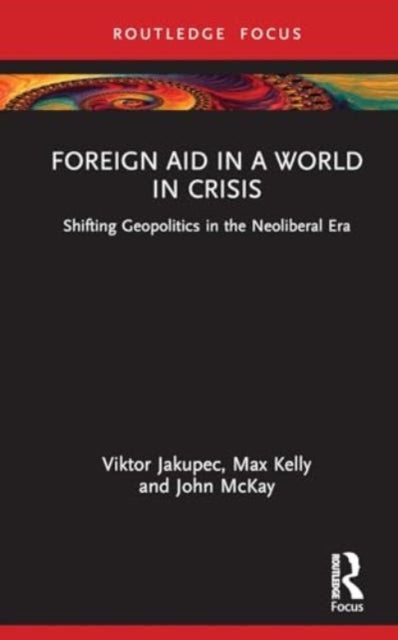
Viktor Jakupec,Max Kelly,John McKay
Foreign Aid in a World in Crisis: Shifting Geopolitics in the Neoliberal Era
Foreign Aid in a World in Crisis: Shifting Geopolitics in the Neoliberal Era
💎 Earn 320 Points (£3.20) on this item.
YOU SAVE £3.81
- Condition: Brand new
- UK Delivery times: Usually arrives within 2 - 3 working days
- UK Shipping: Fee starts at £2.39. Subject to product weight & dimension
Bulk ordering. Want 15 or more copies? Get a personalised quote and bigger discounts. Learn more about bulk orders.
Couldn't load pickup availability
- More about Foreign Aid in a World in Crisis: Shifting Geopolitics in the Neoliberal Era
The geopoliticization of foreign aid has shifted in recent years due to global crises, with donors framing aid as a geopolitical instrument to impose their values and norms. This book investigates this weaponization of foreign aid and concludes that the world is at a tipping point towards a new socio-political world order.
Format: Hardback
Length: 112 pages
Publication date: 29 February 2024
Publisher: Taylor & Francis Ltd
Foreign aid has long been seen as a tool to promote development and advance the interests of both recipient countries and donor nations. However, in recent years, the geopolitics of foreign aid has become increasingly prominent, as global crises such as climate change, conflict, COVID-19, economic crisis, energy shortages, and migration have reshaped the international landscape. This book investigates the evolving relationship between foreign aid and geopolitics, examining how donors have increasingly used aid as a geopolitical instrument to impose their values and norms on recipient countries.
The shift towards framing aid as a geopolitical instrument has been driven by a range of factors, including the increasing importance of power and politics in international relations, the rise of new actors on the global stage, and the need to address complex global challenges such as poverty, inequality, and climate change. Donors have increasingly used aid as a means to influence political outcomes, promote their own interests, and undermine rival powers.
One of the key ways in which donors have weaponized foreign aid is through the use of conditionality. Donors often attach conditions to their aid, such as political reforms, economic liberalization, and adherence to specific policies or ideologies. These conditions can be used to leverage recipient countries into adopting policies that align with the donor's interests, but they can also create resentment and undermine the legitimacy of the aid program.
Another way in which donors have weaponized foreign aid is through the use of selective aid distribution. Donors may prioritize certain countries or regions over others based on their geopolitical interests, such as access to natural resources or strategic locations. This can create tensions and conflicts between recipient countries and undermine the effectiveness of aid programs, as resources are allocated based on political rather than humanitarian considerations.
The weaponization of foreign aid has significant implications for both recipient countries and donor nations. For recipient countries, the pressure to adopt policies that align with donor interests can undermine their sovereignty and independence, and can lead to social and economic instability. For donor nations, the use of foreign aid as a geopolitical instrument can undermine their reputation and legitimacy, and can lead to backlash and criticism from other countries.
The book argues that the world is at a tipping point towards a new socio-political world order, where the power dynamics within the aid sector are undergoing a significant transformation. Donors are increasingly asserting their influence over recipient countries, and the role of the United Nations and other international organizations is being questioned. The book calls for a more nuanced and equitable approach to foreign aid, where aid is provided based on humanitarian needs and the principles of sustainable development, rather than as a tool to promote donor interests.
In conclusion, this book provides an in-depth analysis of the geopolitics of foreign aid in recent years, examining how donors have increasingly used aid as a geopolitical instrument to impose their values and norms on recipient countries. The shift towards framing aid as a geopolitical instrument has significant implications for both recipient countries and donor nations, and calls for a more nuanced and equitable approach to foreign aid. By asking important questions about the power dynamics at play within the aid sector, this book will be an important read for researchers across development studies, political science, international relations, and global affairs.
Dimension: 216 x 138 (mm)
ISBN-13: 9781032530536
This item can be found in:
UK and International shipping information
UK and International shipping information
UK Delivery and returns information:
- Delivery within 2 - 3 days when ordering in the UK.
- Shipping fee for UK customers from £2.39. Fully tracked shipping service available.
- Returns policy: Return within 30 days of receipt for full refund.
International deliveries:
Shulph Ink now ships to Australia, Belgium, Canada, France, Germany, Ireland, Italy, India, Luxembourg Saudi Arabia, Singapore, Spain, Netherlands, New Zealand, United Arab Emirates, United States of America.
- Delivery times: within 5 - 10 days for international orders.
- Shipping fee: charges vary for overseas orders. Only tracked services are available for most international orders. Some countries have untracked shipping options.
- Customs charges: If ordering to addresses outside the United Kingdom, you may or may not incur additional customs and duties fees during local delivery.