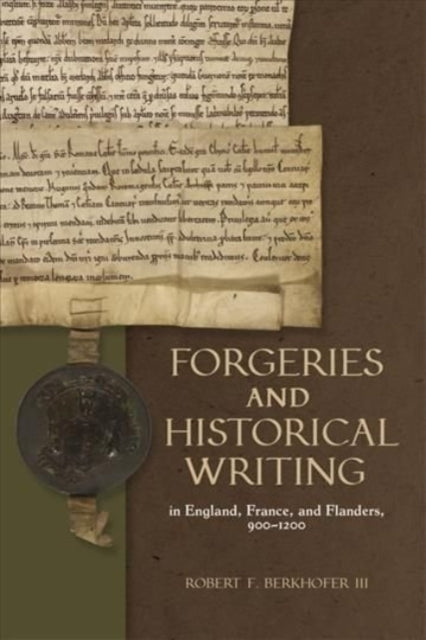
Robert F.Berkhofer III
Forgeries and Historical Writing in England, France, and Flanders, 900-1200
Forgeries and Historical Writing in England, France, and Flanders, 900-1200
💎 Earn 480 Points (£4.80) on this item.
- Condition: Brand new
- UK Delivery times: Usually arrives within 2 - 3 working days
- UK Shipping: Fee starts at £2.39. Subject to product weight & dimension
Bulk ordering. Want 15 or more copies? Get a personalised quote and bigger discounts. Learn more about bulk orders.
Couldn't load pickup availability
- More about Forgeries and Historical Writing in England, France, and Flanders, 900-1200
A close analysis of forgeries and historical writings at Saint Peter's, Ghent; Saint-Denis near Paris; and Christ Church, Canterbury, reveals why medieval people often rewrote their pasts. Monks rewrote their archives to claim lands and privileges, reform their community, and reshape their relationship with lay and ecclesiastical authorities. Forgeries embedded in historical narratives show what their composers believed should have happened, offering valuable access to why medieval people rewrote their pasts.
Format: Hardback
Length: 348 pages
Publication date: 19 April 2022
Publisher: Boydell & Brewer Ltd
Rewriting history was a common practice during the medieval period, particularly among monks who sought to enhance their position and influence within their communities. Monks often rewrote their archives, including charters, letters, and narratives, to create new usable pasts for claiming lands and privileges or to reform their communities and reshape their relationships with lay and ecclesiastical authorities. These creative rewritings, known as forgeries, were not considered wrong during this time, as lying was not universally condemned.
Despite being forgeries, these imaginative rewritings can provide valuable evidence of medieval mentalities. They reveal what their composers believed should have happened and thus offer insight into why medieval people rewrote their pasts.
This book offers a close analysis of three monastic archives from the eleventh century: Saint Peter's, Ghent; Saint-Denis near Paris; and Christ Church, Canterbury. These foci provide the basis for contextualizing key shifts in documentary culture in the twelfth century across Europe. The book argues that connections between monastic forgeries and historical writing in the tenth through twelfth centuries reveal attempts to reshape reality. Both forgeries and historical writing sought to rewrite the past and thereby promote the interests of monks in their present or future.
The use of forgeries in medieval history has been a controversial topic among scholars. While some argue that forgeries can provide valuable evidence of historical events and cultural practices, others argue that they can distort our understanding of the past. One of the most significant uses of forgeries in medieval history is in the realm of land ownership and inheritance. Monks and other religious institutions often sought to claim land and property by rewriting historical records to support their claims. For example, in the eleventh century, the Abbey of Saint-Denis near Paris was able to acquire land and property through the use of forgeries. The abbey claimed that it had been granted land by Charlemagne, the king of the Franks, in the ninth century, even though there is no historical evidence to support this claim.
Another use of forgeries in medieval history is in the realm of religious reform. Monks and other religious institutions often sought to reform their communities and reshape their relationships with lay and ecclesiastical authorities through the use of forgeries. For example, in the twelfth century, the Cistercian order sought to reform its community and promote its values through the use of forgeries. The order claimed that it had been founded by Saint Bernard of Clairvaux, the founder of the Cistercian order, even though there is no historical evidence to support this claim.
Despite the controversy surrounding the use of forgeries in medieval history, they can still be valuable sources of information. By studying forgeries, scholars can gain insight into the beliefs and practices of medieval people and the social and cultural context in which they lived. Forgeries can also provide valuable evidence of historical events and cultural practices that may have been overlooked or forgotten by traditional historical sources.
In conclusion, the use of forgeries in medieval history was a common practice among monks and other religious institutions who sought to enhance their position and influence within their communities. While forgeries can be controversial, they can still provide valuable evidence of historical events and cultural practices. By studying forgeries, scholars can gain insight into the beliefs and practices of medieval people and the social and cultural context in which they lived.
Dimension: 234 x 156 (mm)
ISBN-13: 9781783276912
This item can be found in:
UK and International shipping information
UK and International shipping information
UK Delivery and returns information:
- Delivery within 2 - 3 days when ordering in the UK.
- Shipping fee for UK customers from £2.39. Fully tracked shipping service available.
- Returns policy: Return within 30 days of receipt for full refund.
International deliveries:
Shulph Ink now ships to Australia, Belgium, Canada, France, Germany, Ireland, Italy, India, Luxembourg Saudi Arabia, Singapore, Spain, Netherlands, New Zealand, United Arab Emirates, United States of America.
- Delivery times: within 5 - 10 days for international orders.
- Shipping fee: charges vary for overseas orders. Only tracked services are available for most international orders. Some countries have untracked shipping options.
- Customs charges: If ordering to addresses outside the United Kingdom, you may or may not incur additional customs and duties fees during local delivery.