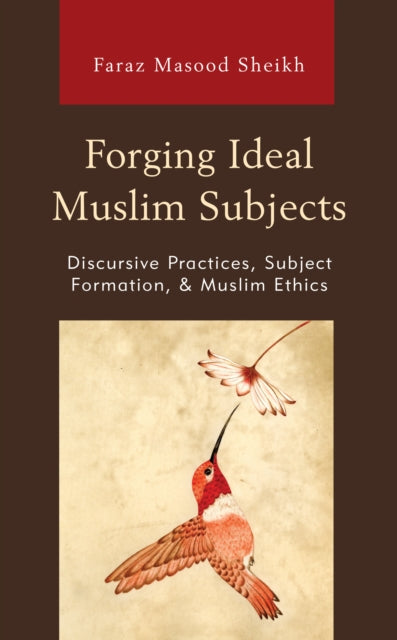
Faraz Masood Sheikh
Forging Ideal Muslim Subjects: Discursive Practices, Subject Formation, & Muslim Ethics
Forging Ideal Muslim Subjects: Discursive Practices, Subject Formation, & Muslim Ethics
We can order this item for you. Delivery usually takes about 4 to 6 weeks.
This item is not held in our immediate stock. We will order it for you after checkout.
Estimated delivery: About 4 to 6 weeks
- Condition: Brand new
- UK Delivery times: Usually arrives within 2 - 3 working days
- UK Shipping: Fee starts at £3.89. Subject to product weight & dimension
Bulk ordering. Want 15 or more copies? Get a personalised quote and bigger discounts. Learn more about bulk orders.
Couldn't load pickup availability
- More about Forging Ideal Muslim Subjects: Discursive Practices, Subject Formation, & Muslim Ethics
This book explores the ideal Muslim subjectivity through the accounts of al-Harith al-Muhasibi and Said Nursi, emphasizing the importance of discursive practices in religious and moral self-production. It discusses the range of psychic states and ethical relations necessary for living an authentically Muslim life and draws on Foucault's insights to examine familiar Muslim discourses.
Format: Paperback / softback
Length: 198 pages
Publication date: 15 May 2022
Publisher: Lexington Books
This book offers two significant perspectives on the ideal Muslim subjectivity, one from the 9th-century moral pedagogue al-Harith al-Muhasibi (d. 857) and the other from the 20th-century Kurdish Quran scholar Said Nursi (d. 1960). It reconstructs the accounts of ideal Muslim consciousness offered by Muhasibi and Nursi, analyzing the discursive practices involved in their formation and expression. The book explores the diverse range of psychic states and ethical relations considered essential for living an authentically Muslim life. It emphasizes the significance of discursive practices in the religious and moral self-production of Muslims. Drawing on Foucault's insights into ethics and practices of self-care, the author examines familiar Muslim discourses in new ways, enriching contemporary conversations about identity, individuality, community, authority, moral agency, and virtue in the fields of religious studies, Islamic studies, and Muslim ethics. The book deepens our understanding of the fluidity and fragility of both the more familiar, obligation-centered ethics in Islamic thought and the less familiar, belief-centered modes of religio-moral being.
Introduction:
The concept of ideal Muslim subjectivity has been a subject of scholarly inquiry for centuries. While Islamic thought has traditionally emphasized the importance of obedience and adherence to religious laws, there has also been a recognition of the need for individuals to cultivate their own spiritual and moral development. This book seeks to explore the various forms that a religiously informed, ethical Muslim life can take.
Al-Harith al-Muhasibi's Perspective:
Al-Harith al-Muhasibi, a 9th-century moral pedagogue, offers a comprehensive account of ideal Muslim consciousness in his work "The Book of the Ideal Muslim." According to Muhasibi, the ideal Muslim is characterized by a profound sense of self-awareness and self-discipline. He emphasizes the importance of cultivating a virtuous character, which includes traits such as honesty, compassion, and self-control. Muhasibi also stresses the importance of seeking knowledge and understanding, both of the Quran and of other religious texts, in order to develop a deeper understanding of God and his teachings.
Said Nursi's Perspective:
Said Nursi, a 20th-century Kurdish Quran scholar, provides a unique perspective on ideal Muslim subjectivity in his work "The Message of the Quran." Nursi emphasizes the importance of living a life that is in harmony with the teachings of the Quran and the Prophet Muhammad. He believes that the ideal Muslim should strive to cultivate a deep love and reverence for God, as well as a sense of responsibility towards his or her fellow human beings. Nursi also emphasizes the importance of living a life of simplicity and humility, avoiding extravagance and materialism.
Reconstructing Ideal Muslim Consciousness:
The book reconstructs the accounts of ideal Muslim consciousness offered by Muhasibi and Nursi, analyzing the discursive practices involved in their formation and expression. It explores the diverse range of psychic states and ethical relations that Muhasibi and Nursi consider critical for living an authentically Muslim life. The book highlights the importance of discursive practices in Muslim religious and moral self-production.
Psychic States and Ethical Relations:
Muhasibi and Nursi consider a wide range of psychic states and ethical relations to be essential for living an authentically Muslim life. These include the states of spiritual awakening, self-realization, and mystical union with God. They also emphasize the importance of ethical relations with other human beings, including love, respect, and compassion. The book discusses the challenges and difficulties that individuals face in cultivating these psychic states and ethical relations, and offers insights into how to overcome them.
Discursive Practices:
Discursive practices play a crucial role in the formation and expression of ideal Muslim consciousness. The book discusses the importance of engaging in meaningful dialogue and discourse with others, both within the Muslim community and in broader society. It highlights the role of education and learning in developing a deeper understanding of Islamic teachings and values. The book also examines the role of media and technology in shaping Muslim discourse and identity.
Conclusion:
In conclusion, this book presents two important accounts of ideal Muslim subjectivity, one from the 9th-century moral pedagogue al-Harith al-Muhasibi and the other from the 20th-century Kurdish Quran scholar Said Nursi. It reconstructs their accounts of ideal Muslim consciousness, analyzes the discursive practices involved in their formation and expression, and explores the diverse range of psychic states and ethical relations that they consider critical for living an authentically Muslim life. The book emphasizes the importance of discursive practices in Muslim religious and moral self-production and offers insights into how individuals can cultivate a deeper understanding of Islamic teachings and values.
Dimension: 229 x 152 (mm)
ISBN-13: 9781793620149
UK and International shipping information
UK and International shipping information
We deliver throughout the United Kingdom and to 128 countries and territories worldwide, including the United States, Australia, Canada, Germany, Spain and France.