Max Oidtmann
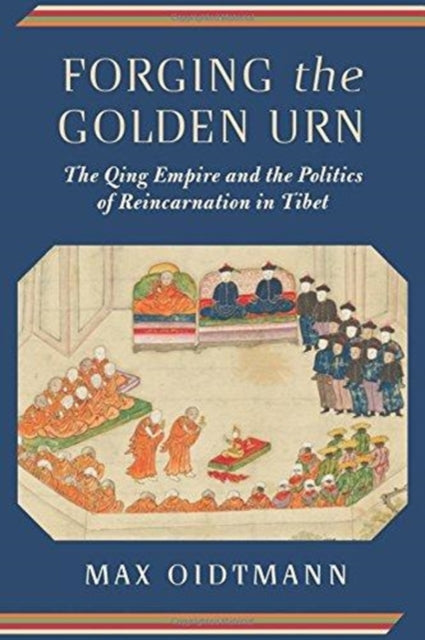
Forging the Golden Urn: The Qing Empire and the Politics of Reincarnation in Tibet
Forging the Golden Urn: The Qing Empire and the Politics of Reincarnation in Tibet
💎 Earn 250 Points (£2.50) on this item.
YOU SAVE £11.83
- Condition: Brand new
- UK Delivery times: Usually arrives within 2 - 3 working days
- UK Shipping: Fee starts at £2.39. Subject to product weight & dimension
Bulk ordering. Want 15 or more copies? Get a personalised quote and bigger discounts. Learn more about bulk orders.
Couldn't load pickup availability
- More about Forging the Golden Urn: The Qing Empire and the Politics of Reincarnation in Tibet
In 1995, the People's Republic of China resurrected a Qing-era law mandating that the reincarnations of prominent Tibetan Buddhist monks be identified by drawing lots from a golden urn. The Chinese Communist Party hoped to limit the ability of the Dalai Lama and the Tibetan government-in-exile to independently identify reincarnations, elevating a long-forgotten ceremony into a controversial symbol of Chinese sovereignty in Tibet.
Format: Hardback
Length: 352 pages
Publication date: 31 July 2018
Publisher: Columbia University Press
The People's Republic of China revived a Qing-era law in 1995, mandating the identification of reincarnations of prominent Tibetan Buddhist monks through a golden urn drawing. The Chinese Communist Party aimed to restrict the Dalai Lama and the Tibetan government-in-exile's ability to independently identify reincarnations, elevating a long-forgotten ceremony into a contentious symbol of Chinese sovereignty in Tibet.
In his book, Forging the Golden Urn, Max Oidtmann delves into the multilingual realm of the Qing empire, exploring the origins of the golden urn tradition. He seeks to understand the intricate relationship between the Qing state and its most influential partner in Inner Asia, the Geluk school of Tibetan Buddhism. Why did the Qianlong emperor introduce the golden urn lottery in 1792? What powers did the Qing state possess to influence Tibetan religious and political traditions? How did this law impact Qing rulers, their advisors, and Tibetan Buddhists?
Oidtmann employs a combination of Manchu-language archives from the empire's colonial bureaucracy and chronicles of Tibetan elites to trace the transformation of a Chinese bureaucratic technology—a lottery for assigning administrative posts—into a ritual for identifying and authenticating reincarnations in the Tibetan and Mongolian regions of the Qing empire.
Through his meticulous research, Forging the Golden Urn sheds fresh light on how the empire's frontier officers navigated issues of sovereignty, faith, and law. It also unveils the significant role played by Tibetan elites in the creation of new religious traditions within the context of Qing rule.
Weight: 696g
Dimension: 163 x 236 x 24 (mm)
ISBN-13: 9780231184069
This item can be found in:
UK and International shipping information
UK and International shipping information
UK Delivery and returns information:
- Delivery within 2 - 3 days when ordering in the UK.
- Shipping fee for UK customers from £2.39. Fully tracked shipping service available.
- Returns policy: Return within 30 days of receipt for full refund.
International deliveries:
Shulph Ink now ships to Australia, Belgium, Canada, France, Germany, Ireland, Italy, India, Luxembourg Saudi Arabia, Singapore, Spain, Netherlands, New Zealand, United Arab Emirates, United States of America.
- Delivery times: within 5 - 10 days for international orders.
- Shipping fee: charges vary for overseas orders. Only tracked services are available for most international orders. Some countries have untracked shipping options.
- Customs charges: If ordering to addresses outside the United Kingdom, you may or may not incur additional customs and duties fees during local delivery.