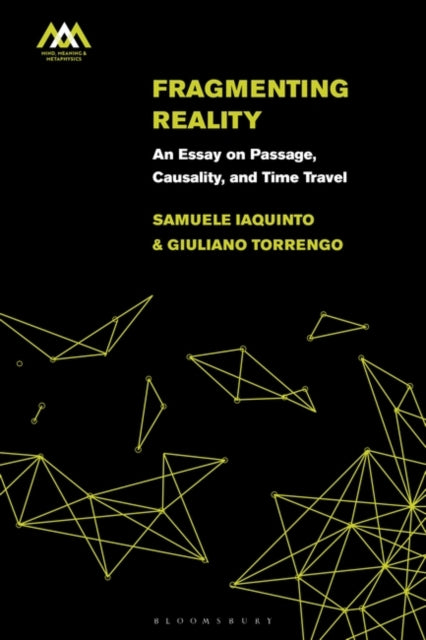
Samuele Iaquinto,Giuliano Torrengo
Fragmenting Reality: An Essay on Passage, Causality and Time Travel
Fragmenting Reality: An Essay on Passage, Causality and Time Travel
💎 Earn 504 Points (£5.04) on this item.
We can order this item for you. Delivery usually takes about 4 to 6 weeks.
This item is not held in our immediate stock. We will order it for you after checkout.
Estimated delivery: About 4 to 6 weeks
- Condition: Brand new
- UK Delivery times: Usually arrives within 2 - 3 working days
- UK Shipping: Fee starts at £2.39. Subject to product weight & dimension
Bulk ordering. Want 15 or more copies? Get a personalised quote and bigger discounts. Learn more about bulk orders.
Couldn't load pickup availability
- More about Fragmenting Reality: An Essay on Passage, Causality and Time Travel
Samuele Iaquinto and Giuliano Torrengo present a novel theory of the passage of time, arguing that it vindicates the inherent dynamism of reality and offers a radically new understanding of time.
Format: Hardback
Length: 208 pages
Publication date: 03 November 2022
Publisher: Bloomsbury Publishing PLC
The burgeoning fascination with fragmentalism is a captivating and transformative trend that is reshaping the forefront of the philosophical discourse on time. In a comprehensive exploration of this perspective, Samuele Iaquinto and Giuliano Torrengo present a novel theory of time's passage, contending that it emerges as the most efficacious means of defending the inherent dynamism of reality. Through their comprehensive application of fragmentalism to a diverse range of metaphysical domains, including the open future, causation, the A-theoretic interpretation of special relativity, and time travel, Iaquinto and Torrengo unveil a profound and groundbreaking understanding of time. This novel perspective holds the promise of a paradigm shift, offering a fresh and revolutionary perspective on the nature of time and its implications for our understanding of the universe.
The concept of fragmentalism is rooted in the recognition that time is not a homogeneous and continuous entity, but rather a collection of distinct fragments or moments. According to Iaquinto and Torrengo, each fragment possesses its own unique properties and characteristics, and the interactions between these fragments give rise to the perception of time as a flowing and dynamic process. This perspective challenges the traditional notion of time as a linear progression, suggesting that time is more akin to a patchwork of moments that are interconnected and interdependent.
One of the key insights of fragmentalism is its ability to explain the open future. Traditional accounts of the open future often rely on the concept of indeterminacy, which suggests that the future is inherently uncertain and that our choices and actions do not necessarily determine its outcome. However, fragmentalism offers a different perspective by positing that the open future is not a result of indeterminacy but rather of the inherent dynamism of reality. Iaquinto and Torrengo argue that the future is not predetermined but rather emerges from the complex interplay of past events, present circumstances, and future possibilities. This view allows for a more nuanced understanding of the open future, as it acknowledges the role of human agency and decision-making while also recognizing the inherent unpredictability of the universe.
Another important aspect of fragmentalism is its application to causation. Traditional accounts of causation typically rely on the concept of necessity, which asserts that every event has a necessary cause. However, fragmentalism challenges this notion by proposing that causation is not a linear process but rather a web of interconnections and dependencies. Iaquinto and Torrengo argue that every event is the result of a complex network of causal factors, including both physical and mental factors, and that the outcome of an event is not predetermined but rather emerges from the interplay of these factors. This view provides a more flexible and nuanced understanding of causation, as it recognizes the role of chance and contingency in the process of cause and effect.
In addition to its applications to the open future and causation, fragmentalism also offers a novel interpretation of special relativity and time travel. Traditional accounts of these phenomena often rely on the concept of spacetime, which suggests that time and space are intertwined and that the passage of time is a result of the movement of objects through spacetime. However, fragmentalism challenges this notion by proposing that time and space are distinct entities that are not interconnected in a linear manner. Iaquinto and Torrengo argue that time is a collection of moments that are independent of the physical world, and that the passage of time is a result of the accumulation of these moments. This view provides a more coherent and consistent understanding of special relativity and time travel, as it avoids the paradoxes and inconsistencies that are often associated with these phenomena.
Overall, the growing interest in fragmentalism is a testament to the power of philosophical inquiry and the potential for new and innovative perspectives to transform our understanding of the world. Iaquinto and Torrengo's novel theory of time's passage offers a compelling and comprehensive interpretation of this perspective, and its applications to a range of metaphysical topics provide a rich and nuanced understanding of the nature of time and its implications for our understanding of reality. As we continue to explore the depths of this philosophical trend, we can expect to see further advancements and breakthroughs that will shape the future of our understanding of time and its role in the universe.
Dimension: 234 x 156 (mm)
ISBN-13: 9781350235328
This item can be found in:
UK and International shipping information
UK and International shipping information
UK Delivery and returns information:
- Delivery within 2 - 3 days when ordering in the UK.
- Shipping fee for UK customers from £2.39. Fully tracked shipping service available.
- Returns policy: Return within 30 days of receipt for full refund.
International deliveries:
Shulph Ink now ships to Australia, Belgium, Canada, France, Germany, Ireland, Italy, India, Luxembourg Saudi Arabia, Singapore, Spain, Netherlands, New Zealand, United Arab Emirates, United States of America.
- Delivery times: within 5 - 10 days for international orders.
- Shipping fee: charges vary for overseas orders. Only tracked services are available for most international orders. Some countries have untracked shipping options.
- Customs charges: If ordering to addresses outside the United Kingdom, you may or may not incur additional customs and duties fees during local delivery.