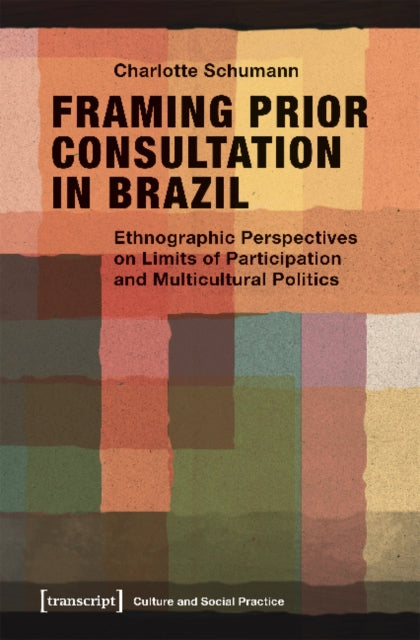
Charlotte Schumann
Framing Prior Consultation in Brazil - Ethnographic Perspectives on Limits of Participation and Multicultural Politics
Framing Prior Consultation in Brazil - Ethnographic Perspectives on Limits of Participation and Multicultural Politics
💎 Earn 206 Points (£2.06) on this item.
We can order this item for you. Delivery usually takes about 4 to 6 weeks.
This item is not held in our immediate stock. We will order it for you after checkout.
Estimated delivery: About 4 to 6 weeks
YOU SAVE £8.70
- Condition: Brand new
- UK Delivery times: Usually arrives within 2 - 3 working days
- UK Shipping: Fee starts at £2.39. Subject to product weight & dimension
Bulk ordering. Want 15 or more copies? Get a personalised quote and bigger discounts. Learn more about bulk orders.
Couldn't load pickup availability
- More about Framing Prior Consultation in Brazil - Ethnographic Perspectives on Limits of Participation and Multicultural Politics
This book explores the juridification of prior consultation in Brazil, examining conflicts over competence, interpretation, and cultural difference. It highlights the struggle between state actors, social movements, and experts in Brasilia, leading to an intriguing discussion of law, anthropology, and multiculturalist politics.
Format: Paperback / softback
Length: 330 pages
Publication date: 08 December 2021
Publisher: Transcript Verlag
This book is a comprehensive ethnographic and historical exploration of the juridification of prior consultation in Brazil. In her in-depth case study on the national regulation of ILO Convention 169, Charlotte Schumann delves into the intricate dynamics surrounding the conflicts over competence and interpretation of this vital safeguard mechanism for indigenous self-determination. The administrative center of Brasilia becomes the focal point of a fierce battle between state actors, social movements, and experts, as they grapple with the boundaries of participation, the reification of cultural differences, and the strategies for vernacularizing international human rights. This captivating discussion intertwines law, anthropology, and multiculturalist politics, resulting in a thought-provoking exploration that sheds light on the complex interplay between these disciplines.
The book offers a rich and detailed account of the historical and cultural context in which prior consultation has emerged as a key mechanism for indigenous self-determination in Brazil. It provides a comprehensive analysis of the legal and political frameworks that have shaped the implementation of Convention 169 and the broader debates surrounding indigenous rights and self-determination. Through her case study, Schumann highlights the complex dynamics and conflicts that arise when different stakeholders, including state actors, social movements, and experts, engage in the regulation and interpretation of international human rights standards.
One of the key themes of the book is the struggle over the limits of participation and the reification of cultural difference. Schumann explores how state actors, social movements, and experts negotiate and contest the boundaries of participation in decision-making processes that affect indigenous communities. She argues that the dominant narratives and discourses surrounding cultural difference often limit the ability of indigenous communities to participate fully in these processes and to assert their rights and interests.
To address these challenges, Schumann proposes several strategies for vernacularizing international human rights. She advocates for the use of indigenous languages and cultural practices in the interpretation and implementation of international human rights standards, as well as for the recognition of indigenous knowledge and expertise in decision-making processes. She also highlights the importance of building alliances and networks between indigenous communities, social movements, and legal experts to strengthen their collective voice and advocate for their rights.
Another important aspect of the book is its discussion of the role of law in promoting and protecting indigenous rights. Schumann argues that law is not just a tool for the enforcement of rights but also a means of transforming social and political structures to promote greater equality and justice. She explores how legal frameworks and institutions can be used to challenge the dominant narratives and discourses surrounding cultural difference and to promote the recognition and protection of indigenous rights.
The book also raises important questions about the intersection of law, anthropology, and multiculturalist politics. Schumann argues that these disciplines are not separate but rather interrelated and that a comprehensive understanding of indigenous rights and self-determination requires a multidisciplinary approach. She highlights the importance of engaging with indigenous communities and their knowledge systems to develop more effective and culturally sensitive legal and policy interventions.
Overall, this book is a valuable contribution to the field of law, anthropology, and multiculturalist politics. It provides a rich and nuanced account of the juridification of prior consultation in Brazil and the broader debates surrounding indigenous rights and self-determination. Through its in-depth case study and thoughtful analysis, the book offers valuable insights and recommendations for promoting greater equality and justice for indigenous communities around the world.
Weight: 666g
Dimension: 226 x 147 x 15 (mm)
ISBN-13: 9783837641752
This item can be found in:
UK and International shipping information
UK and International shipping information
UK Delivery and returns information:
- Delivery within 2 - 3 days when ordering in the UK.
- Shipping fee for UK customers from £2.39. Fully tracked shipping service available.
- Returns policy: Return within 30 days of receipt for full refund.
International deliveries:
Shulph Ink now ships to Australia, Belgium, Canada, France, Germany, Ireland, Italy, India, Luxembourg Saudi Arabia, Singapore, Spain, Netherlands, New Zealand, United Arab Emirates, United States of America.
- Delivery times: within 5 - 10 days for international orders.
- Shipping fee: charges vary for overseas orders. Only tracked services are available for most international orders. Some countries have untracked shipping options.
- Customs charges: If ordering to addresses outside the United Kingdom, you may or may not incur additional customs and duties fees during local delivery.