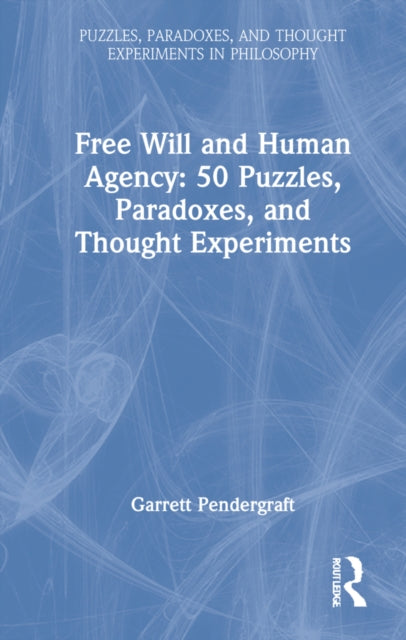
Garrett Pendergraft
Free Will and Human Agency: 50 Puzzles, Paradoxes, and Thought Experiments
Free Will and Human Agency: 50 Puzzles, Paradoxes, and Thought Experiments
💎 Earn 811 Points (£8.11) on this item.
We can order this item for you. Delivery usually takes about 4 to 6 weeks.
This item is not held in our immediate stock. We will order it for you after checkout.
Estimated delivery: About 4 to 6 weeks
YOU SAVE £9.63
- Condition: Brand new
- UK Delivery times: Usually arrives within 2 - 3 working days
- UK Shipping: Fee starts at £2.39. Subject to product weight & dimension
Bulk ordering. Want 15 or more copies? Get a personalised quote and bigger discounts. Learn more about bulk orders.
Couldn't load pickup availability
- More about Free Will and Human Agency: 50 Puzzles, Paradoxes, and Thought Experiments
Garrett Pendergraft's Free Will and Human Agency is a collection of 50 thought experiments and puzzles about free will and human agency. It covers topics such as fatalism, determinism, practical reason, social dimensions, and moral luck, and is accessible, succinct, and self-contained. It is an effective teaching tool and resource for anyone interested in exploring these questions.
Format: Hardback
Length: 264 pages
Publication date: 21 July 2022
Publisher: Taylor & Francis Ltd
Organized into five broad categories: the threat from fatalism,the threat from determinism,practical reason,social dimensions,and moral luck.
The Grandfather Paradox:
One of the most famous thought experiments in the study of free will is the Grandfather Paradox. It involves a scenario in which a time traveler goes back in time and kills their own grandfather before their parents are born. The paradox arises from the fact that if the time traveler kills their grandfather,then their parents would never have been born,and therefore,the time traveler would never have existed. This paradox has been the subject of much debate and discussion among philosophers,with some arguing that it shows that free will is impossible,while others argue that it is not a paradox at all.
Theological Fatalism:
Theological fatalism is the belief that everything that happens in the world is predetermined by God. This belief is often associated with the idea of divine determinism,which holds that God has a plan for everything that happens in the world and that human beings have no free will. Theological fatalism has been the subject of much debate among philosophers,with some arguing that it is incompatible with the idea of human agency and others arguing that it is compatible with it.
The Consequence Argument:
The Consequence Argument is a philosophical argument that holds that the only thing that determines whether an action is morally right or wrong is its consequences. This argument is often used to defend the idea that free will is not necessary for moral responsibility. The argument states that if an action has good consequences,then it is morally right,and if it has bad consequences,then it is morally wrong. This argument has been the subject of much debate among philosophers,with some arguing that it is too simplistic and others arguing that it is a valid way to understand moral responsibility.
Manipulation Arguments:
Manipulation arguments are philosophical arguments that hold that human beings have no free will because they are manipulated by external factors such as their environment,their upbringing,and their genetics. These arguments argue that human beings are not capable of making independent decisions because they are influenced by these external factors. Manipulation arguments have been the subject of much debate among philosophers,with some arguing that they are valid and others arguing that they are not.
Luck Arguments:
Luck arguments are philosophical arguments that hold that human beings have no free will because their actions are determined by luck. These arguments argue that human beings are not capable of making independent decisions because their actions are influenced by factors beyond their control,such as chance. Luck arguments have been the subject of much debate among philosophers,with some arguing that they are valid and others arguing that they are not.
Weakness of Will:
The weakness of will is a philosophical concept that holds that human beings are not capable of making decisions that are in their best interests. This concept is often associated with the idea of addiction,where people are unable to control their behavior despite their best efforts. The weakness of will has been the subject of much debate among philosophers,with some arguing that it is a valid concept and others arguing that it is not.
Action Explanation:
Action explanation is a philosophical concept that holds that human beings have no free will because their actions are explained by their desires and beliefs. This concept is often associated with the idea of rational choice theory,which holds that human beings make decisions based on their best interests. Action explanation has been the subject of much debate among philosophers,with some arguing that it is a valid concept and others arguing that it is not.
Addiction:
Addiction is a psychological condition that involves a person's inability to control their behavior despite their best efforts. Addiction is often associated with drug and alcohol abuse,but it can also apply to other behaviors such as gambling,eating,and shopping. Addiction has been the subject of much debate among philosophers,with some arguing that it is a result of free will and others arguing that it is not.
Blame and Punishment:
Blame and punishment are philosophical concepts that hold that human beings have no free will because they are responsible for their actions. Blame and punishment are often associated with the idea of moral responsibility,which holds that human beings are responsible for the consequences of their actions. Blame and punishment have been the subject of much debate among philosophers,with some arguing that they are necessary for moral behavior and others arguing that they are not.
Situationism in Moral Psychology:
Situationism in moral psychology is a philosophical concept that holds that human beings have no free will because their actions are determined by their environment. Situationism in moral psychology is often associated with the idea of moral luck,which holds that human beings are responsible for their actions only to the extent that they are influenced by their environment. Situationism in moral psychology has been the subject of much debate among philosophers,with some arguing that it is a valid concept and others arguing that it is not.
Huckleberry Finn:
Huckleberry Finn is a novel by Mark Twain that explores the themes of freedom,responsibility,and moral ambiguity. The novel follows the adventures of Huckleberry Finn,a young boy who runs away from his abusive father and travels down the Mississippi River with a runaway slave named Jim. The novel explores the themes of freedom,responsibility,and moral ambiguity through the character of Huckleberry Finn,who is forced to make difficult moral decisions throughout his journey.
In conclusion, Free Will and Human Agency is an essential resource for anyone interested in exploring the questions that have made human agency a topic of perennial philosophical interest. The book offers broad coverage of the key areas of free will and human agency,describes each imaginative case directly and in a memorable way,and provides a list of suggested readings for each case. Whether you are a student,a teacher,or a philosopher,this book is a valuable tool for understanding the complexities of free will and human agency.
Dimension: 198 x 129 (mm)
ISBN-13: 9780367647575
This item can be found in:
UK and International shipping information
UK and International shipping information
UK Delivery and returns information:
- Delivery within 2 - 3 days when ordering in the UK.
- Shipping fee for UK customers from £2.39. Fully tracked shipping service available.
- Returns policy: Return within 30 days of receipt for full refund.
International deliveries:
Shulph Ink now ships to Australia, Belgium, Canada, France, Germany, Ireland, Italy, India, Luxembourg Saudi Arabia, Singapore, Spain, Netherlands, New Zealand, United Arab Emirates, United States of America.
- Delivery times: within 5 - 10 days for international orders.
- Shipping fee: charges vary for overseas orders. Only tracked services are available for most international orders. Some countries have untracked shipping options.
- Customs charges: If ordering to addresses outside the United Kingdom, you may or may not incur additional customs and duties fees during local delivery.