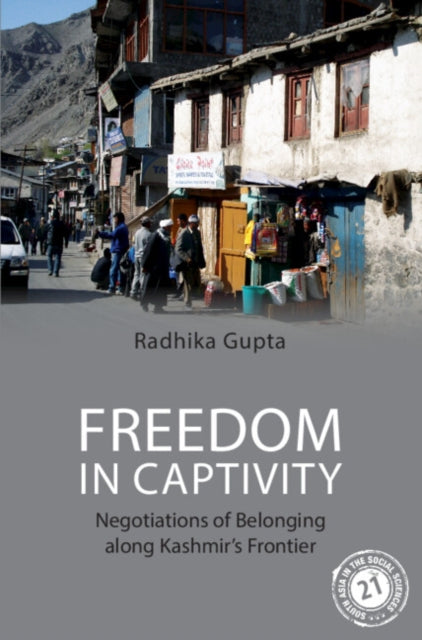
RadhikaGupta
Freedom in Captivity: Negotiations of Belonging along Kashmir's Frontier
Freedom in Captivity: Negotiations of Belonging along Kashmir's Frontier
💎 Earn 420 Points (£4.20) on this item.
We can order this item for you. Delivery usually takes about 4 to 6 weeks.
This item is not held in our immediate stock. We will order it for you after checkout.
Estimated delivery: About 4 to 6 weeks
YOU SAVE £4.98
- Condition: Brand new
- UK Delivery times: Usually arrives within 2 - 3 working days
- UK Shipping: Fee starts at £2.39. Subject to product weight & dimension
Bulk ordering. Want 15 or more copies? Get a personalised quote and bigger discounts. Learn more about bulk orders.
Couldn't load pickup availability
- More about Freedom in Captivity: Negotiations of Belonging along Kashmir's Frontier
Borderland dwellers living along militarised frontiers negotiate state security and their geopolitical location in everyday life. Freedom in Captivity examines the affective attachments, political imaginaries, and ethical claims-making among the Shia Muslims of Kargil, who have sought belonging to India but do not entirely succumb to its hegemonic ideological boundaries. This book offers a unique long-durée insight into the lives of people residing at the intersections of the biggest states in Asia.
Format: Hardback
Length: 290 pages
Publication date: 11 May 2023
Publisher: Cambridge University Press
Living along militarized frontiers, borderland dwellers face the complex challenges of negotiating regimes of state security and their geopolitical location in their everyday lives. These individuals, who often belong to double minorities, navigate a delicate balance between their identity and the security measures imposed by the state. In the context of the Kargil region, this study explores the experiences of Shia Muslims, who constitute a minority within a minority. Despite their desire for belonging to India, Shias on the frontiers of Kashmir do not fully align themselves with the dominant ideological boundaries of the country.
This book departs from the conventional focus on physical cross-border mobility and proposes a reimagining of borderlands as cartographies of ideas. By examining the affective attachments, political imaginaries, and ethical claims-making among the Shia Muslims of Kargil, the author offers a unique long-durée insight into the lives of people residing at the intersections of the largest states in Asia. Through original ethnographic research conducted between 2008 and 2021, the monograph provides a deep understanding of the complexities and nuances of borderland existence, challenging prevailing narratives and highlighting the resilience and creativity of those who live in these marginalized regions.
The study reveals that borderland dwellers negotiate regimes of state security through a combination of strategies. They develop intricate networks of social support, relying on family, community, and religious institutions to mitigate the risks associated with their location. At the same time, they engage in subterranean forms of resistance, such as covert religious practices and secret political organizations, to challenge the dominant narratives and assert their rights.
Freedom, in the context of borderland dwellers, takes on a multifaceted meaning. It encompasses not only the physical ability to move across borders but also the psychological and emotional freedom to assert one's identity and pursue one's aspirations. For those who do not resist captivity engendered by borders, freedom may signify the ability to live according to their cultural and religious beliefs, to engage in meaningful social interactions, and to access basic human rights.
However, the pursuit of freedom is often fraught with challenges. Borderland dwellers face discrimination, marginalization, and violence, both from state authorities and from other groups within their communities. They are subjected to surveillance, restrictions on movement, and the violation of their human rights. Moreover, the geopolitical location of borderlands often complicates their quest for freedom, as they are caught in the crossfire of competing territorial claims and geopolitical tensions.
In conclusion, Freedom in Captivity offers a valuable contribution to the study of borderlands and the politics of state security. By focusing on the experiences of a double-minority, the book sheds light on the complex negotiations and adaptations that borderland dwellers undertake to navigate their geopolitical location and assert their rights. It challenges the notion of borderlands as static and fixed spaces and proposes a more nuanced understanding of these regions as sites of contestation, resilience, and creativity. Through its rich ethnographic analysis, the book provides insights into the lives of borderland dwellers and contributes to our understanding of the broader political and social dynamics of the region.
Weight: 438g
Dimension: 237 x 162 x 21 (mm)
ISBN-13: 9781009201612
UK and International shipping information
UK and International shipping information
UK Delivery and returns information:
- Delivery within 2 - 3 days when ordering in the UK.
- Shipping fee for UK customers from £2.39. Fully tracked shipping service available.
- Returns policy: Return within 30 days of receipt for full refund.
International deliveries:
Shulph Ink now ships to Australia, Belgium, Canada, France, Germany, Ireland, Italy, India, Luxembourg Saudi Arabia, Singapore, Spain, Netherlands, New Zealand, United Arab Emirates, United States of America.
- Delivery times: within 5 - 10 days for international orders.
- Shipping fee: charges vary for overseas orders. Only tracked services are available for most international orders. Some countries have untracked shipping options.
- Customs charges: If ordering to addresses outside the United Kingdom, you may or may not incur additional customs and duties fees during local delivery.