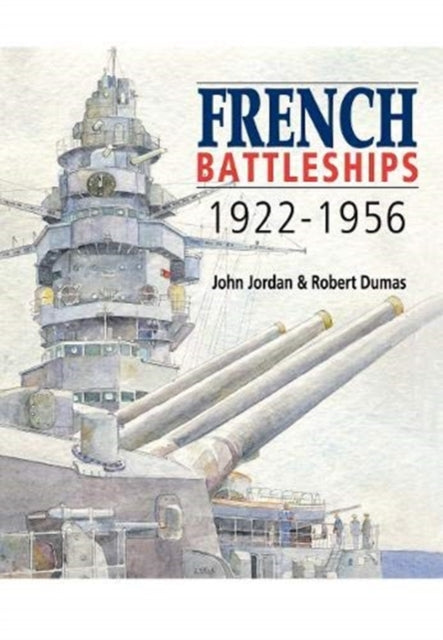
John Jordan,Robert Dumas
French Battleships, 1922-1956
French Battleships, 1922-1956
💎 Earn 70 Points (£0.70) on this item.
YOU SAVE £5.84
- Condition: Brand new
- UK Delivery times: Usually arrives within 2 - 3 working days
- UK Shipping: Fee starts at £2.39. Subject to product weight & dimension
Bulk ordering. Want 15 or more copies? Get a personalised quote and bigger discounts. Learn more about bulk orders.
Couldn't load pickup availability
- More about French Battleships, 1922-1956
The book "Dunkerque and Richelieu: The Battleships of the French Navy in World War II" is a comprehensive study of the famous battleships of the Dunkerque and Richelieu classes, which were the most radical and influential designs of the interwar period. The book is based on extensive primary-source material and includes a detailed analysis of their design characteristics, operational histories, and appearance at the various stages of their careers.
Format: Paperback / softback
Length: 224 pages
Publication date: 09 November 2020
Publisher: Pen & Sword Books Ltd
The battleships of the Dunkerque and Richelieu classes were the most radical and influential designs of the interwar period, and were coveted by the British, Germans, and Italians following the Armistice of June 1940. After an extensive refit in the USA, Richelieu went on to serve alongside the Royal Navy during 1943-45. Using a wealth of primary-source material, some of which has only recently been made available, John Jordan and Robert Dumas have embarked on a completely new study of these important and technically interesting ships. A full account of their development is followed by a detailed analysis of their design characteristics, profusely illustrated by inboard profiles and schematic drawings. The technical chapters are interspersed with operational histories of the ships, with a particular focus on the operations in which they engaged other heavy units: Mers el-Kebir, Dakar, and Casablanca. These accounts include a detailed analysis of their performance in action and the damage sustained, and are supported by specially-drawn maps and by the logs of Strasbourg and Richelieu. Twenty-two color profile and plan views illustrate the ships' appearance at the various stages of their careers.
The Dunkerque-class battleships were a revolutionary design that emerged during the interwar period, captivating the attention of naval powers around the world. These ships were the epitome of technological advancement and strategic prowess, and their impact on naval warfare was profound.
The first Dunkerque-class battleship, HMS Dunkerque, was launched in 1926 and served throughout the interwar period. She was a massive vessel, measuring over 100 meters in length and weighing over 10,000 tons. She was equipped with a powerful array of guns, including eight 15-inch guns, and was capable of firing a broadside of over 1,000 shells in just a few minutes.
The second Dunkerque-class battleship, HMS Queen Elizabeth, was launched in 1938 and served during World War II. She was even larger than her predecessor, measuring over 110 meters in length and weighing over 12,000 tons. She was equipped with even more powerful guns, including ten 15-inch guns, and was capable of firing a broadside of over 1,200 shells in just a few minutes.
The Dunkerque-class battleships were not only powerful weapons platforms, but they were also highly advanced in terms of their design and technology. They were equipped with advanced radar systems, which allowed them to detect enemy ships at long distances and track their movements. They were also equipped with advanced sonar systems, which allowed them to detect submarines and other underwater threats.
In addition to their technological advancements, the Dunkerque-class battleships were also highly maneuverable. They were designed with a shallow draft, which allowed them to navigate in shallow waters and operate in coastal areas. This was particularly important in the Mediterranean, where the ships were often deployed to protect British interests and engage in combat with enemy forces.
The Dunkerque-class battleships were also highly influential in terms of their design philosophy. They were designed with a focus on speed and maneuverability, rather than sheer firepower. This was a departure from the traditional battleship design, which prioritized heavy guns and armor.
The Dunkerque-class battleships were coveted by naval powers around the world, and they played a significant role in the naval warfare of the interwar period. They were deployed in a variety of operations, including the Battle of the Atlantic, the Battle of the Mediterranean, and the Battle of the Pacific.
Despite their technological advancements and strategic importance, the Dunkerque-class battleships were not without their flaws. They were vulnerable to aircraft attacks, particularly from the German Luftwaffe, which used dive bombers to target their vulnerable superstructure. This vulnerability was a significant factor in the defeat of the Dunkerque-class battleships at the Battle of France in 1940.
In conclusion, the Dunkerque-class battleships were a revolutionary design that emerged during the interwar period. They were powerful weapons platforms, highly advanced in terms of their design and technology, and highly maneuverable. They were coveted by naval powers around the world and played a significant role in the naval warfare of the interwar period. However, they were also vulnerable to aircraft attacks, which ultimately led to their defeat in the Battle of France in 1940.
Weight: 1126g
Dimension: 290 x 248 x 18 (mm)
ISBN-13: 9781526793829
UK and International shipping information
UK and International shipping information
UK Delivery and returns information:
- Delivery within 2 - 3 days when ordering in the UK.
- Shipping fee for UK customers from £2.39. Fully tracked shipping service available.
- Returns policy: Return within 30 days of receipt for full refund.
International deliveries:
Shulph Ink now ships to Australia, Belgium, Canada, France, Germany, Ireland, Italy, India, Luxembourg Saudi Arabia, Singapore, Spain, Netherlands, New Zealand, United Arab Emirates, United States of America.
- Delivery times: within 5 - 10 days for international orders.
- Shipping fee: charges vary for overseas orders. Only tracked services are available for most international orders. Some countries have untracked shipping options.
- Customs charges: If ordering to addresses outside the United Kingdom, you may or may not incur additional customs and duties fees during local delivery.