ReneChartrand
French Naval & Colonial Troops 1872-1914
French Naval & Colonial Troops 1872-1914
💎 Earn 49 Points (£0.49) on this item.
YOU SAVE £3.03
- Condition: Brand new
- UK Delivery times: Usually arrives within 2 - 3 working days
- UK Shipping: Fee starts at £2.39. Subject to product weight & dimension
Bulk ordering. Want 15 or more copies? Get a personalised quote and bigger discounts. Learn more about bulk orders.
Couldn't load pickup availability
- More about French Naval & Colonial Troops 1872-1914
Format: Paperback / softback
Length: 48 pages
Publication date: 23 August 2018
Publisher: Bloomsbury Publishing PLC
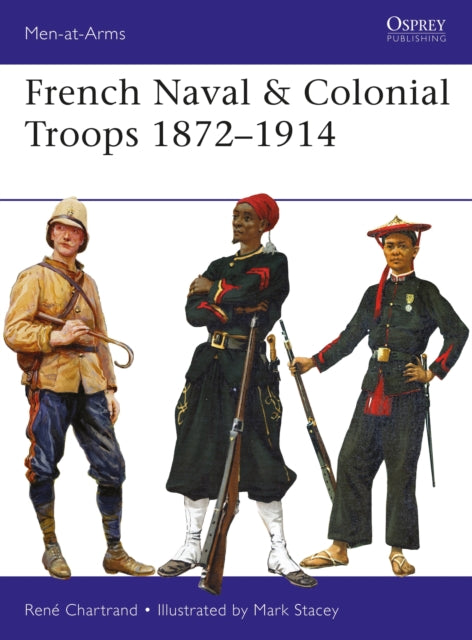
France's extensive involvement in sub-Saharan Africa and South-East Asia during the colonial era was primarily conducted by a distinct military organization, separate from both the home-defense Metropolitan Army and the Armée d'Afrique in Algeria. The Naval Troops, known as the Troupes de la Marine, consisted of volunteers who gained a reputation for their exceptional toughness and endurance compared to the conscripted Metropolitan Army. These Naval Troops were distributed across the French Empire, with large infantry and artillery regiments based in France, mixed-race regiments (Régiments Mixtes), and entire native regiments raised in West Africa, Madagascar, and Indochina. Among these, the Tirailleurs, a group of native soldiers, were organized and led by officers and cadres from the Naval Troops. They sported a diverse and colorful uniform, drawing inspiration from formalized versions of traditional local costumes.
French Naval & Colonial Troops 1872–1914: A Visual History of Tough Colonial Units is a comprehensive book that employs rich and detailed full-color plates alongside thorough analysis to explore the remarkable story of these resilient colonial units. It delves into the various aspects of these tough colonial units, including their organization, uniforms, training, and deployment in Africa and Vietnam. The book provides a comprehensive overview of the role played by the Naval Troops in shaping French colonial policies and strategies during this period.
The Naval Troops played a crucial role in France's colonial wars by providing a mobile and versatile force capable of operating in diverse environments. They were particularly well-suited for conducting campaigns in Africa and Southeast Asia, where the terrain and climate posed significant challenges. The volunteers who joined the Naval Troops were drawn from a wide range of backgrounds, including sailors, farmers, and artisans, and they brought with them a wealth of experience and skills that contributed to their effectiveness on the battlefield.
One of the distinguishing features of the Naval Troops was their large infantry and artillery regiments. These units were often composed of conscripts from France's urban centers, but they also included a significant number of volunteers. The volunteers were known for their dedication and commitment to the cause of French colonial expansion, and they often displayed a greater level of toughness and endurance than their conscripted counterparts.
In addition to their large infantry and artillery regiments, the Naval Troops also employed mixed-race regiments. These regiments were formed by combining soldiers of different ethnic backgrounds, such as French, African, and Asian, and they were designed to promote integration and cooperation within the French colonial empire. The mixed-race regiments were often led by officers and cadres from the Naval Troops, who were skilled in managing and training diverse groups of soldiers.
Another notable aspect of the Naval Troops was their deployment of entire native regiments. These regiments were raised and trained in West Africa, Madagascar, and Indochina, and they were tasked with defending French interests in these regions. The native regiments were often led by officers and cadres from the Naval Troops, who were familiar with the local customs, languages, and terrain. They were able to adapt quickly to the challenges of their environment and were highly effective in combat.
The Naval Troops also played a significant role in the expansion of French colonial territories. They were often deployed to support French military campaigns and were instrumental in securing French control over new regions. Their presence in these territories helped to establish French dominance and facilitated the spread of French culture, language, and religion.
However, the Naval Troops' involvement in colonial wars was not without its challenges. They faced opposition from local populations who resented French colonialism and sought to resist French expansion. The Naval Troops were often required to engage in combat with indigenous forces, and they faced a range of threats, including ambushes, raids, and rebellions.
Despite these challenges, the Naval Troops played a crucial role in shaping French colonial policies and strategies during the late 19th and early 20th centuries. They demonstrated their resilience and adaptability in the face of adversity, and their contributions to the expansion of French colonial empire are widely recognized.
In conclusion, France's colonial wars in sub-Saharan Africa and South-East Asia were largely fought by a separate military organization known as the Naval Troops. These volunteers, known for their exceptional toughness and endurance, played a significant role in shaping French colonial policies and strategies. The Naval Troops were characterized by large infantry and artillery regiments, mixed-race regiments, and entire native regiments raised in West Africa, Madagascar, and Indochina. Their deployment in these regions facilitated the spread of French culture, language, and religion, and their contributions to the expansion of French colonial territories are widely recognized. Despite facing opposition and challenges, the Naval Troops demonstrated their resilience and adaptability in the face of adversity, and their legacy continues to be studied and celebrated today.
Weight: 166g
Dimension: 184 x 247 x 5 (mm)
ISBN-13: 9781472826190
UK and International shipping information
UK and International shipping information
UK Delivery and returns information:
- Delivery within 2 - 3 days when ordering in the UK.
- Shipping fee for UK customers from £2.39. Fully tracked shipping service available.
- Returns policy: Return within 30 days of receipt for full refund.
International deliveries:
Shulph Ink now ships to Australia, Belgium, Canada, France, Germany, Ireland, Italy, India, Luxembourg Saudi Arabia, Singapore, Spain, Netherlands, New Zealand, United Arab Emirates, United States of America.
- Delivery times: within 5 - 10 days for international orders.
- Shipping fee: charges vary for overseas orders. Only tracked services are available for most international orders. Some countries have untracked shipping options.
- Customs charges: If ordering to addresses outside the United Kingdom, you may or may not incur additional customs and duties fees during local delivery.