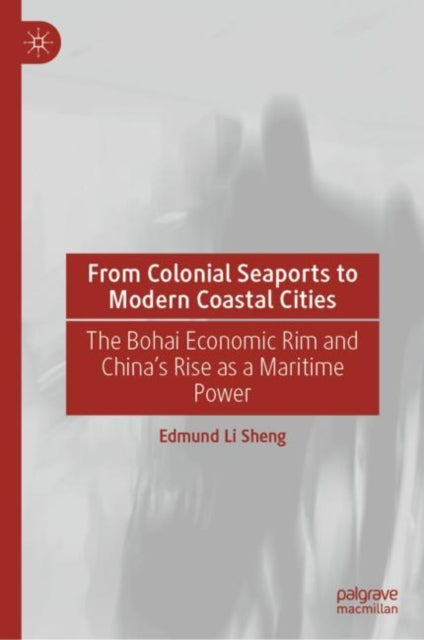
Edmund Li Sheng
From Colonial Seaports to Modern Coastal Cities: The Bohai Economic Rim and China’s Rise as a Maritime Power
From Colonial Seaports to Modern Coastal Cities: The Bohai Economic Rim and China’s Rise as a Maritime Power
💎 Earn 454 Points (£4.54) on this item.
We can order this item for you. Delivery usually takes about 4 to 6 weeks.
This item is not held in our immediate stock. We will order it for you after checkout.
Estimated delivery: About 4 to 6 weeks
YOU SAVE £19.14
- Condition: Brand new
- UK Delivery times: Usually arrives within 2 - 3 working days
- UK Shipping: Fee starts at £2.39. Subject to product weight & dimension
Bulk ordering. Want 15 or more copies? Get a personalised quote and bigger discounts. Learn more about bulk orders.
Couldn't load pickup availability
- More about From Colonial Seaports to Modern Coastal Cities: The Bohai Economic Rim and China’s Rise as a Maritime Power
This book examines China's ambition to become a maritime power, challenging its traditional continental status through two national strategies. It explores China's maritime power development using world-island and sea-power theories, with fieldwork, interviews, and data collection.
Format: Hardback
Length: 119 pages
Publication date: 11 January 2024
Publisher: Springer Verlag, Singapore
China's Ambition to Build a Maritime Power
China, with its vast continental coastline of 18,000 kilometers and territorial waters covering one-third of its land mass, has traditionally been considered a continental power. However, Beijing is now embarking on a mission to transform this historical reality through two national strategies. This book aims to explore China's maritime power development from historical and geopolitical perspectives, drawing on the world-island and sea-power theories. Through fieldwork, in-depth interviews, and extensive data collection, this book will present a series of compelling examples and vivid stories to help readers understand China's maritime strategies, making it of interest to scholars, historians, and economists alike.
China's Maritime History and Legacy
China's maritime history dates back thousands of years, with the country's coastal regions playing a significant role in its economic, cultural, and political development. The ancient Chinese civilization was built on the back of its maritime trade, which extended across the Indian Ocean and the Pacific Ocean. China's maritime power was further enhanced during the Ming Dynasty, when the country's navy became one of the largest in the world. However, China's maritime power declined in the 19th and 20th centuries due to various factors, including internal conflicts, foreign invasions, and economic stagnation.
China's Current Maritime Strategies
In recent years, China has been actively pursuing its maritime power ambitions. The country's national strategies include the Belt and Road Initiative (BRI) and the Maritime Silk Road (MSR). The BRI is a massive infrastructure development project that aims to connect China with Europe, Africa, and the Middle East through a network of land and sea routes. The MSR is a maritime trade route that connects China with Southeast Asia, the Indian Ocean, and the Pacific Ocean.
The Belt and Road Initiative (BRI)
The BRI is a massive infrastructure development project that aims to connect China with Europe, Africa, and the Middle East through a network of land and sea routes. The project includes the construction of ports, highways, railways, and other infrastructure projects in various countries along the route. The BRI has been criticized for its environmental impact, but it has also been praised for its economic benefits. The project has created thousands of jobs and has helped to improve the infrastructure in many countries.
The Maritime Silk Road (MSR)
The MSR is a maritime trade route that connects China with Southeast Asia, the Indian Ocean, and the Pacific Ocean. The route includes the ports of Shanghai, Ningbo, and Guangzhou, as well as the Strait of Malacca. The MSR has been criticized for its security risks, but it has also been praised for its economic benefits. The route has helped to increase trade between China and Southeast Asia, and has also helped to reduce the cost of shipping goods between the two regions.
Challenges to China's Maritime Power Ambitions
China's maritime power ambitions face several challenges. One of the biggest challenges is the competition from other maritime powers, such as the United States, Japan, and India. These countries have larger and more advanced navies, and they have a greater presence in the region. China's navy is still relatively small compared to these countries, and it lacks the necessary equipment and technology to compete with them.
Another challenge is the environmental impact of China's maritime power ambitions. The construction of ports, highways, and other infrastructure projects can have negative impacts on the environment, including pollution and habitat destruction. China has been working to address these issues, but it has a long way to go.
Conclusion
China's maritime power ambitions are a significant part of its national strategy. The country's national strategies include the Belt and Road Initiative (BRI) and the Maritime Silk Road (MSR). These strategies aim to connect China with Europe, Africa, and the Middle East through a network of land and sea routes, and to increase trade between China and Southeast Asia. However, China's maritime power ambitions face several challenges, including competition from other maritime powers and the environmental impact of its maritime power ambitions. By addressing these challenges, China can become a more powerful maritime power in the region.
Weight: 371g
Dimension: 235 x 155 (mm)
ISBN-13: 9789819990764
Edition number: 1st ed. 2024
This item can be found in:
UK and International shipping information
UK and International shipping information
UK Delivery and returns information:
- Delivery within 2 - 3 days when ordering in the UK.
- Shipping fee for UK customers from £2.39. Fully tracked shipping service available.
- Returns policy: Return within 30 days of receipt for full refund.
International deliveries:
Shulph Ink now ships to Australia, Belgium, Canada, France, Germany, Ireland, Italy, India, Luxembourg Saudi Arabia, Singapore, Spain, Netherlands, New Zealand, United Arab Emirates, United States of America.
- Delivery times: within 5 - 10 days for international orders.
- Shipping fee: charges vary for overseas orders. Only tracked services are available for most international orders. Some countries have untracked shipping options.
- Customs charges: If ordering to addresses outside the United Kingdom, you may or may not incur additional customs and duties fees during local delivery.