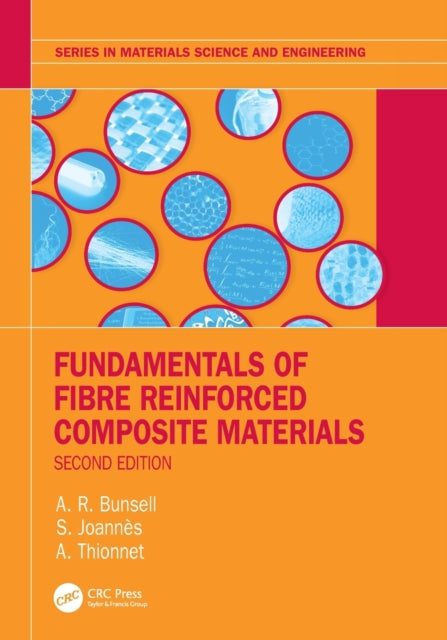
A.R.Bunsell,S.Joannes,A.Thionnet
Fundamentals of Fibre Reinforced Composite Materials
Fundamentals of Fibre Reinforced Composite Materials
💎 Earn 254 Points (£2.54) on this item.
We can order this item for you. Delivery usually takes about 4 to 6 weeks.
This item is not held in our immediate stock. We will order it for you after checkout.
Estimated delivery: About 4 to 6 weeks
YOU SAVE £3.03
- Condition: Brand new
- UK Delivery times: Usually arrives within 2 - 3 working days
- UK Shipping: Fee starts at £2.39. Subject to product weight & dimension
Bulk ordering. Want 15 or more copies? Get a personalised quote and bigger discounts. Learn more about bulk orders.
Couldn't load pickup availability
- More about Fundamentals of Fibre Reinforced Composite Materials
Fibre-reinforced composite materials are increasingly used in various applications, from food trays to spacecraft, and contribute to environmental solutions. This updated edition provides an authoritative introduction to the topic, covering composite development, applications, manufacture, and markets, as well as computer simulation of composite behavior. It is ideal for undergraduate and graduate students, researchers, and engineers working with composite materials.
Format: Paperback / softback
Length: 350 pages
Publication date: 26 September 2022
Publisher: Taylor & Francis Ltd
Fibre reinforced composite materials are experiencing remarkable growth in an expanding array of applications, spanning from food trays to spacecraft, and playing a crucial role in addressing environmental concerns. This second edition of Fundamentals of Fibre Reinforced Composite Materials has undergone a comprehensive update to provide a authoritative and contemporary introduction to the field. It offers a brief history of composite development, a comprehensive review of composite applications, manufacturing processes, and markets, an in-depth exploration of the types of fibres and matrices employed, and a detailed introduction to computer simulation of composite behaviour. Accompanied by extensive sets of sample problems for each chapter, this book is ideally suited for undergraduate and graduate students pursuing courses in materials science, structural engineering, mechanical engineering, polymer science, metallurgy, and related disciplines. It serves as a valuable reference for researchers and engineers engaged in the field of composite materials, as well as material scientists in general.
The history of composite materials dates back to ancient times when humans used natural fibres such as straw and bamboo to create lightweight and durable structures. However, the development of modern composite materials began in the mid-20th century with the introduction of synthetic fibres such as glass, carbon, and aramid. These fibres were stronger and more durable than natural fibres, making them ideal for use in aircraft, automotive, and construction industries.
One of the key advantages of composite materials is their high strength-to-weight ratio. This means that they can be designed to be lighter than traditional materials, which reduces the weight of vehicles and aircraft, resulting in lower fuel consumption and emissions. Additionally, composite materials are resistant to corrosion, fatigue, and high temperatures, making them suitable for use in a wide range of applications, including military and aerospace equipment.
Another advantage of composite materials is their ability to be customized to meet specific requirements. For example, they can be designed to have different properties such as stiffness, strength, and thermal conductivity, making them suitable for use in a variety of industries, including sports equipment, medical devices, and consumer goods.
Composite materials are also environmentally friendly. They are made from renewable resources, such as wood and recycled plastic, and do not release harmful chemicals into the environment during production or use. Additionally, composite materials can be recycled, which reduces waste and conserves natural resources.
Despite their many advantages, composite materials also have some challenges. One of the main challenges is the cost of production. Synthetic fibres are expensive, and the manufacturing process for composite materials can be complex and time-consuming. Additionally, composite materials can be difficult to repair if they are damaged, which can be costly and time-consuming.
Another challenge is the durability of composite materials. While they are resistant to many environmental factors, they can be susceptible to damage from high-impact forces, such as collisions or impacts. Additionally, composite materials can be affected by temperature changes, which can cause them to expand or contract, leading to damage or failure.
To address these challenges, researchers and engineers are continuously developing new technologies and materials to improve the durability and performance of composite materials. For example, they are exploring the use of hybrid materials, which combine different types of fibres and matrices to create materials with specific properties. They are also developing new manufacturing processes that are faster and more efficient, which can reduce the cost of production and improve the quality of composite materials.
In conclusion, fibre reinforced composite materials are a rapidly growing field with significant potential for innovation and growth. They offer a wide range of advantages, including high strength-to-weight ratio, customization, and environmental friendliness. However, they also face some challenges, such as the cost of production and durability. By continuing to develop new technologies and materials, researchers and engineers can improve the performance and durability of composite materials, making them an even more attractive option for a wide range of applications.
Weight: 672g
Dimension: 177 x 251 x 40 (mm)
ISBN-13: 9780367744335
Edition number: 2 ed
This item can be found in:
UK and International shipping information
UK and International shipping information
UK Delivery and returns information:
- Delivery within 2 - 3 days when ordering in the UK.
- Shipping fee for UK customers from £2.39. Fully tracked shipping service available.
- Returns policy: Return within 30 days of receipt for full refund.
International deliveries:
Shulph Ink now ships to Australia, Belgium, Canada, France, Germany, Ireland, Italy, India, Luxembourg Saudi Arabia, Singapore, Spain, Netherlands, New Zealand, United Arab Emirates, United States of America.
- Delivery times: within 5 - 10 days for international orders.
- Shipping fee: charges vary for overseas orders. Only tracked services are available for most international orders. Some countries have untracked shipping options.
- Customs charges: If ordering to addresses outside the United Kingdom, you may or may not incur additional customs and duties fees during local delivery.