Shulph Ink
Future Law: Emerging Technology, Ethics and Regulation
Future Law: Emerging Technology, Ethics and Regulation
💎 Earn 444 Points (£4.44) on this item.
YOU SAVE £31.08
- Condition: Brand new
- UK Delivery times: Usually arrives within 2 - 3 working days
- UK Shipping: Fee starts at £3.89. Subject to product weight & dimension
Bulk ordering. Want 15 or more copies? Get a personalised quote and bigger discounts. Learn more about bulk orders.
Couldn't load pickup availability
- More about Future Law: Emerging Technology, Ethics and Regulation
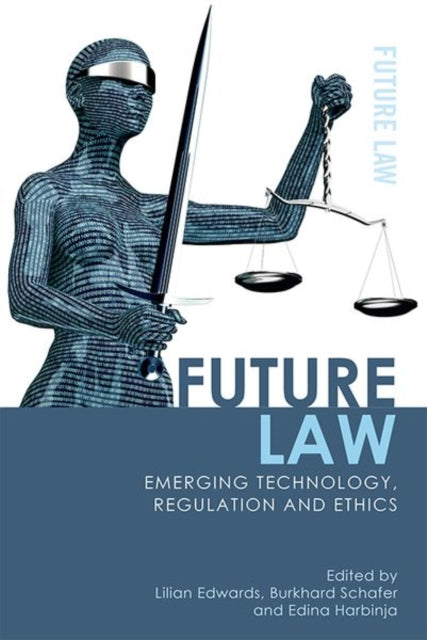
Future Law explores the power of human imagination in understanding, critiquing, and improving the legal responses to technological change, focusing on practical difficulties of applying law, policy, and ethical structures to emergent technologies. It covers crucial current issues such as big data ethics, ubiquitous surveillance, and the Internet of Things, and disruptive technologies such as autonomous vehicles, DIY genetics, and robot agents. It uses examples from popular culture to bring hypothetical examples to life and asks where law might go next to regulate new-phase technology such as artificial intelligence, smart homes, and automated emotion recognition.
Format: Hardback
Length: 256 pages
Publication date: 30 November 2019
Publisher: Edinburgh University Press
Future Law is a groundbreaking book that explores and leverages the power of human imagination in understanding, critiquing, and improving the legal responses to technological change. It brings together cutting-edge authors from academia, legal practice, and the technology industry to address the practical difficulties of applying law, policy, and ethical structures to emergent technologies both now and in the future.
One of the key issues explored in Future Law is the ethical implications of big data. With the increasing amount of data being collected and analyzed, there are concerns about privacy, security, and the potential for discrimination. The book examines the various ethical frameworks that have been developed to address these issues, including the GDPR, the California Consumer Privacy Act, and the Fair Credit Reporting Act. It also explores the role of artificial intelligence in big data analysis and the potential for it to be used for good or bad.
Ubiquitous surveillance is another major issue addressed in Future Law. With the increasing use of surveillance cameras, smartphones, and other devices, there are concerns about the privacy of individuals and the potential for government surveillance. The book examines the various legal and ethical frameworks that have been developed to address these issues, including the Fourth Amendment, the Foreign Intelligence Surveillance Act, and the European Union's General Data Protection Regulation. It also explores the role of technology companies in surveillance and the potential for them to be held accountable for their actions.
The Internet of Things (IoT) is a rapidly growing technology that connects devices and systems to the internet. While it has many benefits, it also poses significant risks. The book examines the various legal and ethical frameworks that have been developed to address these issues, including the IoT Security Act, the Consumer Product Safety Commission's regulations, and the European Union's General Data Protection Regulation. It also explores the role of technology companies in IoT and the potential for them to be held accountable for their actions.
Disruptive technologies such as autonomous vehicles, DIY genetics, and robot agents are also discussed in Future Law. These technologies have the potential to revolutionize many aspects of our lives, but they also pose significant risks. The book examines the various legal and ethical frameworks that have been developed to address these issues, including the Automated Vehicles Act, the Genetic Information Nondiscrimination Act, and the Robotics Industry Association's guidelines. It also explores the role of technology companies in these technologies and the potential for them to be held accountable for their actions.
In addition to these issues, Future Law also explores the role of law, policy, and ethics in shaping the future of technology. It examines the potential for technology to be used for social good, such as improving healthcare, education, and transportation. It also examines the potential for technology to be used for harm, such as cybercrime, terrorism, and discrimination.
One of the key challenges facing law, policy, and ethics in the future of technology is the pace of change. Technology is evolving at a rapid pace, and it can be difficult for laws and policies to keep up. This can lead to legal uncertainty and confusion, which can have negative consequences for individuals and society.
To address this challenge, Future Law proposes a number of solutions. One of these solutions is to increase the transparency of technology. This can be done by requiring technology companies to disclose their data collection and analysis practices, and by providing individuals with more control over their data.
Another solution is to develop new legal and ethical frameworks that are specifically designed for emerging technologies. This can be done by working with industry experts and policymakers to develop new regulations and policies that are tailored to the specific needs of these technologies.
In addition to these solutions, Future Law also emphasizes the importance of education and training. Law, policy, and ethics professionals need to be able to understand the latest developments in technology and to be able to apply them to real-world situations. This can be done by providing training programs and by encouraging professionals to stay up-to-date on the latest research and trends.
Finally, Future Law emphasizes the importance of collaboration. Law, policy, and ethics professionals need to work together to address the challenges facing technology. This can be done by forming partnerships with industry experts and policymakers, and by participating in public discussions and debates.
In conclusion, Future Law is a groundbreaking book that explores and leverages the power of human imagination in understanding, critiquing, and improving the legal responses to technological change. It brings together cutting-edge authors from academia, legal practice, and the technology industry to address the practical difficulties of applying law, policy, and ethical structures to emergent technologies both now and in the future. By increasing the transparency of technology, developing new legal and ethical frameworks, emphasizing education and training, and collaborating with industry experts and policymakers, we can ensure that technology is used for social good and not for harm.
Weight: 760g
Dimension: 163 x 243 x 30 (mm)
ISBN-13: 9781474417617
UK and International shipping information
UK and International shipping information
We deliver throughout the United Kingdom and to 128 countries and territories worldwide, including the United States, Australia, Canada, Germany, Spain and France.