EnricoAcciai
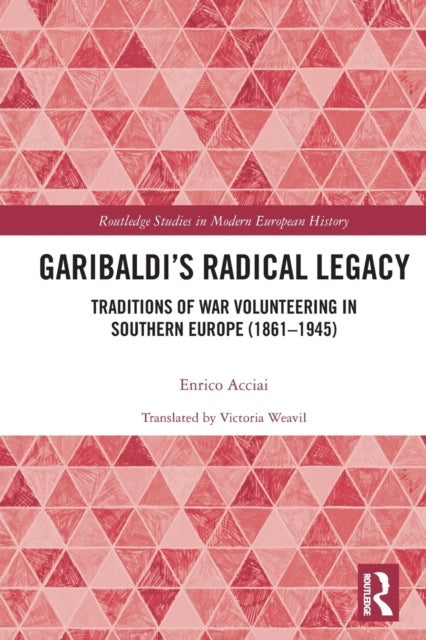
Garibaldi's Radical Legacy: Traditions of War Volunteering in Southern Europe (1861-1945)
Garibaldi's Radical Legacy: Traditions of War Volunteering in Southern Europe (1861-1945)
💎 Earn 226 Points (£2.26) on this item.
We can order this item for you. Delivery usually takes about 4 to 6 weeks.
This item is not held in our immediate stock. We will order it for you after checkout.
Estimated delivery: About 4 to 6 weeks
YOU SAVE £2.69
- Condition: Brand new
- UK Delivery times: Usually arrives within 2 - 3 working days
- UK Shipping: Fee starts at £2.39. Subject to product weight & dimension
Bulk ordering. Want 15 or more copies? Get a personalised quote and bigger discounts. Learn more about bulk orders.
Couldn't load pickup availability
- More about Garibaldi's Radical Legacy: Traditions of War Volunteering in Southern Europe (1861-1945)
During the interwar period, thousands of European antifascists were mobilized by the political circumstances of the time, particularly in the Spanish Civil War and the Second World War. This book explores the radical and transnational tradition of war volunteering connected to Giuseppe Garibaldi's legacy in Southern Europe between 1861 and 1945, examining its long-term, interconnected, and radical dimensions.
Format: Paperback / softback
Length: 196 pages
Publication date: 01 August 2022
Publisher: Taylor & Francis Ltd
Between the two world wars, the political circumstances of the time pushed thousands of European antifascists to take action. In this context, the Spanish Civil War and the armed resistances during the Second World War saw a significant involvement of transnational fighters. The primary motivation behind these fighters' decision to mobilize was undoubtedly the urgent need to combat fascism wherever it emerged. Despite this, there has been a lack of attention to the fact that some of these volunteers considered themselves the last representatives of a nineteenth-century tradition of armed volunteering. The endurance and persistence of war volunteering over time have rarely been explored in historical research. The purpose of this book is to reconstruct the radical and transnational tradition of war volunteering associated with Giuseppe Garibaldi's legacy in Southern Europe between the unification of Italy in 1861 and the end of the Second World War in 1945. This book aims to offer a comprehensive analysis of the long-term, interconnected, and radical dimensions of what is known as Garibaldinism.
The political climate of Europe during the interwar period was marked by a surge of fascist movements and ideologies, which posed a significant threat to democracy and human rights. In response to this threat, a group of individuals known as antifascists emerged, dedicated to opposing fascism and promoting social justice. These antifascists came from various backgrounds and countries, but they shared a common goal of defeating fascism and building a better world.
One of the most significant antifascist movements of the interwar period was the Italian Resistance, which emerged in response to the rise of fascism in Italy under Benito Mussolini. The Resistance was led by Giuseppe Garibaldi, a charismatic military leader who had a long history of fighting for Italian independence. Garibaldi's legacy continued to inspire antifascist movements throughout the world, particularly in Southern Europe.
The Spanish Civil War was another major event that shaped the antifascist movement. The war, which took place between 1936 and 1939, was fought between the Republican government, led by Francisco Franco, and the Republican rebels, supported by the Soviet Union. The war was a brutal struggle, with millions of people killed and millions more displaced. However, it also saw the rise of a new generation of antifascist fighters, who were inspired by the heroic struggle of the Republican rebels.
The Second World War was another turning point in the antifascist movement. The war saw the rise of **** Germany, which was committed to the extermination of Jews, Roma, and other minority groups. Antifascist movements around the world responded to this threat by organizing resistance movements and providing support to the victims of **** persecution.
One of the most significant antifascist movements of the Second World War was the French Resistance, which was led by Charles de Gaulle and operated in occupied France. The Resistance was a network of resistance cells that operated in secret, providing support to the French Resistance and sabotaging **** operations. The Resistance also played a crucial role in the liberation of France from **** control.
The antifascist movement also had a significant impact on the development of international law and human rights. The Nuremberg Trials, which took place after the Second World War, were a landmark event in the history of international law, as they held **** leaders responsible for their crimes against humanity. The trials laid the foundation for the development of the International Criminal Court, which is dedicated to prosecuting individuals responsible for genocide, war crimes, and other crimes against humanity.
Despite the significant achievements of the antifascist movement, the movement faced many challenges during the interwar period. One of the most significant challenges was the rise of fascism in Europe, which threatened to undermine the gains made by antifascist movements. Another challenge was the lack of international cooperation and support for antifascist movements, particularly in the face of the rise of fascism in Europe.
Despite these challenges, the antifascist movement continued to grow and evolve during the interwar period. Antifascist movements emerged in new countries, such as Greece, Portugal, and Spain, and they continued to inspire resistance movements around the world. The antifascist movement also played a crucial role in the development of democratic institutions and human rights in many countries, particularly in Europe.
In conclusion, the antifascist movement was a crucial component of the struggle against fascism and oppression during the interwar period. The movement was led by a diverse group of individuals from various backgrounds and countries, but they shared a common goal of defeating fascism and building a better world. The antifascist movement's achievements were significant, and they laid the foundation for the development of international law and human rights. However, the movement faced many challenges during the interwar period, and it continued to evolve and grow in response to these challenges. The legacy of the antifascist movement continues to inspire resistance movements around the world, and it is essential that we continue to learn from the lessons of the past to build a more just and peaceful world.
Weight: 380g
Dimension: 234 x 156 (mm)
ISBN-13: 9780367653507
This item can be found in:
UK and International shipping information
UK and International shipping information
UK Delivery and returns information:
- Delivery within 2 - 3 days when ordering in the UK.
- Shipping fee for UK customers from £2.39. Fully tracked shipping service available.
- Returns policy: Return within 30 days of receipt for full refund.
International deliveries:
Shulph Ink now ships to Australia, Belgium, Canada, France, Germany, Ireland, Italy, India, Luxembourg Saudi Arabia, Singapore, Spain, Netherlands, New Zealand, United Arab Emirates, United States of America.
- Delivery times: within 5 - 10 days for international orders.
- Shipping fee: charges vary for overseas orders. Only tracked services are available for most international orders. Some countries have untracked shipping options.
- Customs charges: If ordering to addresses outside the United Kingdom, you may or may not incur additional customs and duties fees during local delivery.