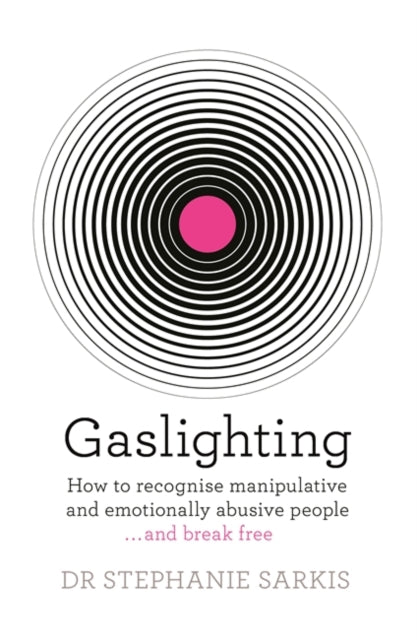
Dr Stephanie Sarkis
Gaslighting: How to recognise manipulative and emotionally abusive people - and break free
Gaslighting: How to recognise manipulative and emotionally abusive people - and break free
💎 Earn 53 Points (£0.53) on this item.
YOU SAVE £4.38
- Condition: Brand new
- UK Delivery times: Usually arrives within 2 - 3 working days
- UK Shipping: Fee starts at £2.39. Subject to product weight & dimension
Bulk ordering. Want 15 or more copies? Get a personalised quote and bigger discounts. Learn more about bulk orders.
Couldn't load pickup availability
- More about Gaslighting: How to recognise manipulative and emotionally abusive people - and break free
Gaslighters are master controllers and manipulators who distort the truth by lying, withholding, triangulation, and more, making their victims question their own reality and sanity. Dr. Stephanie Sarkis delves into this hidden manipulation technique, covering gaslighting in every life scenario, sharing warning signs, red flags, practical strategies, and how to break free and heal.
\n Format: Paperback / softback
\n Length: 272 pages
\n Publication date: 07 March 2019
\n Publisher: Orion Publishing Co
\n
Gaslighting is a deceptive and manipulative tactic where individuals or groups try to manipulate their victims into questioning their own perceptions, memories, and sanity. It is often employed by those in positions of power or authority, such as spouses, parents, co-workers, or friends, to control and undermine their targets.
The term "gaslighting" comes from the 1944 play "Gas Light" by Patrick Hamilton, where a husband tries to convince his wife that she is going crazy by dimming the gas lights in their home. In the play, the husband slowly reduces the amount of gas used, making the wife feel like she is losing her mind and questioning her own senses.
Gaslighting can take many forms, but it always involves a deliberate attempt to distort the truth and undermine the victim's confidence. Some common techniques used by gaslighters include:
Lying: Gaslighters may lie about their own actions or the actions of others, making it difficult for their victims to trust their own perceptions.
Withholding information: Gaslighters may withhold important information or facts, making it difficult for their victims to make informed decisions.
Triangulation: Gaslighters may create conflicts between their victims and other people, making their victims feel like they are being blamed or misunderstood.
Denial: Gaslighters may deny their own actions or the actions of others, making their victims feel like they are crazy or delusional.
Gaslighting can have serious consequences for the victims, including emotional distress, mental health problems, and even physical harm. It can also damage relationships and trust, making it difficult for victims to seek help or support.
Spotting gaslighting can be difficult, as gaslighters are often skilled at manipulating their victims and making them feel like they are the ones in the wrong. However, there are some warning signs that may indicate that someone is gaslighting you:
Feeling like you are always wrong or being blamed for things that you did not do.
Feeling like you are constantly questioning your own perceptions and memories.
Feeling like you are being isolated or cut off from friends and family.
Feeling like you are being gaslighted by someone in a position of power or authority.
If you suspect that you are being gaslighted, it is important to seek support from trusted friends, family, or a mental health professional. It may also be helpful to keep a record of any incidents of gaslighting, including dates, times, and details of what happened.
Breaking free from gaslighting can be a challenging and difficult process, but it is not impossible. Some practical strategies for coping with gaslighting include:
Setting boundaries: Setting clear boundaries with the gaslighter can help to protect yourself from further manipulation. This may include limiting contact with the gaslighter or refusing to engage in arguments or debates.
Seeking support: Seeking support from trusted friends, family, or a mental health professional can help you to cope with the emotional distress and confusion that can result from gaslighting.
Building self-esteem: Building self-esteem can help you to feel more confident and resilient in the face of gaslighting. This may include engaging in activities that you enjoy and that make you feel good about yourself.
Cognitive restructuring: Cognitive restructuring can help you to challenge the negative thoughts and beliefs that are associated with gaslighting. This may involve questioning the gaslighter's motivations and examining the evidence for yourself.
It is important to note that breaking free from gaslighting may take time and effort, and it is not always possible to completely recover from the damage that has been done. However, by seeking support and implementing practical strategies, you can begin to heal and move forward.
Gaslighting can occur in many different contexts, including personal relationships, professional settings, and even political contexts. In the workplace, gaslighting can be particularly damaging, as it can undermine employee confidence, reduce productivity, and create a toxic work environment.
One example of gaslighting in the workplace is when a boss or supervisor denies or downplays an employee's achievements or contributions. This can make the employee feel like they are not valued or appreciated, and can lead to feelings of frustration and resentment.
Another example of gaslighting in the workplace is when a boss or supervisor creates a false narrative or assigns blame to an employee for something that was not their fault. This can make the employee feel like they are being targeted or singled out, and can lead to feelings of anxiety and insecurity.
To protect yourself from gaslighting in the workplace, it is important to maintain open and honest communication with your boss or supervisor. This may include documenting your achievements and contributions, keeping a record of any incidents of gaslighting, and seeking support from colleagues or human resources.
In conclusion, gaslighting is a deceptive and manipulative tactic that can have serious consequences for its victims. It is important to be aware of the warning signs of gaslighting and to seek support from trusted friends, family, or a mental health professional if you suspect that you are being gaslighted. By setting boundaries, seeking support, building self-esteem, and cognitive restructuring, you can begin to heal and move forward from the damage that gaslighting has done.
\n Weight: 344g\n
Dimension: 154 x 234 x 21 (mm)\n
ISBN-13: 9781409187875\n \n
UK and International shipping information
UK and International shipping information
UK Delivery and returns information:
- Delivery within 2 - 3 days when ordering in the UK.
- Shipping fee for UK customers from £2.39. Fully tracked shipping service available.
- Returns policy: Return within 30 days of receipt for full refund.
International deliveries:
Shulph Ink now ships to Australia, Belgium, Canada, France, Germany, Ireland, Italy, India, Luxembourg Saudi Arabia, Singapore, Spain, Netherlands, New Zealand, United Arab Emirates, United States of America.
- Delivery times: within 5 - 10 days for international orders.
- Shipping fee: charges vary for overseas orders. Only tracked services are available for most international orders. Some countries have untracked shipping options.
- Customs charges: If ordering to addresses outside the United Kingdom, you may or may not incur additional customs and duties fees during local delivery.