Pinar Sarigoel
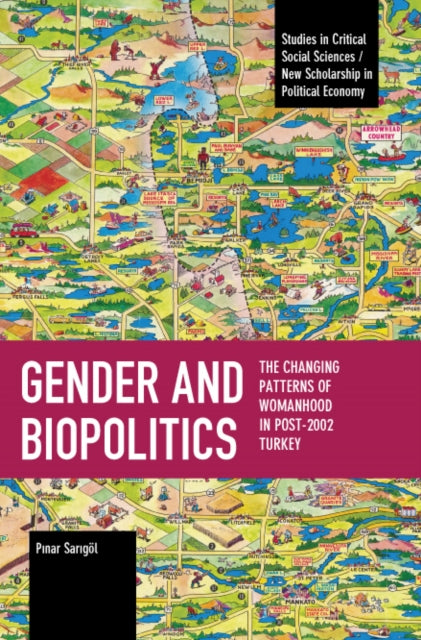
Gender and Biopolitics: The Changing Patterns of Womanhood in Post-2002 Turkey
Gender and Biopolitics: The Changing Patterns of Womanhood in Post-2002 Turkey
💎 Earn 115 Points (£1.15) on this item.
We can order this item for you. Delivery usually takes about 4 to 6 weeks.
This item is not held in our immediate stock. We will order it for you after checkout.
Estimated delivery: About 4 to 6 weeks
YOU SAVE £6.99
- Condition: Brand new
- UK Delivery times: Usually arrives within 2 - 3 working days
- UK Shipping: Fee starts at £2.39. Subject to product weight & dimension
Bulk ordering. Want 15 or more copies? Get a personalised quote and bigger discounts. Learn more about bulk orders.
Couldn't load pickup availability
- More about Gender and Biopolitics: The Changing Patterns of Womanhood in Post-2002 Turkey
Pınar Sarıgöl's Gender and Biopolitics explores neoliberal Islamic thinking about individuals and populations, particularly in post-2002 Turkey. Drawing from Michel Foucault's critical perspective, Sarıgöl examines the governmental rationality of Islamic neoliberalism and its implications for moral and religious practices. The book highlights the interplay between rational and moral values constituting Islamic neoliberal female subjects.
Format: Paperback / softback
Length: 245 pages
Publication date: 08 December 2022
Publisher: Haymarket Books
In her groundbreaking work "Gender and Biopolitics," Pınar Sarıgöl delves into the intricate realms of women's lives, offering a fresh perspective on neoliberal Islamic thought regarding individuals and populations. Drawing upon the critical insights of Michel Foucault, Sarıgöl's examination of the governmental rationality of post-2002 Turkey's Islamic neoliberalism takes on a particularly insightful dimension. The principles and merits of Islamic neoliberalism invite a profound exploration of moral and religious practices in shaping the broader discourse on societal order and the ideal womanhood. By engaging in a fruitful dialogue between Islam and neoliberalism, this book highlights the interconnectedness between rational and moral values that constitute Islamic neoliberal female subjects.
Sarıgöl's exploration of the governmental rationality of post-2002 Turkey's Islamic neoliberalism is informed by Michel Foucault's critical perspective. This critical lens helps shed light on the ways in which governmentality shapes and governs individuals and populations within the context of Islamic neoliberalism. Through her analysis, Sarıgöl highlights the ways in which governmentality operates as a mechanism of control, surveillance, and discipline, shaping the lives of women in particular.
One of the key insights of Islamic neoliberalism is its recognition of society as a social body in which hierarchies and roles are divinely normalised. This perspective challenges traditional Western notions of individualism and liberalism, which often prioritize individual freedom and autonomy over collective well-being. Islamic neoliberalism instead emphasizes the importance of social cohesion, community, and the fulfillment of divinely ordained roles and responsibilities.
This book uniquely brings this point to the fore and draws attention to the interplay between the rational and moral values constituting Islamic neoliberal female subjects. Sarıgöl explores how women are positioned within the framework of Islamic neoliberalism, highlighting the ways in which they are both empowered and constrained by the ideology. She examines the ways in which women are encouraged to participate in the workforce, but also face discrimination and marginalization in the workplace.
Furthermore, Sarıgöl explores the role of women in the family and society as a whole. She examines how Islamic neoliberalism promotes the ideal of a nuclear family, which is seen as a cornerstone of social stability and economic prosperity. However, she also points out the challenges that women face in fulfilling their roles as mothers and caregivers, particularly in the context of gender-based violence and social inequality.
Overall, "Gender and Biopolitics" is a groundbreaking work that offers a critical analysis of neoliberal Islamic thought regarding individuals and populations. Through her exploration of the governmental rationality of post-2002 Turkey's Islamic neoliberalism, Sarıgöl sheds new light on the lives of women and the ways in which they are shaped by the ideology. This book is essential reading for anyone interested in understanding the complex interplay between religion, politics, and gender in contemporary societies.
Weight: 356g
Dimension: 151 x 229 x 17 (mm)
ISBN-13: 9781642597981
This item can be found in:
UK and International shipping information
UK and International shipping information
UK Delivery and returns information:
- Delivery within 2 - 3 days when ordering in the UK.
- Shipping fee for UK customers from £2.39. Fully tracked shipping service available.
- Returns policy: Return within 30 days of receipt for full refund.
International deliveries:
Shulph Ink now ships to Australia, Belgium, Canada, France, Germany, Ireland, Italy, India, Luxembourg Saudi Arabia, Singapore, Spain, Netherlands, New Zealand, United Arab Emirates, United States of America.
- Delivery times: within 5 - 10 days for international orders.
- Shipping fee: charges vary for overseas orders. Only tracked services are available for most international orders. Some countries have untracked shipping options.
- Customs charges: If ordering to addresses outside the United Kingdom, you may or may not incur additional customs and duties fees during local delivery.