HyaeweolChoi
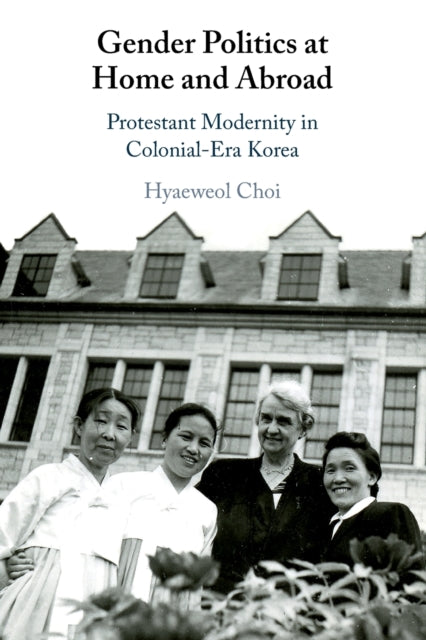
Gender Politics at Home and Abroad: Protestant Modernity in Colonial-Era Korea
Gender Politics at Home and Abroad: Protestant Modernity in Colonial-Era Korea
💎 Earn 127 Points (£1.27) on this item.
We can order this item for you. Delivery usually takes about 4 to 6 weeks.
This item is not held in our immediate stock. We will order it for you after checkout.
Estimated delivery: About 4 to 6 weeks
YOU SAVE £1.51
- Condition: Brand new
- UK Delivery times: Usually arrives within 2 - 3 working days
- UK Shipping: Fee starts at £2.39. Subject to product weight & dimension
Bulk ordering. Want 15 or more copies? Get a personalised quote and bigger discounts. Learn more about bulk orders.
Couldn't load pickup availability
- More about Gender Politics at Home and Abroad: Protestant Modernity in Colonial-Era Korea
Hyaeweol Choi's book explores how Protestant Christianity, introduced to Korea in the late 19th century, shaped modern gender ideology, reformed domestic practices, and expanded women's roles in the public sphere. It challenges the conventional understanding of secularization as a defining feature of modernity and emphasizes the transnational experiences of Koreans in shaping their gender relations.
Format: Paperback / softback
Length: 251 pages
Publication date: 20 October 2022
Publisher: Cambridge University Press
Hyaeweol Choi delves into the intricate tapestry of modern gender relations in Korea, offering a transnational lens to understand their evolution. Contrary to the conventional notion of secularization as a defining trait of modernity, Choi contends that Protestant Christianity, introduced to Korea in the late 19th century, played a pivotal role in shaping the country's gender ideology, transforming domestic practices, and granting women expanded opportunities in the public realm.
In the context of Korea, the influence of Japanese colonial power and its accompanying representations of modernity collided with the dominant cultural and material power of Europe and the United States. This interplay was evident in the Korean attitudes toward Western modernity. One of the significant conduits for transmitting notions of "Western modernity" in Korea was globally connected Christianity, particularly through the efforts of US-led Protestant missionary organizations. By centering his analysis on the interplay between gender and religion, Choi demonstrates that the development of modern gender relations in Korea was intricately woven with the transnational experiences of the Korean people, transcending a simplistic relationship between the colonizer and the colonized.
The arrival of Protestant Christianity in Korea marked a transformative moment in the country's social and cultural landscape. The missionaries brought with them a distinct worldview that challenged traditional Korean beliefs and practices. They emphasized the importance of individual salvation and personal responsibility, which resonated with the Korean desire for social reform and progress. As a result, Christianity became a powerful tool for social change, advocating for gender equality and women's rights.
One of the most significant impacts of Protestant Christianity on gender relations in Korea was its emphasis on the equality of all human beings, regardless of gender. The missionaries challenged the traditional Korean belief that women were inferior to men and advocated for their equal rights and opportunities. They promoted education for women, encouraged them to participate in public life, and advocated for women's suffrage. These efforts laid the foundation for the eventual realization of women's rights in Korea in the 20th century.
Protestant Christianity also played a role in reforming domestic practices in Korea. The missionaries introduced Western-style household management systems, which were based on the division of labor and gender roles. They encouraged women to take on more responsibilities in the household, such as cooking, cleaning, and child-rearing, which helped to alleviate the burden of men and promote gender equality.
Furthermore, Protestant Christianity provided a new space for women in the public sphere. The missionaries established schools, hospitals, and orphanages for women, which allowed them to gain knowledge, skills, and independence. These institutions also served as a platform for women to participate in social and political activities, challenging the traditional gender roles and stereotypes.
However, the impact of Protestant Christianity on gender relations in Korea was not without its challenges. The missionaries faced resistance from traditional Korean society, which was deeply rooted in Confucianism and patriarchy. They were often accused of promoting Western values and undermining Korean culture and tradition. Additionally, the missionaries' emphasis on individual salvation and personal responsibility could sometimes lead to a neglect of the collective well-being of society, particularly in terms of gender equality.
Despite these challenges, Protestant Christianity continued to play a significant role in shaping modern gender relations in Korea. Its emphasis on gender equality, women's rights, and social reform paved the way for the eventual realization of women's rights in the country. Today, Korea is recognized as a leader in gender equality, with women holding high positions in government, business, and society.
In conclusion, Hyaeweol Choi's examination of the formation of modern gender relations in Korea from a transnational perspective highlights the crucial role of Protestant Christianity in shaping the country's gender ideology, reforming domestic practices, and granting women expanded opportunities in the public realm. The transnational experience of Koreans, combined with the influence of Japanese colonial power and Western modernity, played a pivotal role in shaping the development of modern gender relations in the country. While Protestant Christianity faced challenges, its impact on gender relations in Korea remains profound, and its legacy continues to shape the country's social and cultural landscape.
Weight: 370g
ISBN-13: 9781108720281
UK and International shipping information
UK and International shipping information
UK Delivery and returns information:
- Delivery within 2 - 3 days when ordering in the UK.
- Shipping fee for UK customers from £2.39. Fully tracked shipping service available.
- Returns policy: Return within 30 days of receipt for full refund.
International deliveries:
Shulph Ink now ships to Australia, Belgium, Canada, France, Germany, Ireland, Italy, India, Luxembourg Saudi Arabia, Singapore, Spain, Netherlands, New Zealand, United Arab Emirates, United States of America.
- Delivery times: within 5 - 10 days for international orders.
- Shipping fee: charges vary for overseas orders. Only tracked services are available for most international orders. Some countries have untracked shipping options.
- Customs charges: If ordering to addresses outside the United Kingdom, you may or may not incur additional customs and duties fees during local delivery.