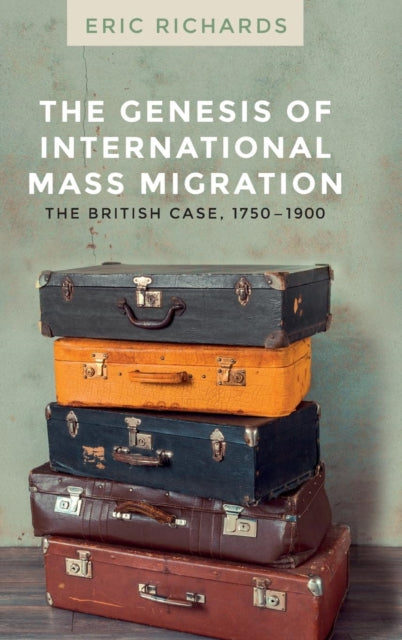
Eric Richards
Genesis of International Mass Migration: The British Case, 1750-1900
Genesis of International Mass Migration: The British Case, 1750-1900
💎 Earn 235 Points (£2.35) on this item.
YOU SAVE £37.95
- Condition: Brand new
- UK Delivery times: Usually arrives within 2 - 3 working days
- UK Shipping: Fee starts at £2.39. Subject to product weight & dimension
Bulk ordering. Want 15 or more copies? Get a personalised quote and bigger discounts. Learn more about bulk orders.
Couldn't load pickup availability
- More about Genesis of International Mass Migration: The British Case, 1750-1900
After 1770, a significant number of people began to leave the British Isles for the New Worlds, leading to a pioneering movement of mass economic migration that was a rehearsal for modern international migration. The reasons for this migration were various, including economic opportunities, dispossession, settlement, family dreams, individual aspirations, and imperial strategies.
Format: Hardback
Length: 296 pages
Publication date: 11 July 2018
Publisher: Manchester University Press
After around 1770, a significant number of people started leaving the British Isles for the New Worlds. These individuals were the pioneers of mass economic migration, bringing with them a new wave of global labor forces. They played various roles, including dispossession, settlement, fulfilling family dreams, pursuing individual aspirations, and contributing to imperial strategies. This migration was unprecedented in scale and marked a significant milestone in the history of international migration.
The British Isles were the epicenter of these early mass intercontinental movements. What sparked these massive exchanges of humanity, which laid the foundation for so much modern population transfer and global turmoil? This is a central question in the study of genealogy and plays a crucial role in shaping the modern world.
The reasons for this migration were multifaceted. One factor was the economic opportunities offered in the New Worlds. The colonies and territories in North America, Africa, and Asia were rapidly expanding and seeking workers to cultivate their land and industries. The British Isles, with their established economies and skilled workforce, were a desirable destination for those seeking a better life.
Another factor was the political and social unrest in the British Isles. The Industrial Revolution brought about significant changes in the social and economic landscape, leading to increased poverty, inequality, and social unrest. Many people, especially in rural areas, were struggling to make a living and saw migration as a way to escape the harsh conditions and improve their prospects.
Additionally, the spread of ideas and ideologies such as democracy, capitalism, and religious freedom also played a role in motivating people to leave the British Isles. The Enlightenment period saw a rise in intellectual and philosophical discourse, which challenged traditional social and political structures and promoted individual rights and freedoms. Many people were attracted to these ideas and sought to apply them in their lives in a new environment.
The migration process itself was complex and challenging. It involved long voyages across the ocean, often in cramped and uncomfortable conditions, with high risks of disease, malnutrition, and death. The immigrants faced numerous challenges upon their arrival in the New Worlds, including discrimination, language barriers, and cultural differences.
Despite these challenges, the migration from the British Isles to the New Worlds had a profound impact on the development of the world. It contributed to the growth of new economies, the spread of new technologies and ideas, and the diversification of cultures. It also shaped the identities of the immigrants and their descendants, creating a rich and complex tapestry of global heritage.
In conclusion, the migration from the British Isles to the New Worlds after around 1770 was a significant event in the history of human migration. It was driven by economic opportunities, political and social unrest, the spread of ideas and ideologies, and the desire for a better life. The migration process was complex and challenging, but it had a profound impact on the development of the world. It serves as a reminder of the power of human mobility and the importance of understanding the factors that drive people to move across borders.
Weight: 602g
Dimension: 162 x 241 x 29 (mm)
ISBN-13: 9781526131485
This item can be found in:
UK and International shipping information
UK and International shipping information
UK Delivery and returns information:
- Delivery within 2 - 3 days when ordering in the UK.
- Shipping fee for UK customers from £2.39. Fully tracked shipping service available.
- Returns policy: Return within 30 days of receipt for full refund.
International deliveries:
Shulph Ink now ships to Australia, Belgium, Canada, France, Germany, Ireland, Italy, India, Luxembourg Saudi Arabia, Singapore, Spain, Netherlands, New Zealand, United Arab Emirates, United States of America.
- Delivery times: within 5 - 10 days for international orders.
- Shipping fee: charges vary for overseas orders. Only tracked services are available for most international orders. Some countries have untracked shipping options.
- Customs charges: If ordering to addresses outside the United Kingdom, you may or may not incur additional customs and duties fees during local delivery.