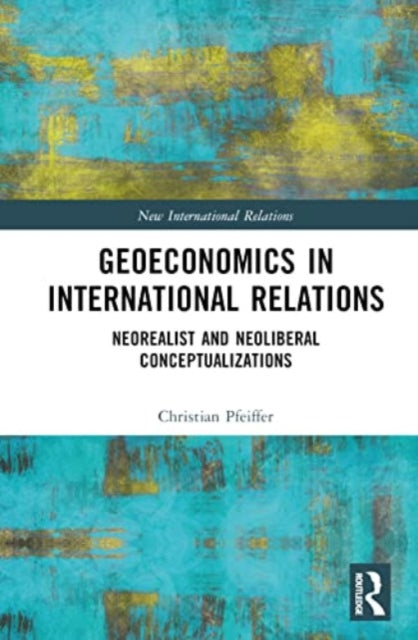
ChristianPfeiffer
Geoeconomics in International Relations: Neorealist and Neoliberal Conceptualizations
Geoeconomics in International Relations: Neorealist and Neoliberal Conceptualizations
💎 Earn 811 Points (£8.11) on this item.
We can order this item for you. Delivery usually takes about 4 to 6 weeks.
This item is not held in our immediate stock. We will order it for you after checkout.
Estimated delivery: About 4 to 6 weeks
YOU SAVE £9.63
- Condition: Brand new
- UK Delivery times: Usually arrives within 2 - 3 working days
- UK Shipping: Fee starts at £3.89. Subject to product weight & dimension
Bulk ordering. Want 15 or more copies? Get a personalised quote and bigger discounts. Learn more about bulk orders.
Couldn't load pickup availability
- More about Geoeconomics in International Relations: Neorealist and Neoliberal Conceptualizations
Geoeconomics is an interdisciplinary field that examines the relationship between geography, economics, and international relations.
Geoeconomics is an interdisciplinary field that examines the relationship between geography, economics, and international relations, focusing on the impact of location on economic activities and security.
Format: Hardback
Length: 200 pages
Publication date: 03 November 2023
Publisher: Taylor & Francis Ltd
Geoeconomics is a field of study that examines the complex relationships between geography, economics, and international relations (IR). It provides a comprehensive and systematic analysis of the concept of geoeconomics in IR, exploring its historical development, theoretical foundations, methodological approaches, ideological underpinnings, normative aspects, and practical relevance.
Geoeconomics emerged as a distinct field of study in the late 20th century, driven by the growing interconnectedness of the global economy and the increasing importance of geographical factors in shaping international relations. The field draws on various disciplines, including geography, economics, political science, and international law, to understand the complex interactions between economic activities, resource distribution, and geopolitical power dynamics.
One of the key approaches to geoeconomics is the resource-based view, which argues that the distribution of natural resources, such as oil, gas, and minerals, plays a significant role in shaping international relations. Countries with abundant resources are often seen as having greater economic and political power, which can lead to conflicts over access and control. For example, the oil crisis of the 1970s and the subsequent conflicts in the Middle East were largely driven by the competition for oil resources.
Another important aspect of geoeconomics is the concept of the "geo-political economy," which emphasizes the role of geography in shaping economic activities and international trade. Countries with favorable geographic conditions, such as access to ports, trade routes, and natural resources, can enjoy economic advantages over their competitors. For example, countries located along the Silk Road, which was a major trade route connecting China and Europe, were able to benefit from the trade in goods and ideas.
Geoeconomics also examines the relationship between economic development and international security. The pursuit of economic growth and development can often lead to tensions and conflicts, particularly in regions with scarce resources or competing claims over territory. For example, the conflicts in the Middle East and Africa are often driven by competition for land, water, and oil resources.
In addition to its analytical framework, geoeconomics also provides practical insights into international relations and policymaking. Governments and international organizations can use geoeconomic analysis to identify potential risks and opportunities in the global economy, and develop strategies to mitigate them. For example, the United States has used geoeconomic analysis to shape its foreign policy towards China and Russia, focusing on their access to resources and trade routes.
Despite its many contributions, geoeconomics is not without its critics. Some argue that the field is too narrow and limited in its scope, focusing solely on the distribution of natural resources and neglecting other important factors such as culture, history, and political institutions. Others argue that geoeconomics is too deterministic and fails to account for the complex and unpredictable nature of international relations.
In conclusion, geoeconomics is a field of study that provides a comprehensive and systematic analysis of the complex relationships between geography, economics, and international relations. It offers valuable insights into the factors that shape international power dynamics, economic development, and international security. While geoeconomics is not without its critics, it remains an important tool for understanding the world we live in and for developing effective strategies for navigating the complex geopolitical landscape.
Geoeconomics is a field of study that examines the complex relationships between geography, economics, and international relations (IR). It provides a comprehensive and systematic analysis of the concept of geoeconomics in IR, exploring its historical development, theoretical foundations, methodological approaches, ideological underpinnings, normative aspects, and practical relevance.
Weight: 560g
Dimension: 234 x 156 (mm)
ISBN-13: 9781032500386
UK and International shipping information
UK and International shipping information
We deliver throughout the United Kingdom and to 128 countries and territories worldwide, including the United States, Australia, Canada, Germany, Spain and France.