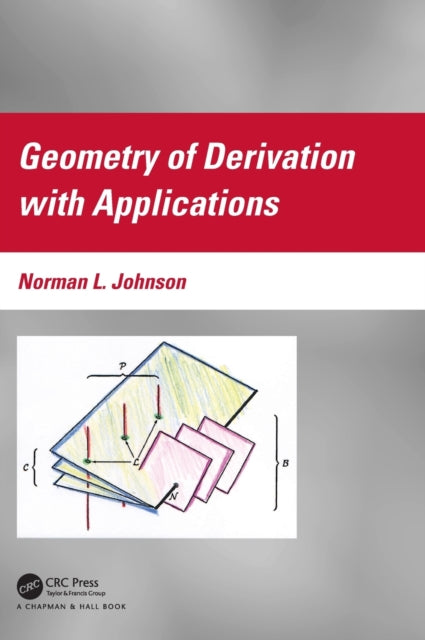
Norman L.Johnson
Geometry of Derivation with Applications
Geometry of Derivation with Applications
💎 Earn 589 Points (£5.89) on this item.
We can order this item for you. Delivery usually takes about 4 to 6 weeks.
This item is not held in our immediate stock. We will order it for you after checkout.
Estimated delivery: About 4 to 6 weeks
YOU SAVE £7.00
- Condition: Brand new
- UK Delivery times: Usually arrives within 2 - 3 working days
- UK Shipping: Fee starts at £3.89. Subject to product weight & dimension
Bulk ordering. Want 15 or more copies? Get a personalised quote and bigger discounts. Learn more about bulk orders.
Couldn't load pickup availability
- More about Geometry of Derivation with Applications
The study of quadrics and their connections to incidence geometry, non-commutative algebra, coding theory, and other areas of mathematics is known as quadratic geometry. It has produced a wide range of new geometries and has applications in various fields.
Format: Hardback
Length: 356 pages
Publication date: 06 June 2023
Publisher: Taylor & Francis Ltd
Connections with incidence geometry and non-commutative algebra:
Incidence geometry, a branch of mathematics, has deep connections with non-commutative algebra. This relationship is explored through various theories and concepts, including the study of quadrics, translation planes, and skewfield extensions. Quadrics, which are algebraic curves defined by a quadratic equation, play a central role in incidence geometry. They are used to study the geometry of plane curves and surfaces, and their properties are closely related to those of non-commutative algebras. Translation planes, on the other hand, are planes that intersect a given curve or surface in a specific way. They are used to study the geometry of surfaces and curves, and their properties are also closely related to those of non-commutative algebras. Skewfield extensions, which are a type of extension of a field, are used to study the geometry of surfaces and curves in higher dimensions. They are closely related to the study of non-commutative algebras and have applications in coding theory.
Extensions to the flocks of quadrics and equivalent translation planes:
In addition to the study of quadrics and translation planes, there are several extensions to the flocks of quadrics and equivalent translation planes. One such extension is the study of quadrics with multiple components, which are quadrics that have more than one intersection with a given plane. These quadrics are used to study the geometry of surfaces and curves in higher dimensions, and their properties are closely related to those of non-commutative algebras. Another extension is the study of equivalent translation planes, which are planes that intersect a given curve or surface in a similar way. These planes are used to study the geometry of surfaces and curves, and their properties are also closely related to those of non-commutative algebras.
Skewfield extension of the theorem of Andre over finite Desarguesian planes:
One of the most important results in incidence geometry is the theorem of Andre, which states that a plane curve can be embedded in a projective space of dimension two if and only if it is a Desarguesian plane. In this theorem, the Desarguesian plane is a plane that intersects a given curve or surface in a single point. However, there are cases where the Desarguesian plane is not finite, such as when the curve or surface is a circle. In such cases, the skewfield extension of the theorem of Andre is used. The skewfield extension of the theorem of Andre states that a plane curve can be embedded in a projective space of dimension two if and only if it is a skewfield plane. A skewfield plane is a plane that intersects a given curve or surface in a single point and has a non-zero determinant.
Features ideas used in coding theory via cyclic division algebras:
Cyclic division algebras, which are a type of algebraic structure, have been used to study the geometry of codes and cryptography. These algebras are used to encode and decode messages, and their properties are closely related to those of non-commutative algebras. One of the most important features of cyclic division algebras is their cyclicity, which means that they have a cyclic group of automorphisms. This cyclicity allows for the study of the geometry of codes and cryptography, and it has been used to develop new encryption algorithms and protocols.
Great variety of new planes, quasifibrations, and interconnecting geometries:
Incidence geometry has led to the discovery of a wide variety of new planes, quasifibrations, and interconnecting geometries. One such example is the study of hyperbolic surfaces, which are surfaces that are modeled by hyperbolic geometry. Hyperbolic surfaces have a number of interesting properties, including the fact that they are non-Euclidean and have a non-trivial topology. They have been used to study the geometry of knots and links, and they have applications in the study of quantum mechanics and string theory. Another example is the study of quasifibrations, which are a type of dynamical system that is defined by a non-linear differential equation. Quasifibrations have a wide variety of applications, including the study of the behavior of fluids and gases, the study of the behavior of biological systems, and the study of the behavior of celestial bodies. They have also been used to develop new algorithms for solving differential equations and for studying the behavior of complex systems.
In conclusion, incidence geometry has deep connections with non-commutative algebra, and these connections are explored through various theories and concepts. Quadrics, translation planes, skewfield extensions, and cyclic division algebras are just a few of the areas where these connections are studied. The study of these areas has led to the discovery of a wide variety of new planes, quasifibrations, and interconnecting geometries, and these discoveries have had a significant impact on a number of fields, including mathematics, physics, and computer science.
Weight: 808g
Dimension: 184 x 261 x 27 (mm)
ISBN-13: 9781032349169
UK and International shipping information
UK and International shipping information
We deliver throughout the United Kingdom and to 128 countries and territories worldwide, including the United States, Australia, Canada, Germany, Spain and France.