Agnes Bernek
Geopolitics of Central and Eastern Europe in the 21st Century: From the Buffer Zone to the Gateway Zone
Geopolitics of Central and Eastern Europe in the 21st Century: From the Buffer Zone to the Gateway Zone
💎 Earn 152 Points (£1.52) on this item.
We can order this item for you. Delivery usually takes about 4 to 6 weeks.
This item is not held in our immediate stock. We will order it for you after checkout.
Estimated delivery: About 4 to 6 weeks
YOU SAVE £3.96
- Condition: Brand new
- UK Delivery times: Usually arrives within 2 - 3 working days
- UK Shipping: Fee starts at £2.39. Subject to product weight & dimension
Bulk ordering. Want 15 or more copies? Get a personalised quote and bigger discounts. Learn more about bulk orders.
Couldn't load pickup availability
- More about Geopolitics of Central and Eastern Europe in the 21st Century: From the Buffer Zone to the Gateway Zone
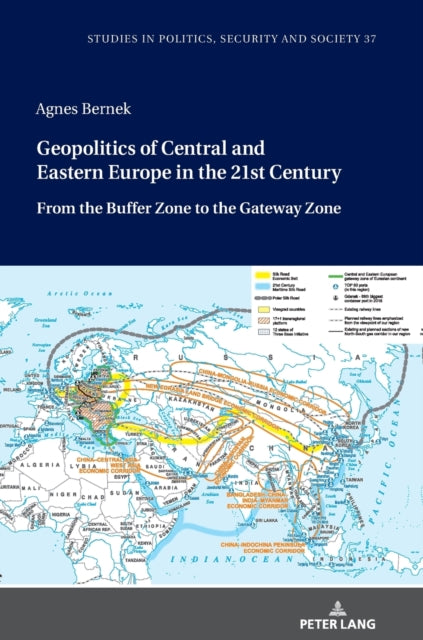
This book explores how the geopolitical situation of the Central and Eastern European (CEE) region can be repositioned in the 21st century, abandoning the paradigms of the Cold War and considering the development of a new gateway zone along the north-south Baltic-Adriatic axis.
Format: Hardback
Length: 242 pages
Publication date: 25 February 2021
Publisher: Peter Lang AG
This book aims to explore how we can reorient the geopolitical landscape of the Central and Eastern European (CEE) region in the twenty-first century. The CEE region, characterized by its socialist heritage, has undergone significant transformations in the twenty-first century. Within the realm of geopolitical thought, we must shed the paradigms of the Cold War era. The role of a gateway zone, traditionally associated with facilitating connections between great powers, becomes less relevant in the CEE region. However, it is possible to identify four gateway regions along the north-south Baltic-Adriatic axis (Baltic, North Adriatic, Central European, and Eurasian) and two gateway regions along the southeast-east European axis (Mediterranean and Black Sea). The central question of the twenty-first century revolves around the potential development of a new gateway zone, akin to the World-Island, along a north-south Baltic-Adriatic axis.
The geopolitical landscape of the CEE region has been shaped by a complex history, marked by the influence of various powers and ideologies. The region's location at the crossroads of Europe, Asia, and Africa has made it a strategic hub for trade, commerce, and cultural exchange. However, the Cold War era and the subsequent division of the continent into NATO and the Warsaw Pact also left deep scars in the region's geopolitical landscape.
One of the key challenges facing the CEE region in the twenty-first century is the process of integration into the European Union (EU). The EU has provided a framework for economic and political cooperation, but the accession of several former Soviet republics has been slow and contentious. The region's economies are still largely based on industry and agriculture, and there are significant disparities in wealth and development between different member states.
Another challenge is the impact of globalization on the CEE region. The region has been a major beneficiary of the global economy, with many companies and industries locating their operations in the region. However, the region's exposure to international markets has also led to increased competition and vulnerability to economic shocks.
In terms of geopolitical strategy, the CEE region faces several options. One option is to continue to align itself with the EU and seek closer integration into the European political and economic system. This would involve deepening economic and political ties with EU member states and working towards a common currency and a unified foreign policy.
Another option is to pursue a more independent and assertive geopolitical strategy. This could involve strengthening ties with Russia, China, and other non-EU powers, as well as promoting regional cooperation and stability. However, this approach could also lead to increased tensions and conflicts with EU member states.
The CEE region also has significant natural resources, including energy, minerals, and agricultural products. These resources could be used to promote economic development and create new opportunities for investment and growth. However, there are also concerns about environmental sustainability and the impact of resource extraction on local communities.
In conclusion, the geopolitical landscape of the CEE region is complex and multifaceted. The region faces a range of challenges, including economic integration, globalization, and geopolitical tensions. However, there are also opportunities for growth and development, particularly through closer integration with the EU and the promotion of regional cooperation.
Weight: 464g
Dimension: 156 x 219 x 22 (mm)
ISBN-13: 9783631819159
Edition number: New ed
UK and International shipping information
UK and International shipping information
UK Delivery and returns information:
- Delivery within 2 - 3 days when ordering in the UK.
- Shipping fee for UK customers from £2.39. Fully tracked shipping service available.
- Returns policy: Return within 30 days of receipt for full refund.
International deliveries:
Shulph Ink now ships to Australia, Belgium, Canada, France, Germany, Ireland, Italy, India, Luxembourg Saudi Arabia, Singapore, Spain, Netherlands, New Zealand, United Arab Emirates, United States of America.
- Delivery times: within 5 - 10 days for international orders.
- Shipping fee: charges vary for overseas orders. Only tracked services are available for most international orders. Some countries have untracked shipping options.
- Customs charges: If ordering to addresses outside the United Kingdom, you may or may not incur additional customs and duties fees during local delivery.