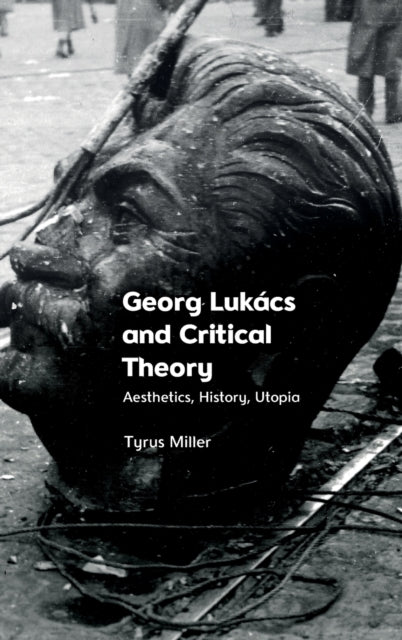
Tyrus Miller
Georg Lukacs and Critical Theory: Aesthetics, History, Utopia
Georg Lukacs and Critical Theory: Aesthetics, History, Utopia
💎 Earn 383 Points (£3.83) on this item.
YOU SAVE £23.30
- Condition: Brand new
- UK Delivery times: Usually arrives within 2 - 3 working days
- UK Shipping: Fee starts at £2.39. Subject to product weight & dimension
Bulk ordering. Want 15 or more copies? Get a personalised quote and bigger discounts. Learn more about bulk orders.
Couldn't load pickup availability
- More about Georg Lukacs and Critical Theory: Aesthetics, History, Utopia
This book explores the legacy of critical theory from Lukács to the Frankfurt School, examining art, utopia, and authoritarian politics. It offers unique perspectives on left-wing intellectuals' efforts to understand and resist societal impoverishment of thought and experience.
Format: Hardback
Length: 280 pages
Publication date: 31 October 2022
Publisher: Edinburgh University Press
This book delves into the rich heritage of critical theory, tracing its roots from the Hungarian Marxist philosopher Georg Lukács to the early Frankfurt School and its contemporary relevance in addressing authoritarian politics and democratisation. Through a captivating blend of discussions on art, literature, utopian thought, and the dialectics of high art and mass culture, the book offers unique perspectives on a group of left-wing intellectuals who sought to understand and resist the systematic impoverishment of thought and experience in their society.
The book begins with Lukács's reflections on art, utopia, and historical action, exploring the role of art in shaping society and the potential for utopian visions to transform reality. It then moves on to Theodor W. Adorno's analyses of music, media, avant-garde, and kitsch, examining the impact of these cultural forms on society and the ways in which they can be used to manipulate and control individuals.
The book concludes with discussions of erotic utopia, authoritarianism, postsocialism, and organised deceit in show trials, highlighting the enduring relevance of Lukács and Frankfurt School critical theory in understanding the complexities of contemporary politics and society.
Lukács's reflections on art, utopia, and historical action provide a foundation for understanding the role of art in shaping society. He argues that art is not merely a reflection of reality but can also be a means of transforming it. He explores the potential for utopian visions to inspire social change and argues that art can play a crucial role in creating a more just and equitable world.
Adorno's analyses of music, media, avant-garde, and kitsch are equally important in understanding the impact of cultural forms on society. He argues that these cultural forms can be used to manipulate and control individuals, and that they can contribute to the systematic impoverishment of thought and experience. Adorno's work is particularly relevant in the context of authoritarian politics, where cultural forms are used to promote a particular ideology and suppress dissent.
The book also discusses the dialectics of high art and mass culture, exploring the ways in which these two forms of art interact and influence each other. Lukács argues that high art is a form of art that is created for the elite and that it is often inaccessible to the masses. He argues that mass culture, on the other hand, is a form of art that is created for the masses and that it is often superficial and trivial.
However, Lukács also argues that high art and mass culture can be reconciled, and that they can be used to create a more inclusive and democratic society. He suggests that high art can be used to challenge the dominant ideology and to promote a more critical and reflective approach to society.
The book also discusses the legacy of Lukács and Frankfurt School critical theory in contemporary politics and society. It argues that the legacy of Lukács and Frankfurt School critical theory continues to be relevant today, particularly in the context of authoritarian politics and democratisation. The book highlights the ways in which the legacy of Lukács and Frankfurt School critical theory can be used to resist and challenge the systematic impoverishment of thought and experience in our society.
In conclusion, this book is a valuable contribution to the field of critical theory. It offers unique perspectives on a group of left-wing intellectuals who sought to understand and resist the systematic impoverishment of thought and experience in their society. Through a captivating blend of discussions on art, literature, utopian thought, and the dialectics of high art and mass culture, the book provides a rich and insightful exploration of the legacy of Lukács and Frankfurt School critical theory.
Dimension: 234 x 156 (mm)
ISBN-13: 9781399502412
Edition number: 100,079 ed.
This item can be found in:
UK and International shipping information
UK and International shipping information
UK Delivery and returns information:
- Delivery within 2 - 3 days when ordering in the UK.
- Shipping fee for UK customers from £2.39. Fully tracked shipping service available.
- Returns policy: Return within 30 days of receipt for full refund.
International deliveries:
Shulph Ink now ships to Australia, Belgium, Canada, France, Germany, Ireland, Italy, India, Luxembourg Saudi Arabia, Singapore, Spain, Netherlands, New Zealand, United Arab Emirates, United States of America.
- Delivery times: within 5 - 10 days for international orders.
- Shipping fee: charges vary for overseas orders. Only tracked services are available for most international orders. Some countries have untracked shipping options.
- Customs charges: If ordering to addresses outside the United Kingdom, you may or may not incur additional customs and duties fees during local delivery.