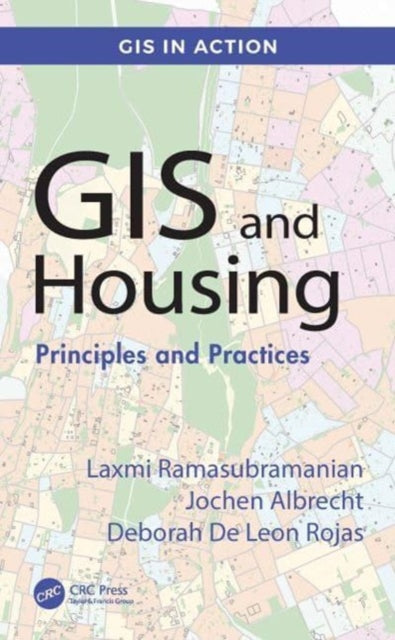
Laxmi Ramasubramanian,Jochen Albrecht,Deborah Rojas De Leon
GIS and Housing: Principles and Practices
GIS and Housing: Principles and Practices
YOU SAVE £11.00
- Condition: Brand new
- UK Delivery times: Usually arrives within 2 - 3 working days
- UK Shipping: Fee starts at £3.89. Subject to product weight & dimension
Bulk ordering. Want 15 or more copies? Get a personalised quote and bigger discounts. Learn more about bulk orders.
Couldn't load pickup availability
- More about GIS and Housing: Principles and Practices
GIS and Housing: Principles and Practices discusses how GIS can be used to address the complex issues underlying the housing crisis, providing an overview of US housing challenges and examples of effective integration of spatial thinking to address housing policy questions. It advocates for a collaborative approach to confront the multifaceted housing crisis and proposes solutions that leverage the integrative capacity of GIS to address established housing issues.
Format: Hardback
Length: 236 pages
Publication date: 29 December 2023
Publisher: Taylor & Francis Ltd
Geographic Information Science (GIS) has been a powerful tool for understanding and addressing various challenges in our world, but one area that has yet to be fully explored is how GIS can be used to address the complex issues underlying the housing crisis. In GIS and Housing: Principles and Practices, authors Markus Brunnermeier and Michael Batty take on this challenge by providing a comprehensive overview of US housing challenges and examples of how GIS can be effectively integrated to address these challenges.
The book begins by examining the historical aspects of housing provision, societal attitudes, demographic shifts, and government policies that have contributed to the housing crisis. It then bridges the gaps between housing professionals and GIS experts, facilitating an interdisciplinary approach to address the housing crisis. The authors explore different challenges that are facing urban, suburban, and rural neighborhoods in different US regions, including issues of affordability, supply shortages, and homelessness.
One of the key strengths of the book is its ability to provide professionals with the necessary tools for informed decision-making. The authors introduce advanced GIS concepts and techniques, such as spatial analysis, mapping, and visualization, that can help professionals analyze data and identify patterns that can inform housing policy and development. They also provide case studies and examples of successful GIS applications in housing, such as the use of GIS to map housing affordability, track housing market trends, and develop smart growth strategies.
Another important aspect of the book is its advocacy for denser housing alternatives to address issues of affordability, supply shortages, and homelessness. The authors argue that traditional single-family housing is not sustainable in many urban areas and that we need to explore new housing options that can provide affordable housing to a wider range of people. They propose solutions that leverage the integrative capacity of GIS to address established housing issues, such as zoning regulations, land use planning, and transportation infrastructure.
The book is intended for graduate students and professionals in housing, community development, urban planning, architecture, and GIS, as well as anyone curious about learning more about the American housing crisis. It provides a comprehensive and accessible introduction to the field of GIS and housing, and it offers valuable insights and practical applications for addressing this pressing issue.
In conclusion, GIS and Housing: Principles and Practices is a valuable resource for anyone interested in understanding and addressing the housing crisis. By providing a comprehensive overview of US housing challenges and examples of how GIS can be effectively integrated to address these challenges, the book offers a valuable contribution to the field of GIS and housing. It is a must-read for professionals, policymakers, and anyone who is committed to creating livable neighborhoods and addressing the multifaceted housing crisis.
Weight: 453g
Dimension: 234 x 156 (mm)
ISBN-13: 9780367197339
UK and International shipping information
UK and International shipping information
We deliver throughout the United Kingdom and to 128 countries and territories worldwide, including the United States, Australia, Canada, Germany, Spain and France.