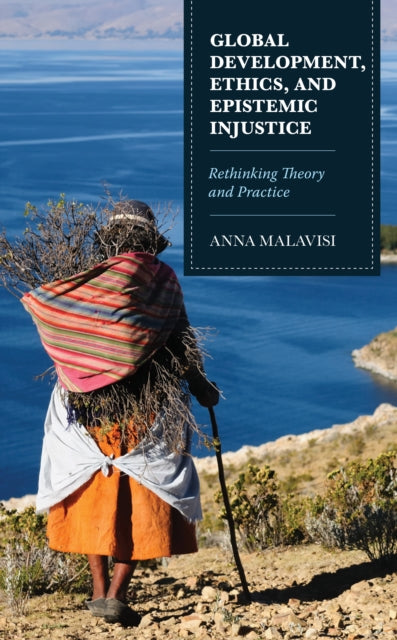
Anna Malavisi
Global Development, Ethics, and Epistemic Injustice: Rethinking Theory and Practice
Global Development, Ethics, and Epistemic Injustice: Rethinking Theory and Practice
We can order this item for you. Delivery usually takes about 4 to 6 weeks.
This item is not held in our immediate stock. We will order it for you after checkout.
Estimated delivery: About 4 to 6 weeks
- Condition: Brand new
- UK Delivery times: Usually arrives within 2 - 3 working days
- UK Shipping: Fee starts at £3.89. Subject to product weight & dimension
Bulk ordering. Want 15 or more copies? Get a personalised quote and bigger discounts. Learn more about bulk orders.
Couldn't load pickup availability
- More about Global Development, Ethics, and Epistemic Injustice: Rethinking Theory and Practice
Global Development, Ethics, and Epistemic Injustice: Rethinking Theory and Practice offers a critical analysis of global development, addressing ethical and epistemic issues. Anna Malavisi argues that ethics in development is overshadowed by economic and political interests and national self-interest, and proposes a strong ethical approach comprising a feminist methodology, social ethical praxis, political responsibility, epistemic justice, and deep-green theory to address Chagas Disease and other development problems more effectively.
Format: Hardback
Length: 232 pages
Publication date: 31 December 2022
Publisher: Bloomsbury Publishing Plc
Global Development, Ethics, and Epistemic Injustice: Rethinking Theory and Practice presents a critical analysis of global development from a theoretical and practical perspective, addressing both ethical and epistemic issues. Anna Malavisi, a practitioner in global development for several years, argues that one of the problems in global development today is the absence of an ethical analysis. The book describes how Chagas diseases, as a Neglected Tropical Disease, continues to plague vulnerable populations in poorer countries such as Bolivia due to a limited way in which it has been conceived, understood, and addressed. Malavisi offers a strong ethical approach, comprising a feminist methodology, a social ethical praxis, political responsibility, epistemic justice, and deep-green theory. A strong ethical approach is necessary to address Chagas Disease as well as other development problems in a more effective way.
Malavisi's book highlights the ethical challenges faced by global development practitioners. She argues that ethics in development today is overshadowed by economic and political interests, as well as national self-interest. This leads to a lack of attention to the ethical implications of development projects and policies. Malavisi's feminist methodology, social ethical praxis, political responsibility, epistemic justice, and deep-green theory provide a framework for addressing these ethical challenges.
One of the key issues addressed in the book is the Neglected Tropical Disease (NTD) of Chagas Disease. Chagas Disease is a parasitic infection that affects millions of people worldwide, particularly in poorer countries such as Bolivia. It is caused by the bite of a triatomine bug, which is found in rural areas and can transmit the disease through blood transfusions, organ transplants, and sexual contact. Malavisi argues that the limited way in which Chagas Disease has been conceived, understood, and addressed has led to a lack of effective treatment and prevention.
Malavisi's feminist methodology involves a critical examination of the gendered nature of global development. She argues that women are disproportionately affected by development projects and policies, and that their voices are often ignored or marginalized. She proposes a feminist approach to development that involves empowering women and promoting gender equality.
Malavisi's social ethical praxis involves a commitment to social justice and the promotion of human rights. She argues that development projects and policies should be designed to benefit the poor and marginalized, and that they should not be used to exploit or oppress them. She proposes a social ethical praxis that involves working with communities to develop sustainable solutions to development problems.
Political responsibility is another key issue addressed in the book. Malavisi argues that governments and international organizations have a responsibility to ensure that development projects and policies are ethical and sustainable. She proposes a political responsibility that involves promoting transparency, accountability, and democratic governance.
Epistemic justice is another key issue addressed in the book. Malavisi argues that development projects and policies should be based on accurate and reliable information. She proposes a epistemic justice that involves promoting access to information and knowledge, and that it should be used to inform decision-making processes.
Deep-green theory is another key issue addressed in the book. Malavisi argues that development should be sustainable and environmentally friendly. She proposes a deep-green theory that involves promoting renewable energy, reducing greenhouse gas emissions, and protecting natural resources.
Malavisi's book provides a comprehensive and insightful analysis of global development from a theoretical and practical perspective. She offers a strong ethical approach that can be used to address the ethical challenges faced by global development practitioners. Her feminist methodology, social ethical praxis, political responsibility, epistemic justice, and deep-green theory provide a framework for promoting ethical and sustainable development.
In conclusion, Global Development, Ethics, and Epistemic Injustice: Rethinking Theory and Practice presents a critical analysis of global development from a theoretical and practical perspective, addressing both ethical and epistemic issues. Anna Malavisi's feminist methodology, social ethical praxis, political responsibility, epistemic justice, and deep-green theory provide a framework for promoting ethical and sustainable development. Her book is a must-read for anyone interested in global development and the ethical challenges faced by practitioners.
Weight: 549g
Dimension: 237 x 158 x 23 (mm)
ISBN-13: 9781793616913
UK and International shipping information
UK and International shipping information
We deliver throughout the United Kingdom and to 128 countries and territories worldwide, including the United States, Australia, Canada, Germany, Spain and France.