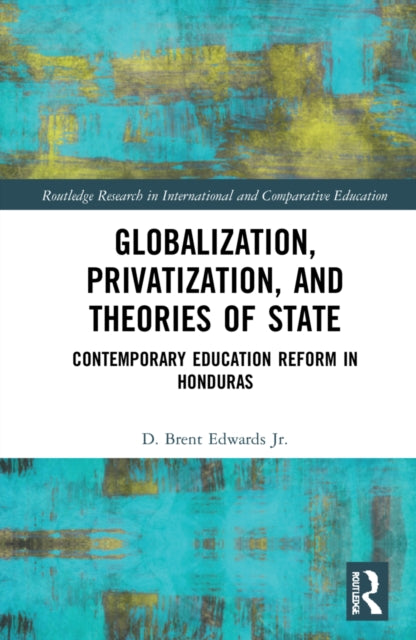
Mauro C. Moschetti,AlejandroCaravaca,D. Brent, Jr. Edwards
Globalization, Privatization, and the State: Contemporary Education Reform in Post-Colonial Contexts
Globalization, Privatization, and the State: Contemporary Education Reform in Post-Colonial Contexts
💎 Earn 811 Points (£8.11) on this item.
We can order this item for you. Delivery usually takes about 4 to 6 weeks.
This item is not held in our immediate stock. We will order it for you after checkout.
Estimated delivery: About 4 to 6 weeks
YOU SAVE £9.63
- Condition: Brand new
- UK Delivery times: Usually arrives within 2 - 3 working days
- UK Shipping: Fee starts at £2.39. Subject to product weight & dimension
Bulk ordering. Want 15 or more copies? Get a personalised quote and bigger discounts. Learn more about bulk orders.
Couldn't load pickup availability
- More about Globalization, Privatization, and the State: Contemporary Education Reform in Post-Colonial Contexts
The dynamics of globalization and privatization have influenced State policy and impacted education reform in Honduras. Understanding education reform in post-colonial contexts requires considering the ways that colonialism's logics, practices, and relationships continue to be embedded in the apparatus of modern States. The framework draws upon scholarship from political economy, world systems, and post-colonialism to depict the ethos of privatization at the core of post-colonial States, where private benefit drives the system, not in the interest of those outside the State.
Format: Hardback
Length: 202 pages
Publication date: 16 August 2022
Publisher: Taylor & Francis Ltd
The impact of globalization and privatization on education reform in Honduras is a complex and multifaceted issue that requires a comprehensive analysis. In this essay, we will explore how these trends have influenced State policy and impacted education reform in the country.
Historical Trends and Evolution of Privatization in Honduras:
Honduras has undergone significant changes in its education system over the past few decades. The country has experienced a shift from a centralized, government-run system to a more decentralized, privatized system. This shift has been driven by a variety of factors, including economic globalization, political instability, and the need for increased efficiency and accountability in the education sector.
One of the key historical trends in Honduras' education system has been the increasing privatization of education. This has been facilitated by the country's participation in international trade agreements, such as the Central American Free Trade Agreement (CAFTA) and the Dominican Republic-Central America Free Trade Agreement (DR-CAFTA). These agreements have opened up opportunities for foreign investors to invest in the education sector, particularly in the areas of private schools, universities, and educational technology.
The privatization of education in Honduras has had a mixed impact on the country's education system. On the one hand, it has brought about increased access to education, particularly for children from low-income families and rural areas. Private schools and universities have been able to expand their operations and offer more courses and programs to students, which has helped to improve the quality of education in the country.
On the other hand, the privatization of education has also led to concerns about the quality of education and the accountability of private actors in the education sector. There have been reports of schools charging high fees without providing adequate education, and of universities awarding degrees without proper accreditation. Additionally, there have been concerns about the impact of privatization on the country's education system's social and economic equity.
State Theory and the Embedded Logics of Colonialism:
Understanding education reform in post-colonial contexts requires that scholars go beyond a surface-level description of such trends as privatization to consider the ways that the logics, practices, and relationships that characterized colonialism continue to be embedded in the apparatus of modern States.
State theory is a framework that helps us to understand the role and functions of the State in modern societies. It emphasizes the importance of the State as a social actor that is responsible for the management of social and economic resources, the provision of public services, and the protection of individual rights. State theory also recognizes the complex and multifaceted nature of the State, which is shaped by a variety of factors, including historical legacies, cultural traditions, and economic structures.
In the case of Honduras, the logics, practices, and relationships that characterized colonialism continue to be embedded in the apparatus of the modern State. This is evident in the country's education system, where the State has played a central role. The State has been responsible for the provision of education, particularly in the areas of primary and secondary education, for many years. However, the State has also been involved in the privatization of education, particularly in the areas of higher education and vocational training.
The privatization of education in Honduras has been facilitated by the country's participation in international trade agreements, such as the Central American Free Trade Agreement (CAFTA) and the Dominican Republic-Central America Free Trade Agreement (DR-CAFTA). These agreements have opened up opportunities for foreign investors to invest in the education sector, particularly in the areas of private schools, universities, and educational technology.
The privatization of education in Honduras has had a mixed impact on the country's education system. On the one hand, it has brought about increased access to education, particularly for children from low-income families and rural areas. Private schools and universities have been able to expand their operations and offer more courses and programs to students, which has helped to improve the quality of education in the country.
On the other hand, the privatization of education has also led to concerns about the quality of education and the accountability of private actors in the education sector. There have been reports of schools charging high fees without providing adequate education, and of universities awarding degrees without proper accreditation. Additionally, there have been concerns about the impact of privatization on the country's education system's social and economic equity.
Framework for Depicting How These Logics Are the Foundational Layer Upon Which States and Global Governance Have Been Constructed:
To better understand how these logics are the foundational layer upon which states and global governance have been constructed, we can draw upon scholarship from political economy, world systems, and post-colonialism.
Political economy is a field of study that examines the relationship between political power and economic structures. It emphasizes the importance of economic resources and institutions in shaping political outcomes and the role of the State in managing these resources and institutions. Political economy also recognizes the complex and multifaceted nature of the State, which is shaped by a variety of factors, including historical legacies, cultural traditions, and economic structures.
World systems theory is a framework that helps us to understand the global dynamics of power and inequality. It emphasizes the importance of the State as a social actor that is embedded in a larger social and economic system, which is shaped by a variety of factors, including historical legacies, cultural traditions, and economic structures. World systems theory also recognizes the complex and multifaceted nature of the State, which is shaped by a variety of factors, including historical legacies, cultural traditions, and economic structures.
Post-colonialism is a field of study that examines the legacies of colonialism and the ways in which they continue to shape contemporary societies. It emphasizes the importance of decolonization and the need for social and economic transformation in order to address the inequalities and injustices that have been perpetuated by colonialism. Post-colonialism also recognizes the complex and multifaceted nature of the State, which is shaped by a variety of factors, including historical legacies, cultural traditions, and economic structures.
Applying This Unique Framework to the Case of Honduras and Offering Empirical Analysis of the Honduran Education Sector:
In order to apply this unique framework to the case of Honduras and offer empirical analysis of the Honduran education sector, we can use the following steps:
Step 1: Identify the key actors and institutions involved in the Honduran education sector.
Step 2: Analyze the historical trends and evolution of privatization in the Honduran education sector.
Step 3: Examine the State theory and the embedded logics of colonialism in the Honduran education sector.
Step 4: Develop a framework for depicting how these logics are the foundational layer upon which states and global governance have been constructed.
Step 5: Apply this framework to the case of Honduras and offer empirical analysis of the Honduran education sector.
Step 6: Conclude with a discussion of the implications of the findings for education reform in Honduras.
Conclusion:
The impact of globalization and privatization on education reform in Honduras is a complex and multifaceted issue that requires a comprehensive analysis. In this essay, we have explored how these trends have influenced State policy and impacted education reform in the country. We have seen that the privatization of education in Honduras has brought about increased access to education, particularly for children from low-income families and rural areas. However, it has also led to concerns about the quality of education and the accountability of private actors in the education sector.
To better understand how these logics are the foundational layer upon which states and global governance have been constructed, we can draw upon scholarship from political economy, world systems, and post-colonialism. We have developed a framework for depicting how these logics are the foundational layer upon which states and global governance have been constructed, which draws upon scholarship from political economy, world systems, and post-colonialism.
Applying this framework to the case of Honduras and offering empirical analysis of the Honduran education sector, we have seen that the State has played a central role in the privatization of education. The State has been responsible for the provision of education, particularly in the areas of primary and secondary education, for many years. However, the State has also been involved in the privatization of education, particularly in the areas of higher education and vocational training.
The privatization of education in Honduras has had a mixed impact on the country's education system. On the one hand, it has brought about increased access to education, particularly for children from low-income families and rural areas. Private schools and universities have been able to expand their operations and offer more courses and programs to students, which has helped to improve the quality of education in the country.
On the other hand, the privatization of education has also led to concerns about the quality of education and the accountability of private actors in the education sector. There have been reports of schools charging high fees without providing adequate education, and of universities awarding degrees without proper accreditation. Additionally, there have been concerns about the impact of privatization on the country's education system's social and economic equity.
In conclusion, the impact of globalization and privatization on education reform in Honduras is a complex and multifaceted issue that requires a comprehensive analysis. By drawing upon scholarship from political economy, world systems, and post-colonialism, we can develop a framework for depicting how these logics are the foundational layer upon which states and global governance have been constructed. Applying this framework to the case of Honduras and offering empirical analysis of the Honduran education sector, we can better understand how the State has played a central role in the privatization of education and the implications of this for education reform in the country.
Weight: 560g
Dimension: 229 x 152 (mm)
ISBN-13: 9780367460822
UK and International shipping information
UK and International shipping information
UK Delivery and returns information:
- Delivery within 2 - 3 days when ordering in the UK.
- Shipping fee for UK customers from £2.39. Fully tracked shipping service available.
- Returns policy: Return within 30 days of receipt for full refund.
International deliveries:
Shulph Ink now ships to Australia, Belgium, Canada, France, Germany, Ireland, Italy, India, Luxembourg Saudi Arabia, Singapore, Spain, Netherlands, New Zealand, United Arab Emirates, United States of America.
- Delivery times: within 5 - 10 days for international orders.
- Shipping fee: charges vary for overseas orders. Only tracked services are available for most international orders. Some countries have untracked shipping options.
- Customs charges: If ordering to addresses outside the United Kingdom, you may or may not incur additional customs and duties fees during local delivery.