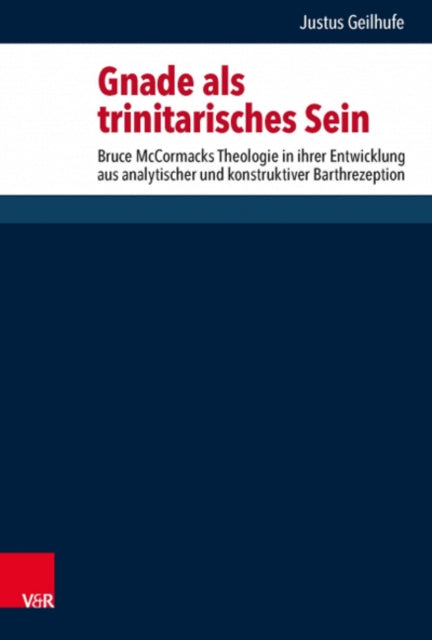
Justus Geilhufe
Gnade als trinitarisches Sein: Bruce McCormacks Theologie in ihrer Entwicklung aus analytischer und konstruktiver Barthrezeption
Gnade als trinitarisches Sein: Bruce McCormacks Theologie in ihrer Entwicklung aus analytischer und konstruktiver Barthrezeption
💎 Earn 472 Points (£4.72) on this item.
YOU SAVE £1.54
- Condition: Brand new
- UK Delivery times: Usually arrives within 2 - 3 working days
- UK Shipping: Fee starts at £2.39. Subject to product weight & dimension
Bulk ordering. Want 15 or more copies? Get a personalised quote and bigger discounts. Learn more about bulk orders.
Couldn't load pickup availability
- More about Gnade als trinitarisches Sein: Bruce McCormacks Theologie in ihrer Entwicklung aus analytischer und konstruktiver Barthrezeption
Karl Barth is known as the Church Father of the 20th Century, but his legacy is controversial in Europe, especially in North America. Bruce McCormack argues that Barth had been a dialectical and critical theologian since 1919 and that his emphasis on the divine election of humanity is incompatible with his concept of divine freedom. McCormack developed his own theological draft, including prolegomena, Christology, and the doctrine of the Trinity, which Barth ultimately left behind.
Format: Hardback
Length: 299 pages
Publication date: 17 June 2021
Publisher: Vandenhoeck & Ruprecht GmbH & Co KG
Karl Barth, often referred to as the Church Father of the 20th Century, has left a contentious legacy in Europe, particularly in North America. While Barth is celebrated for his theological contributions, the reception of his work remains diverse and often divisive. One notable perspective is presented by Bruce McCormack, who argues that Barth had been a dialectical and critical theologian since 1919. This analysis serves as a precursor to McCormack's constructive reception of Barth, wherein he challenges the notion that Barth's emphasis on the divine election of humanity is incompatible with his concept of divine freedom. McCormack then develops his theological draft, encompassing prolegomena, Christology, and the doctrine of the Trinity, which Barth ultimately left behind.
In his early works, such as "The Epistle to the Romans," Barth emphasized the importance of the doctrine of justification by faith alone. He argued that salvation is not merely a matter of individual decision or moral effort but is entirely a gift of God's grace through faith in Jesus Christ. Barth's understanding of justification was rooted in his belief in the sovereignty of God and the necessity of human sinfulness. He saw the doctrine of justification as a means of reconciling God's justice and love and providing a foundation for Christian living.
However, Barth's reception in Europe, particularly in North America, has been marked by controversy. One issue that has been particularly contentious is the so-called neo-orthodoxy, which emerged in the mid-20th century. Neo-orthodox theologians, such as John Howard Yoder and Stanley Hauerwas, challenged Barth's understanding of the doctrine of God and the nature of salvation. They argued that Barth's emphasis on the divine election of humanity and the doctrine of the Trinity led to a neglect of human freedom and responsibility. They also criticized Barth's use of dialectical theology, which they saw as a means of avoiding the hard questions of faith and morality.
In response to these challenges, McCormack presents a constructive reception of Barth. He argues that Barth had been a dialectical and critical theologian since 1919, engaging with other theologians and philosophers and challenging traditional theological assumptions. McCormack emphasizes that Barth's emphasis on the divine election of humanity is not incompatible with his concept of divine freedom. He argues that Barth recognized the importance of human freedom and responsibility and that his dialectical approach was a means of exploring the tensions and complexities of faith and morality.
McCormack also develops his theological draft, which incorporates elements of Barth's work but also incorporates his own insights and perspectives. He emphasizes the importance of the doctrine of the Trinity, which he sees as a means of understanding the relationship between God and humanity and the nature of salvation. McCormack also explores the concept of Christology, which he sees as a means of understanding the nature of Jesus Christ and the role of the Holy Spirit in the life of the Christian.
Despite the controversy surrounding Barth's legacy, McCormack's constructive reception of Barth offers a valuable perspective on his theological contributions. It highlights the importance of engaging with Barth's work critically and creatively, and it demonstrates the potential for developing a theological framework that is both faithful to the tradition of Christian theology and responsive to the challenges of contemporary society.
ISBN-13: 9783525567319
This item can be found in:
UK and International shipping information
UK and International shipping information
UK Delivery and returns information:
- Delivery within 2 - 3 days when ordering in the UK.
- Shipping fee for UK customers from £2.39. Fully tracked shipping service available.
- Returns policy: Return within 30 days of receipt for full refund.
International deliveries:
Shulph Ink now ships to Australia, Belgium, Canada, France, Germany, Ireland, Italy, India, Luxembourg Saudi Arabia, Singapore, Spain, Netherlands, New Zealand, United Arab Emirates, United States of America.
- Delivery times: within 5 - 10 days for international orders.
- Shipping fee: charges vary for overseas orders. Only tracked services are available for most international orders. Some countries have untracked shipping options.
- Customs charges: If ordering to addresses outside the United Kingdom, you may or may not incur additional customs and duties fees during local delivery.