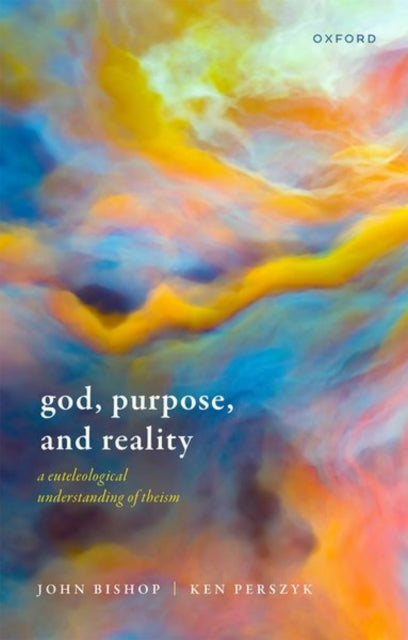
JohnBishop,KenPerszyk
God, Purpose, and Reality: A Euteleological Understanding of Theism
God, Purpose, and Reality: A Euteleological Understanding of Theism
💎 Earn 446 Points (£4.46) on this item.
We can order this item for you. Delivery usually takes about 4 to 6 weeks.
This item is not held in our immediate stock. We will order it for you after checkout.
Estimated delivery: About 4 to 6 weeks
- Condition: Brand new
- UK Delivery times: Usually arrives within 2 - 3 working days
- UK Shipping: Fee starts at £3.89. Subject to product weight & dimension
Bulk ordering. Want 15 or more copies? Get a personalised quote and bigger discounts. Learn more about bulk orders.
Couldn't load pickup availability
- More about God, Purpose, and Reality: A Euteleological Understanding of Theism
John Bishop and Ken Perszyk argue that it is reasonable to reject the standard conception of God as the personal omniGod and present a new argument for euteleology, which claims that reality is inherently purposive and that the Universe exists ultimately because its overall end, the supreme good, is made concretely real within it. Euteleology is a cognitive construction that treats ultimate reality by analogy with our ordinary ways of experiencing and talking about the world, but it is also emphatically realist. It enables humans to align themselves with reality and is deployed in prayer and worship practices to contribute to and enjoy the fulfilment of reality's inherent ultimate purpose.
Format: Hardback
Length: 224 pages
Publication date: 31 January 2023
Publisher: Oxford University Press
Reality is a complex and multifaceted concept that has been the subject of much debate and speculation throughout history. In the context of Abrahamic theism, the belief in the existence of a supremely powerful, knowledgeable, and good personal being is central to the worldview. However, some analytic philosophers have challenged the traditional conception of God as the personal omniGod, suggesting that it is reasonable to reject this notion. John Bishop and Ken Perszyk, in their book "The End of God," argue that a version of the logical Argument from Evil is still very much in play, contrary to the widely held view that this line of argument is bankrupt.
The core claim of euteleology, as proposed by Bishop and Perszyk, is that reality is inherently purposive. They argue that the Universe exists ultimately because its overall end (telos), which is the supreme good, is made concretely real within it. In euteleology, there is no supreme agent (standing by while horrors take place), as God is no-thing in the basic ontology. Instead, talk of God-as-a-personal-being is a cognitive construction, treating ultimate reality by analogy with our ordinary ways of experiencing and talking about the world.
However, euteleological theism is not merely a philosophical construct or a matter of speculation. It is also emphatically realist. Analogizing God-talk enables humans to align themselves with reality and is aptly deployed in prayer and worship-practices whose broad function is a human contribution to, and enjoyment of, the fulfilment of reality's inherent ultimate purpose.
One of the key arguments put forth by Bishop and Perszyk is that the existence of evil and suffering in the world raises a logical challenge to the belief in a supremely good and omnipotent God. They argue that if God is both good and omnipotent, then why does evil exist? Euteleology offers an alternative explanation for the existence of evil by suggesting that it is a necessary consequence of the inherent purposiveness of reality.
According to euteleology, the ultimate end of reality is the supreme good, which is the ultimate source of all value and meaning. The Universe exists as a means to realize this ultimate good, and the existence of evil and suffering is a necessary part of this process. Evil is not a direct result of God's actions or intentions, but rather a result of the complex interplay of natural forces and human free will.
While euteleology may be a challenging concept to grasp, it has the potential to provide a deeper understanding of the nature of reality and the role of God in human life. By rejecting the traditional conception of God as the personal omniGod, euteleology opens up new possibilities for exploring the relationship between humans and God and the ultimate purpose of existence.
In conclusion, the existence of a supremely powerful, knowledgeable, and good personal being is central to the worldview of Abrahamic theism. However, some analytic philosophers have challenged this traditional conception, suggesting that it is reasonable to reject the notion of the personal omniGod. John Bishop and Ken Perszyk's book "The End of God" presents an alternative view called euteleology, which argues that reality is inherently purposive and that the Universe exists ultimately because its overall end (telos), which is the supreme good, is made concretely real within it. Euteleology is emphatically realist, enabling humans to align themselves with reality and deploy God-talk in prayer and worship-practices to contribute to the fulfilment of reality's inherent ultimate purpose. While euteleology may be a challenging concept to grasp, it has the potential to provide a deeper understanding of the nature of reality and the role of God in human life.
Weight: 392g
Dimension: 225 x 146 x 20 (mm)
ISBN-13: 9780192864116
UK and International shipping information
UK and International shipping information
We deliver throughout the United Kingdom and to 128 countries and territories worldwide, including the United States, Australia, Canada, Germany, Spain and France.