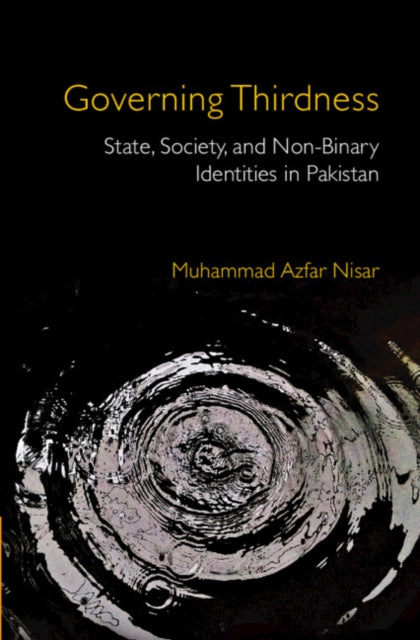
Muhammad AzfarNisar
Governing Thirdness: State, Society, and Non-Binary Identities in Pakistan
Governing Thirdness: State, Society, and Non-Binary Identities in Pakistan
💎 Earn 387 Points (£3.87) on this item.
We can order this item for you. Delivery usually takes about 4 to 6 weeks.
This item is not held in our immediate stock. We will order it for you after checkout.
Estimated delivery: About 4 to 6 weeks
YOU SAVE £4.59
- Condition: Brand new
- UK Delivery times: Usually arrives within 2 - 3 working days
- UK Shipping: Fee starts at £2.39. Subject to product weight & dimension
Bulk ordering. Want 15 or more copies? Get a personalised quote and bigger discounts. Learn more about bulk orders.
Couldn't load pickup availability
- More about Governing Thirdness: State, Society, and Non-Binary Identities in Pakistan
Khawaja Sira of Pakistan are a marginalized gender nonconforming individuals who defy traditional notions of gender and sexuality. Governing Thirdness provides insights about their identity, marginalization and governance, and argues that labels like third gender and transgender fail to account for their gender fluid lives.
Format: Hardback
Length: 238 pages
Publication date: 16 June 2022
Publisher: Cambridge University Press
Khawaja Sira of Pakistan are a diverse and marginalized group of individuals who challenge traditional notions of gender and sexuality. Through extensive ethnographic fieldwork in Lahore, Pakistan, Governing Thirdness offers valuable insights into the identity, marginalization, and governance of the Khawaja Sira community. This book takes a broad perspective on governance, encompassing a comprehensive analysis of the governance of the Khawaja Sira across legal, social, and administrative institutions. It also challenges the notion of labels such as "third gender" and "transgender," which fail to capture the complex and fluid nature of gender experiences among the Khawaja Sira. These categories, largely imported from the West, are often applied without much consideration to govern this heterogeneous group.
The Khawaja Sira community in Pakistan is characterized by its diverse and marginalized status, defying traditional notions of gender and sexuality. This group comprises individuals who do not conform to binary gender norms and may identify as transgender, genderqueer, or gender nonconforming. Their experiences of marginalization and discrimination are profound, as they face societal rejection, violence, and social exclusion.
Governing Thirdness, based on extensive ethnographic fieldwork in Lahore, provides valuable insights into the identity, marginalization, and governance of the Khawaja Sira community. The book explores the complex interplay between legal, social, and administrative institutions and their impact on the lives of Khawaja Sira individuals. It highlights the challenges faced by this community in accessing basic rights, such as healthcare, education, and employment, and the efforts they undertake to assert their rights and seek justice.
One of the key findings of the book is that labels such as "third gender" and "transgender" fail to adequately capture the diverse experiences and identities of the Khawaja Sira community. These categories, largely imported from the West, are often imposed on individuals without their consent or understanding of their own gender identities. The book argues that a more nuanced and inclusive approach is necessary to govern this heterogeneous group, which requires a recognition of the fluidity of gender and the multiplicity of identities that exist within the community.
To address the challenges faced by the Khawaja Sira community, the book proposes a range of policy recommendations. It calls for the recognition of the Khawaja Sira as a distinct minority group with specific rights and protections, including the right to self-identification and the protection from discrimination and violence. It also advocates for the development of inclusive policies and programs that address the needs of Khawaja Sira individuals, such as healthcare, education, and employment opportunities.
Furthermore, the book highlights the importance of community-based organizations and grassroots movements in advocating for the rights of Khawaja Sira individuals. It suggests that these organizations can play a crucial role in raising awareness, providing support, and mobilizing communities to challenge systemic discrimination and oppression.
In conclusion, Governing Thirdness provides a valuable contribution to the understanding of the identity, marginalization, and governance of the Khawaja Sira community in Pakistan. The book challenges traditional notions of gender and sexuality and advocates for a more inclusive and nuanced approach to governing this heterogeneous group. By recognizing the rights and needs of Khawaja Sira individuals and promoting community-based organizations and grassroots movements, the book aims to contribute to the social and political empowerment of this marginalized community.
Weight: 460g
Dimension: 162 x 238 x 22 (mm)
ISBN-13: 9781316516713
UK and International shipping information
UK and International shipping information
UK Delivery and returns information:
- Delivery within 2 - 3 days when ordering in the UK.
- Shipping fee for UK customers from £2.39. Fully tracked shipping service available.
- Returns policy: Return within 30 days of receipt for full refund.
International deliveries:
Shulph Ink now ships to Australia, Belgium, Canada, France, Germany, Ireland, Italy, India, Luxembourg Saudi Arabia, Singapore, Spain, Netherlands, New Zealand, United Arab Emirates, United States of America.
- Delivery times: within 5 - 10 days for international orders.
- Shipping fee: charges vary for overseas orders. Only tracked services are available for most international orders. Some countries have untracked shipping options.
- Customs charges: If ordering to addresses outside the United Kingdom, you may or may not incur additional customs and duties fees during local delivery.