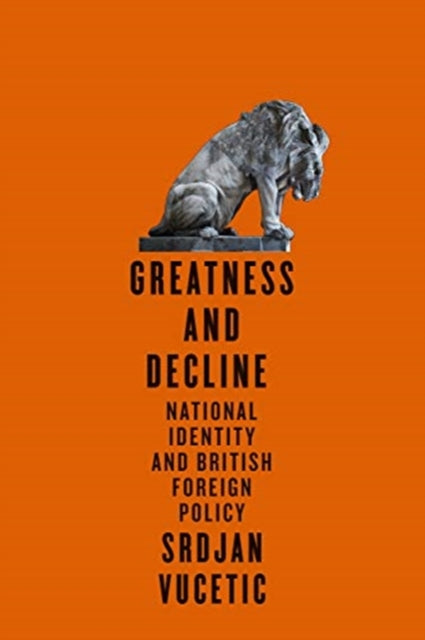
Srdjan Vucetic
Greatness and Decline: National Identity and British Foreign Policy
Greatness and Decline: National Identity and British Foreign Policy
YOU SAVE £4.93
- Condition: Brand new
- UK Delivery times: Usually arrives within 2 - 3 working days
- UK Shipping: Fee starts at £3.89. Subject to product weight & dimension
Bulk ordering. Want 15 or more copies? Get a personalised quote and bigger discounts. Learn more about bulk orders.
Couldn't load pickup availability
- More about Greatness and Decline: National Identity and British Foreign Policy
Exceptionalist ideas have long influenced British foreign policy, and Srdjan Vucetic's book "Greatness and Decline" explores the period between Clement Attlee's New Jerusalem and Tony Blair's New Labour. It argues that Britain's pursuit of global power was not just a function of consensus among policymakers but also of popular, everyday, and evolving ideas about identity circulating within British society. Vucetic uses a unique archive of political speeches, newspapers, history textbooks, novels, and movies to uncover these ideas.
Format: Paperback / softback
Length: 312 pages
Publication date: 18 February 2021
Publisher: McGill-Queen's University Press
Exceptionalist ideas have long played a significant role in shaping British foreign policy, and as Britain navigates the challenges of a post-Brexit era in a more unstable world, it is timely to re-examine the nature and causes of this exceptionalist bent. Srdjan Vucetic, in his book "Greatness and Decline: Britain's Search for Global Power," argues that Britain's pursuit of global power was not just a result of consensus among policymakers or political elites but rather developed from popular, everyday, and gradually evolving ideas about identity circulating within British society. To uncover these ideas, Vucetic works with a unique archive of political speeches, newspapers, history textbooks, novels, and movies across colonial, Cold War, and post-Cold War periods. "Greatness and Decline" sheds new light on Britain's interactions with the rest of the world while demonstrating new possibilities for constructivist foreign policy analysis.
The pursuit of global power by Britain has been a long-standing and influential aspect of its foreign policy, and as the country faces the challenges of a post-Brexit era in a more unstable world, it is essential to re-examine the nature and causes of this exceptionalist bent. Srdjan Vucetic, in his book "Greatness and Decline: Britain's Search for Global Power," argues that Britain's pursuit of global power was not just a result of consensus among policymakers or political elites but rather developed from popular, everyday, and gradually evolving ideas about identity circulating within British society. To uncover these ideas, Vucetic works with a unique archive of political speeches, newspapers, history textbooks, novels, and movies across colonial, Cold War, and post-Cold War periods.
"Greatness and Decline" sheds new light on Britain's interactions with the rest of the world while demonstrating new possibilities for constructivist foreign policy analysis. The book explores how Britain's pursuit of global power was shaped by a combination of factors, including its historical legacy, economic interests, and cultural values. It also examines the impact of Britain's global power on other countries and the world as a whole.
One of the key themes of the book is the idea of "exceptionalism." Vucetic argues that Britain has long been characterized by a sense of exceptionalism, which has shaped its foreign policy and its relationship with the rest of the world. This exceptionalism has been driven by a belief in Britain's unique history, culture, and values, as well as its ability to lead and shape global events.
Vucetic traces the origins of Britain's exceptionalism back to the period between Clement Attlee's New Jerusalem and Tony Blair's New Labour. During this time, Britain experienced a period of rapid economic growth and social change, which led to a sense of confidence and self-belief. This confidence was further reinforced by Britain's success in the Second World War and its role as a leading member of the Cold War alliance.
However, Vucetic also argues that Britain's exceptionalism has been challenged in recent years. The country's decision to leave the European Union has been seen as a rejection of the internationalist ideals that have been central to its foreign policy for many years. This has led to a sense of uncertainty and instability in the world, and has also raised questions about Britain's ability to continue to play a leading role in global affairs.
To address these challenges, Vucetic suggests that Britain needs to re-examine its foreign policy and its relationship with the rest of the world. He argues that Britain should focus on building stronger relationships with other countries, particularly those in the European Union and the United States. He also suggests that Britain should be more open to international cooperation and should be willing to take on a more active role in addressing global challenges such as climate change, poverty, and inequality.
One of the key challenges facing Britain in its pursuit of global power is the changing nature of the global economy. The rise of China and other emerging economies has challenged Britain's position as a leading economic power, and has led to concerns about the impact of globalization on British jobs and wages. Vucetic argues that Britain needs to adapt to these changes and should focus on developing new industries and technologies that can compete in the global market.
Another challenge facing Britain is the impact of climate change. The country has been a leader in the fight against climate change, but it has also been criticized for its slow progress in reducing its carbon emissions. Vucetic argues that Britain needs to take more aggressive action to address climate change and should work with other countries to develop a global climate agreement that will limit greenhouse gas emissions and prevent catastrophic climate change.
In addition to these challenges, Britain also faces a number of internal challenges. The country has a complex and diverse society, and there are concerns about social inequality, political instability, and the impact of immigration. Vucetic argues that Britain needs to address these issues and should work to create a more inclusive and fair society.
To address these challenges, Vucetic suggests that Britain should adopt a more proactive and interventionist foreign policy. He argues that Britain should be willing to use its military and economic power to support its interests and to promote peace and stability in the world. He also suggests that Britain should be more open to international cooperation and should be willing to take on a more active role in addressing global challenges such as climate change, poverty, and inequality.
However, Vucetic also recognizes that there are limits to Britain's power and that it cannot solve all of the world's problems on its own. He argues that Britain should work with other countries to develop a global strategy that will address these challenges and that will promote peace and stability in the world.
In conclusion, Srdjan Vucetic's book "Greatness and Decline: Britain's Search for Global Power" is a timely and important contribution to the study of British foreign policy. The book argues that Britain's pursuit of global power has been shaped by a combination of factors, including its historical legacy, economic interests, and cultural values. It also examines the impact of Britain's global power on other countries and the world as a whole.
Vucetic suggests that Britain needs to re-examine its foreign policy and its relationship with the rest of the world in order to address the challenges facing the country in the post-Brexit era. He suggests that Britain should focus on building stronger relationships with other countries, being more open to international cooperation, and taking on a more active role in addressing global challenges such as climate change, poverty, and inequality. However, he also recognizes that there are limits to Britain's power and that it cannot solve all of the world's problems on its own.
Weight: 454g
Dimension: 228 x 151 x 22 (mm)
ISBN-13: 9780228005872
UK and International shipping information
UK and International shipping information
We deliver throughout the United Kingdom and to 128 countries and territories worldwide, including the United States, Australia, Canada, Germany, Spain and France.